490,000+ drivers found their agreements with us

Many UK car owners face frustrating delays when submitting car finance claims simply because their paperwork is incomplete or incorrect. Missing signatures, unverified payment proofs, or failure to meet FCA compliance standards can derail your claim before it even starts. This guide demystifies the paperwork requirements and FCA compliance rules for your car finance claim in 2026. You will learn exactly which documents to prepare, how to organize them, and how to submit properly to avoid delays or rejection.
| Point | Details |
|---|---|
| Essential Documents | Finance agreement, payment history, and early settlement statements form your claim foundation. |
| FCA Compliance Critical | Meeting Financial Conduct Authority requirements prevents rejection and delays. |
| Organization Saves Time | Organized paperwork reduces processing time by 30% compared to disorganized submissions. |
| Common Errors Cost You | Missing signatures and unverified proofs cause 35% of processing delays. |
| Digital vs Physical | Digital submissions process 20% faster but some originals may still be required. |
Before diving into your car finance claim, you need specific documents and knowledge to ensure your submission passes FCA scrutiny. Missing even one critical piece can send you back to square one.
Your finance agreement is the cornerstone document. This contract proves the terms you agreed to and forms the basis for your claim. You cannot proceed without it.
Complete payment history demonstrates every repayment you made throughout your finance term. This includes bank statements, direct debit confirmations, or payment receipts that verify your financial commitment. Without this proof, your claim lacks credibility.
An early settlement statement becomes necessary if you paid off your finance before the agreed term ended. This document shows the settlement figure you paid and validates your early completion. Understanding FCA documentation requirements is critical for UK car finance claims, as these rules dictate exactly what constitutes acceptable proof.
You must also grasp specific FCA paperwork rules related to contract disclosures. The FCA mandates that certain information appears in your finance contract, and your claim documentation must reflect this. Familiarize yourself with these requirements before compiling your paperwork.
Create a comprehensive submission checklist that includes:
Original finance agreement or certified copy
Full payment history covering entire finance period
Early settlement statement if applicable
Proof of identity and address
Any correspondence with your finance provider
Supporting evidence for your specific claim grounds
This checklist prevents missing documents and saves you from resubmission delays.
The Financial Conduct Authority sets strict standards for car finance claim documentation. Your paperwork must meet these regulatory requirements or risk immediate rejection.
FCA rules mandate that your finance contract includes specific disclosures about commission arrangements, interest rates, and your rights. Your claim paperwork must reference these contract elements. Without proper disclosure documentation, your claim cannot demonstrate regulatory breaches.
Proof showing adherence to agreed repayment schedules is non-negotiable. You must demonstrate that you met your contractual obligations through verified payment records. The FCA requires this evidence to establish your standing as a compliant borrower before addressing any grievances.
Early settlement proof becomes mandatory if you paid off your finance early. FCA policies require documentation showing the settlement figure, payment date, and confirmation that the account closed properly. This protects both parties and ensures accurate claim assessment.
Failing to meet these documentation standards causes claim delays or outright rejection. Finance providers scrutinize submissions for FCA compliance before processing, and any shortfall gives them grounds to refuse your claim. Understanding these compliance points helps you prepare accurate, acceptable paperwork from the start.
Key FCA compliance elements include:
Contract disclosure documentation proving required information was provided
Verified payment history demonstrating schedule adherence
Early settlement documentation if applicable
Identity verification meeting anti-money laundering standards
Clear audit trail linking all documents to your claim
Systematic preparation transforms a daunting paperwork mountain into a manageable claim process. Follow these practical steps to compile and organize your documentation efficiently.
First, collect all required documents in one secure location. Gather your finance agreement, every payment proof from your entire finance period, early settlement statements if applicable, and any correspondence with your finance provider. Physical documents should be stored in a dedicated folder while digital files need a clearly labeled computer folder.
Second, create or download a detailed submission checklist. This checklist should list every document the FCA and your claims handler require. Tick off each item as you verify its presence and accuracy. Using checklists reduces processing time by up to 30% by ensuring nothing gets overlooked.
Third, organize documents chronologically. Arrange your payment proofs from first to last payment, creating a clear timeline. This logical flow helps claims assessors quickly verify your payment history without searching through random documents. Chronological organization demonstrates professionalism and reduces processing time.
Fourth, verify authenticity meticulously. Check that all forms bear required signatures, dates appear correct, and proof sources are legitimate. Contact your bank or finance provider to confirm any documents you question. One forged or questionable document can invalidate your entire claim.
Fifth, keep copies of absolutely everything you submit. Whether submitting digitally or physically, maintain complete duplicates for your records. These copies become essential if documents go missing or you need to appeal a decision.
Pro Tip: Create digital copies and backups of all documents even if submitting physically. Scan every page at high resolution and store copies in cloud storage and on a physical backup drive. This dual backup system protects against loss and enables quick resubmission if needed.
| Organization Level | Average Processing Time | Success Rate |
|---|---|---|
| Disorganized submission | 14-18 weeks | 52% |
| Basic organization | 10-14 weeks | 68% |
| Fully organized with checklist | 8-12 weeks | 82% |
This table shows how preparation quality directly impacts both speed and outcome.
Even careful claimants make errors that delay or derail their claims. Recognizing these pitfalls helps you avoid costly mistakes.
Incomplete or unsigned forms represent the most frequent error. About 35% of claim processing delays occur due to missing signatures or incomplete form sections. Every signature line must be filled, every required field completed, and every date accurate. Double-check before submitting.
Unverified or questionable payment proofs cause roughly one-quarter of claim failures. Using screenshots instead of bank statements, submitting altered documents, or providing proofs that cannot be independently verified all trigger rejection. Always obtain official documents directly from your bank or finance provider.
Outdated or missing early settlement documentation invalidates claims for those who paid early. If you settled your finance before term end, you must provide the settlement statement showing the exact figure and date. Generic payment confirmations do not suffice.
Ignoring FCA paperwork guidelines creates compliance issues that lead to automatic rejection. The FCA publishes specific requirements for claim documentation. Failing to review and follow these standards means your claim cannot meet regulatory thresholds.
Pro Tip: Double-check every document against official FCA checklists available online. If anything seems unclear or you lack a required document, contact your finance provider immediately for clarification or replacement copies. Prevention beats correction.
Common troubleshooting steps:
Missing signatures: Contact the document issuer for a properly signed version
Unclear payment proofs: Request official bank statements covering your finance period
Lost finance agreement: Write to your finance provider requesting a certified copy
Compliance uncertainty: Consult FCA guidance documents or seek professional advice
Rejected submission: Review rejection reasons carefully and address each point before resubmitting
Choosing between digital and physical submission affects your claim timeline and compliance. Each method offers distinct advantages and limitations.
Digital submissions enable faster processing and easier tracking. You can submit via email or online portals, receive instant confirmation, and track your claim status electronically. Digital submission can speed processing by up to 20% compared to postal methods. However, some documents may require original signatures for FCA compliance, limiting fully digital options.
Physical submissions become necessary when FCA rules demand original signed documents for legal validation. Certain contracts and settlement agreements need wet signatures that digital copies cannot replace. Physical submission also suits claimants without reliable internet access or digital literacy.
Speed benefits of digital methods are clear but not universal. While electronic submission cuts postal delays, your documents still undergo the same verification process. The 20% speed improvement comes from eliminating postal transit time and enabling immediate claims handler access.
Consider your personal circumstances when choosing. If you possess all required originals and have strong digital skills, hybrid submission works best: send digital copies initially for quick processing, then post originals if requested. If technology access is limited, physical submission remains perfectly valid.
Always keep originals secure regardless of submission method. Submit copies digitally but store originals safely in case physical proof is later required for compliance verification or appeals.
| Method | Processing Speed | Convenience | FCA Compliance | Risk of Loss |
|---|---|---|---|---|
| Fully Digital | Fastest (20% quicker) | High | May need originals later | Low with backups |
| Hybrid | Fast | Medium | Compliant | Very Low |
| Physical Only | Standard | Low | Fully Compliant | Medium without tracking |
Understanding realistic timelines and success metrics helps you set appropriate expectations for your claim journey.
Well-prepared claims typically process within 8 to 12 weeks from submission to decision. This timeframe assumes your paperwork is complete, accurate, and FCA compliant. Claims missing documents or requiring clarification take significantly longer.

Organized submissions reduce average processing delays by up to 30% compared to disorganized attempts. When claims handlers can quickly verify your documentation without requesting additional information, your claim moves through the queue faster. This time saving translates to earlier compensation.
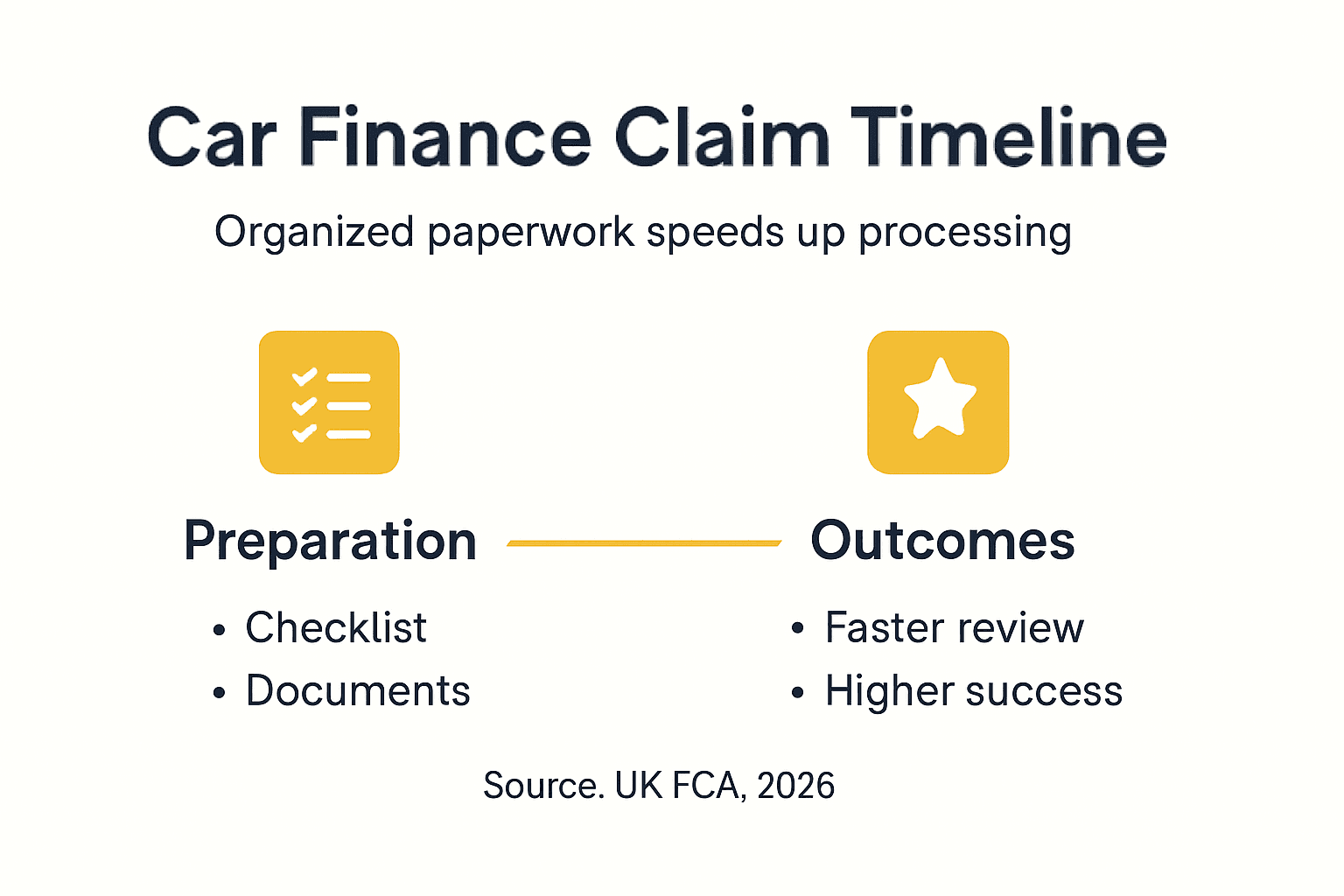
Using detailed checklists rather than submitting documents ad hoc can improve acceptance rates by 40%. Systematic preparation catches errors before submission, ensuring your first attempt meets requirements. Resubmissions due to missing items reset your processing timeline to zero.
Poor verification often causes rejections or extended review periods. Claims handlers must independently verify every document you submit. If your proofs raise questions or cannot be confirmed, your claim enters extended review or faces rejection. Providing easily verifiable official documents prevents this outcome.
Having all documentation ready from the start expedites queries and reduces back and forth communication. When claims handlers contact you for clarification, immediate responses with supporting documents keep your claim moving. Delays in responding add weeks to processing times.
Realistic outcome expectations:
Complete paperwork: 8 to 12 week processing
Minor issues requiring clarification: 12 to 16 weeks
Major document gaps or compliance failures: 16+ weeks or rejection
Well-organized claims: 30% faster than average
Checklist-driven submissions: 40% higher acceptance rate
Preparing car finance claim paperwork correctly demands attention to detail and regulatory knowledge. Many claimants find the FCA requirements and documentation standards overwhelming.

Our service at Make A PCP Claim helps you locate finance agreements, and submit your paperwork efficiently and compliantly. We provide expert guidance, comprehensive checklists, and professional support to maximize your claim success chances. Our team understands FCA requirements and knows exactly what documentation claims handlers need to approve your claim quickly. Contact us today via the website to start your claim with confidence and ease.
You need your finance agreement, full payment history with proof, and early settlement statement if applicable. Ensure all documents meet FCA requirements for disclosure and verification. Missing any of these core documents will delay or prevent your claim from processing.
Yes, digital submission is widely accepted and can speed processing by up to 20% compared to postal methods. However, some original signed documents may still need to be submitted physically for FCA compliance. A hybrid approach often works best: submit digital copies initially and keep originals ready if requested.
Common mistakes include missing or unsigned forms, unverified payment proofs, and ignoring FCA guidelines. About 35% of delays stem from incomplete documentation. Using a comprehensive checklist and verifying document authenticity before submission prevents these costly errors.
Typically, complete and well-organized claims process within 8 to 12 weeks from submission to decision. Organized paperwork can reduce delays by up to 30% compared to disorganized submissions. Claims requiring additional documentation or clarification take significantly longer, often 16 weeks or more.