490,000+ drivers found their agreements with us

If you took out a car or motorbike finance agreement anytime from 6 April 2007 onwards, you may be owed compensation for a mis-sold deal. Payouts are currently paused while a legal challenge works through the courts, but that’s no reason to wait. Find your old finance agreement now, usually the lender’s name is all you need, and get your complaint in so your place in the queue is secured.
TL;DR:
- The FCA’s scheme covers PCP, HP, motorbike, and van finance arranged through dealers or brokers between April 2007 and November 2024.
- Discretionary commission arrangements, where dealers set higher interest rates for bigger commissions without disclosure, are the main cause of mis-selling.
- Gathering old agreements is possible through credit checks, bank statements, or dealership records, even if paperwork is lost.
- Submit claims early using free eligibility checks to secure your place in the queue, as waiting does not speed up payouts or court resolutions.
The eligibility window is precise, and it matters more than most claimants realise. The Financial Conduct Authority’s redress scheme covers agreements taken out between 6 April 2007 and 1 November 2024. Sign an agreement before that start date and you fall outside the scheme entirely, no matter how the commission was structured.
Not every kind of vehicle finance counts, either. The scheme is built around agreements where a dealer or broker arranged your finance and could have influenced the interest rate you paid.
The core issue is something called a discretionary commission arrangement, or DCA. Before 2021, some lenders let brokers and dealers set your interest rate within a range, and the higher the rate, the bigger their commission. You were rarely told this. If your dealer earned more by charging you more, and you weren’t informed, that’s the mis-selling at the heart of most claims.
A few edge cases trip people up. If your finance was arranged directly through a manufacturer’s own finance arm (some car brands run their own lending divisions) rather than a separate broker, you may still be covered, because the commission link can still exist. If you previously accepted a small redress payment from a lender for a different issue, that doesn’t automatically rule you out of a fresh DCA-based complaint. And if the Financial Ombudsman Service already ruled on your specific case, check what that decision actually covered before assuming you’re excluded from the wider scheme.
Losing the paperwork on a car you financed a decade or more ago is normal, not a barrier. Several routes exist to reconstruct what you need.
If none of that turns up anything concrete, don’t let it stop you. Lenders are expected to try to locate customers using whatever records they hold, so a complaint with partial details (make, model, approximate purchase year) can still get you into the system.
Pro Tip: Keep a simple note of every date, registration number, and lender name you find as you go. Claims move faster when you can quote specifics back to a lender rather than asking them to search blind.
A car finance complaint doesn’t need a solicitor’s letter. It needs four things done in the right order.
The tone of your initial letter matters less than the specifics inside it. A short paragraph naming the vehicle, the date, and the lender will get further than three paragraphs of general frustration.
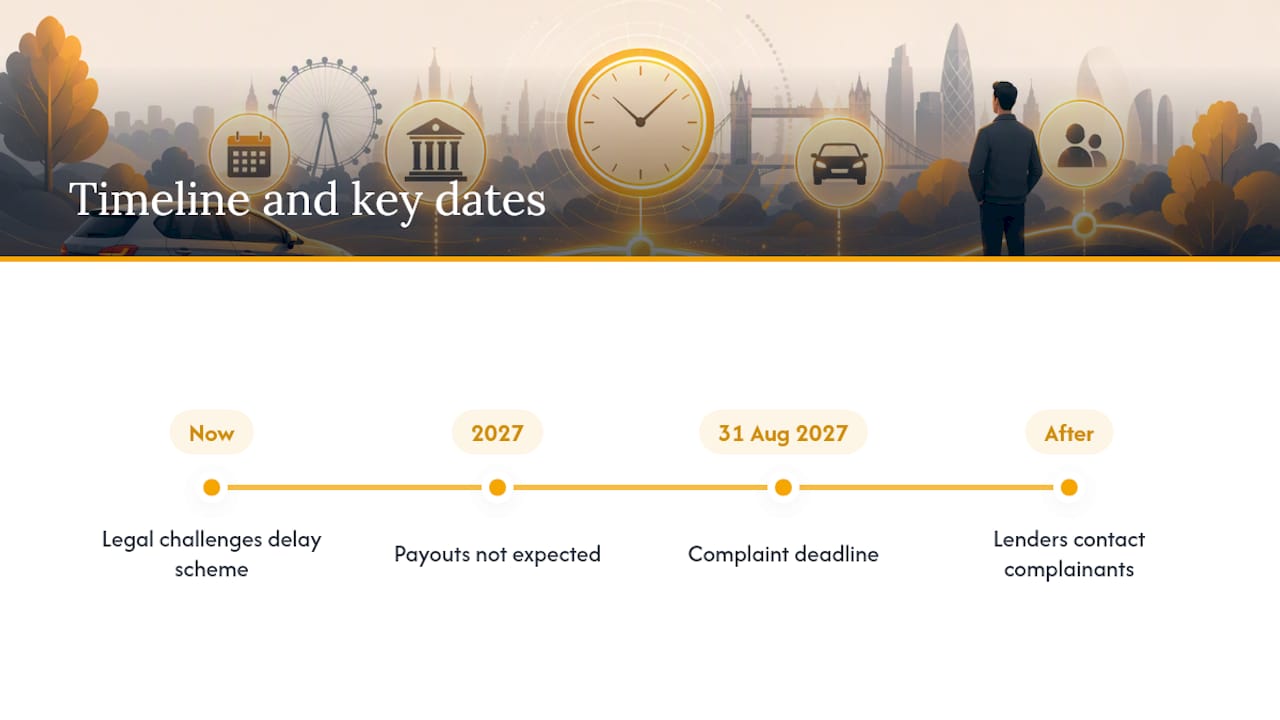
Regulators haven’t started paying compensation yet, and the reason is a legal fight, not a lack of willingness. Reporting confirms that legal challenges have delayed the FCA’s redress scheme, with no payouts expected before 2027 while the courts settle how commission arrangements should be treated.
The numbers so far: Citizens Advice cites an average payout of around £829, though your own figure depends on your loan size, interest rate, and how long you held the finance. The deadline to lodge a complaint is 31 August 2027.
That deadline matters more than the payout delay. Complaining now doesn’t speed up when money arrives, but it does secure your position, and analysis of the delay has consistently advised submitting your complaint immediately rather than waiting for the legal picture to clear.
If you’ve already complained to your lender, you generally don’t need to do anything further. Lenders are expected to contact customers they can locate once the scheme’s implementation timetable is confirmed, so a complaint already on file should carry through automatically.
Not every document carries equal weight. A handful of specifics can turn a vague complaint into one a lender processes quickly.
Ask lenders directly for copies of anything you’re missing. Firms are required to hold certain records for a set number of years, and a polite written request often produces more than you’d expect. Where paperwork genuinely doesn’t exist, secondary evidence still helps: your vehicle’s registration number, an approximate purchase date, or even a witness (a partner or family member who remembers the purchase) can support a complaint that has no surviving contract.
The car finance claims boom has attracted its share of opportunists, and the FCA has been explicit that the official scheme doesn’t require paid help to use.
Legitimate claims managers and solicitors work differently. They should explain their fee structure clearly, take a percentage only if your claim succeeds, and refer you transparently to a regulated law firm rather than handling everything themselves under a vague promise. This is where a free, no-obligation check earns its place. Makeapcpclaim’s free eligibility check locates your agreement without asking for money upfront, which is exactly the low-risk starting point Citizens Advice and the FCA both recommend.
Pro Tip: If anyone contacts you claiming to represent “the government car finance scheme” and asks for a payment to release your compensation, hang up. No legitimate scheme charges a release fee.
Once a lender accepts your complaint, the offer letter should break down how the figure was reached, typically the extra interest you paid because of the hidden commission, plus statutory interest on top for the time that’s passed. You’ll usually have around one month to accept the offer or challenge it if the maths looks wrong.
Payment normally follows shortly after acceptance, though exact timing depends on the lender’s own processes. One thing worth checking before you spend it: compensation isn’t always tax-free. If part of your payout is treated as interest, Gov explains when that portion might need declaring. It rarely affects most claimants, but it’s worth five minutes checking if your payout is substantial.
The timing of the eligibility window isn’t arbitrary. The 6 April 2007 start date sits right at the edge of the global financial crisis, a period when lenders were expanding consumer credit aggressively and dealer networks had strong financial incentives to move stock quickly.
Car dealerships became a convenient sales channel for finance products because commission arrangements let brokers earn more by pushing buyers toward higher-rate deals, often without disclosing that the rate itself was negotiable. As credit tightened later in the crisis, dealers leaned even harder on finance commissions to protect margins on falling vehicle sales. That combination, easy credit availability plus opaque commission structures, is precisely why so many agreements from this era carry the hallmarks regulators are now unwinding. The financial crisis didn’t cause the mis-selling directly, but it created the market conditions where discretionary commission became standard practice rather than the exception.
Most mis-selling comes down to one structural problem: the person setting your interest rate had a financial reason to set it higher. Discretionary commission arrangements meant a broker or dealer could adjust your APR within a range and pocket more commission the higher they went, without ever telling you that was happening.

A second common cause is a complete absence of explanation. Many buyers were simply told “this is your rate” with no mention that it had been negotiated, or that a lower rate might have been available. Some agreements also bundled add-on products, such as extended warranties or GAP insurance, into the same finance deal without clearly separating the costs, making it harder for buyers to see what they were actually paying for the credit itself. Combine an undisclosed commission structure with a buyer under pressure to sign paperwork quickly on the dealership forecourt, and you get exactly the pattern regulators are now trying to redress.
The single biggest misunderstanding is assuming the payout delay means there’s nothing to do yet. That’s backwards. The deadline to complain, 31 August 2027, is fixed regardless of when payments eventually start, so treating the pause as a reason to wait is the most common self-inflicted mistake.
A second pitfall is giving up when paperwork can’t be found. Plenty of claimants assume no agreement copy means no claim, when in reality a credit check, a bank statement, or even a dealer’s records can substitute for the original contract. A third mistake is confusing rejection with the end of the road: a lender turning down your complaint is not a final verdict, it’s a prompt to escalate to the Financial Ombudsman Service. Finally, some people assume every finance agreement automatically qualifies. It doesn’t. Straightforward personal loans with no dealer or broker involvement, and most PCH leasing arrangements, generally fall outside the scheme.
Accepting an offer isn’t necessarily the end of the story. If you financed more than one vehicle since 2007, whether that’s a car you upgraded from, a motorbike, or a second family car, each agreement is assessed separately. A successful claim on one doesn’t rule out a second claim on another, so it’s worth checking every vehicle you’ve financed since April 2007, not just the most recent one.
If you disagree with the redress calculation itself, you’re entitled to challenge it within the response window before accepting, and to take an unresolved dispute to the Financial Ombudsman Service afterwards. Keep copies of your acceptance letter and payment confirmation. If a related issue surfaces later, perhaps a second lender is identified through a fuller credit check, having your paperwork organised makes a follow-up claim considerably faster to process.
The single biggest mistake I see is people waiting for “more clarity” before complaining. There won’t be more clarity, not really, not until the legal challenge resolves. What there is right now is a fixed deadline and a queue that rewards early action.
Most delays I’ve seen come down to one thing: missing basic details. A registration number, an approximate purchase date, and a lender name will get a complaint moving faster than a beautifully written letter with none of that information. Gather what you can before you write anything.
Makeapcpclaim’s free check exists precisely because most people don’t have that information sitting in a drawer. It searches for your agreement in under 60 seconds, no registration document, no old paperwork required, so you can move straight to the complaint stage instead of getting stuck hunting for a file from 2009.
— Jake
Makeapcpclaim is the practical alternative to spending an evening digging through old bank statements and credit reports yourself. Our site finds your car finance agreements for free in under 60 seconds, no registration documents, no lender paperwork, no forms to hunt down.

Here’s how it works: you provide a few basic details, the system searches for matching finance agreements, and if something looks eligible, the case is referred to a partner law firm that handles the claim from there. You don’t chase the lender yourself, and you don’t pay anything upfront for the check. The partner law firms have experience with complex cases in this area of law that is still evolving in the courts.
If you financed a car, van, or motorbike anytime from 2007 onwards, run the free eligibility check now and find out where you stand before the legal picture even settles.
Several organisations offer free, reliable guidance on this topic, and it’s worth going straight to them rather than relying on secondhand summaries.
This article is general information, not a substitute for advice from a qualified financial advisor. Consult a qualified financial professional about your own circumstances before acting on anything here.
Not yet through the main FCA scheme. Payouts are on hold while a legal challenge is resolved, with reporting suggesting no payments before 2027, though individual complaints upheld directly by lenders or the Financial Ombudsman Service outside the scheme have resulted in redress.
The clearest sign is a dealer or broker who could adjust your interest rate and earned more commission the higher it went, known as a discretionary commission arrangement, without telling you this was happening. If you weren’t told how your APR was set, or never knew a lower rate was possible, that’s worth raising as a complaint.
The FCA’s scheme covers agreements from 6 April 2007 to 1 November 2024. Anything financed before that start date falls outside the current scheme regardless of how it was arranged.
The FCA’s redress scheme has been paused by a legal challenge over how commission arrangements should be treated, and payments aren’t expected before 2027. The complaint deadline itself still stands at 31 August 2027, so claimants are advised to submit complaints now rather than wait for the legal outcome.
The eligibility check is free, and current details of the service are available on the Makeapcpclaim site. You only proceed further if a partner law firm takes on your case.