490,000+ drivers found their agreements with us

Most people who were mis-sold car finance will end up with a payout somewhere in the low hundreds of pounds, though some agreements pay out far more. The Financial Conduct Authority puts the average redress at around £829 per agreement, calculated from the commission you paid and an estimated loss figure, plus interest. The final number depends heavily on your loan size, commission structure, and whether a cap applies. The immediate move is to complain to your lender before 31 August 2027, or let Makeapcpclaim find your agreements for free in under 60 seconds.
TL;DR:
- Redress averages around £829 per agreement but varies widely based on loan size, commission structure, and whether caps apply.
- The FCA’s hybrid calculation considers both dealer commission and estimated loss, with the latter set at 17% or 21%, depending on loan date.
- Caps limit payouts to a maximum of 90% of original commission plus interest, and the actual claim depends heavily on agreement specifics and payment history.
- Higher commissions, undisclosed ties, and incomplete payment records generally increase potential refunds, especially for older, larger agreements.
- Claimants should submit their complaints now to avoid missing the August 2027 deadline and can use free tools to locate agreements without paying fees.
The FCA didn’t design a single formula. It designed a hybrid one, and understanding the two halves explains why two people with similar loans can end up with very different cheques.
The first half is straightforward: how much commission did the dealer or broker actually receive for arranging your finance? Lenders hold this on file, so it’s usually the easier figure to pin down. The second half is trickier, because nobody can know for certain what you would have paid under a fairer deal that never happened. The regulator calls this the “estimated loss,” and rather than trying to model every individual case, it applies a flat percentage.
That percentage isn’t fixed. The FCA sets it at 17% for agreements taken out from April 2014 onwards, and 21% for anything earlier. The gap reflects how commission arrangements and market practices shifted over that decade, with older agreements more likely to have hidden or higher commission built into the price you paid. Your redress figure is the mean average of these two numbers, commission paid and estimated loss, not the higher of the two and not a simple sum.
Statistic to note: roughly 12.1 million agreements qualify under the scheme, and the regulator’s own modelling puts the average payout at approximately £829, though the FCA is candid that this figure sits well above what many individual claimants will actually receive once caps are applied.
Interest gets added on top of that base figure, and this is where a lot of people underestimate their eventual total. That interest compounds the longer your agreement has been sitting there, so someone who took out finance in 2015 could see a meaningfully larger interest component than someone who signed in 2022.
There’s a tax wrinkle here too. HMRC generally treats interest on compensation as savings income, and firms have historically deducted basic rate tax at 20% before paying out in similar large-scale redress schemes. If your total savings income for the year, including this interest, sits below your Personal Savings Allowance, you may be able to reclaim that tax from HMRC directly. It’s worth checking rather than assuming the deducted amount is final.
Then come the caps, and these matter more than most guidance admits. The FCA has built in three separate limits designed to stop the scheme overcompensating anyone relative to what they’d have paid on a genuinely fair deal:
Lenders apply whichever cap produces the lowest figure for your specific case. The FCA itself expects roughly one in three claims to be affected by a cap in some way, which is a large enough share that you shouldn’t treat the average headline figure as a personal guarantee.
The average figure hides a wide spread. Two people who borrowed the same amount from the same lender in the same year can still end up with noticeably different payouts, and it usually comes down to a handful of specific factors.
Agreement type matters less than commission structure. Whether you had a Personal Contract Purchase (PCP) or Hire Purchase (HP) agreement affects the mechanics slightly, but the bigger driver is whether a Discretionary Commission Arrangement (DCA) was used, where the dealer had discretion to set your interest rate and earned more commission the higher it went. Agreements with a DCA or an undisclosed contractual tie between dealer and lender tend to attract stronger redress because the conflict of interest was more direct.
Very high commission changes the calculation entirely, as explained in detail in this guide to loan to value on auto loans that covers lender calculations such as loan-to-value and related borrower finance maths. Where commission was unusually large as a proportion of the loan, or where the tie between broker and lender wasn’t disclosed at all, the FCA’s guidance points toward fuller repayment, potentially the whole commission amount plus interest, rather than the blended average used for standard cases.
A less obvious factor is data quality. Lenders need a complete payment history to run the full adjusted total cost of credit calculation. Where records are patchy, especially on older agreements, firms fall back on the simplified cap, which tends to produce a lower figure than the fuller calculation would have.
If you had more than one financed vehicle over the years, each agreement is assessed separately, not lumped together. That’s good news if you’re wondering whether multiple claims dilute each other. They don’t, but it also means the admin burden of tracking down each agreement multiplies.
Key factors affecting your final amount:
Pro Tip: Keep a note of every car you’ve financed since 2007, even ones you’ve since sold or part-exchanged. Each one is a separate potential claim, and it’s easy to forget an agreement from a decade ago that’s still sitting in a lender’s system with your name on it.
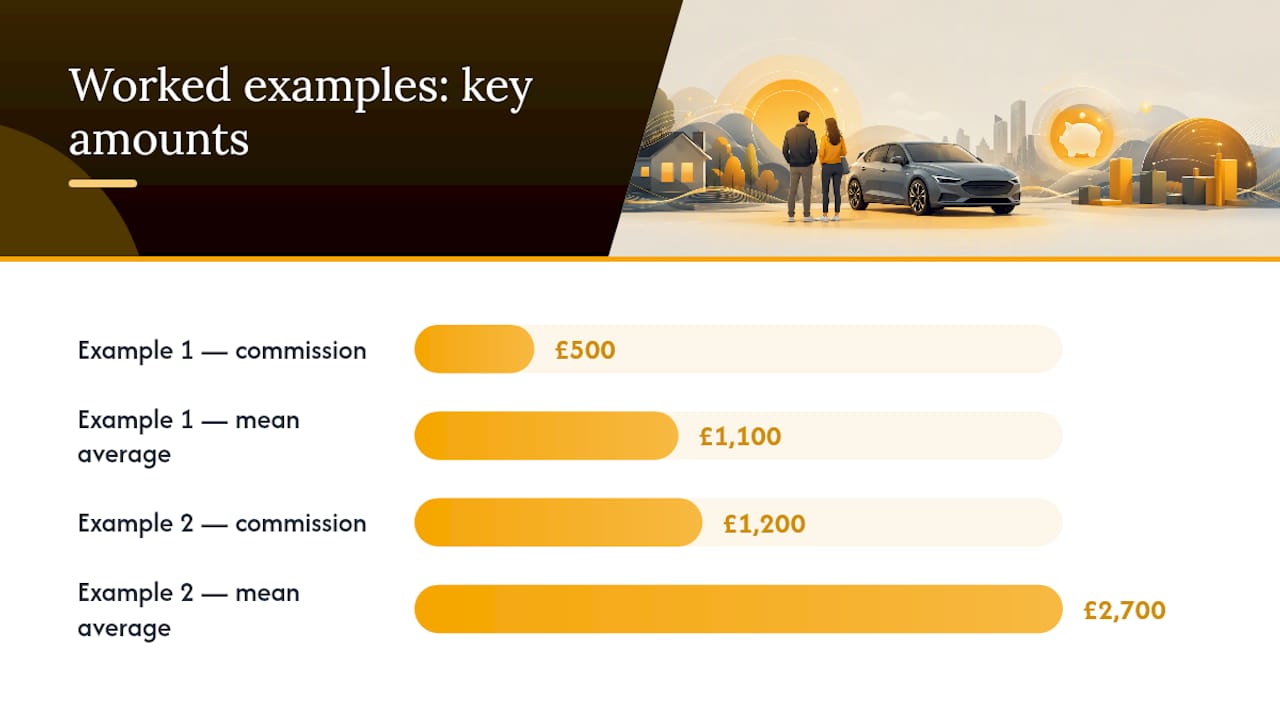
Numbers land better with examples, so here are two illustrative scenarios based on the FCA’s published methodology. Neither is a promise of what you’ll receive. Treat them as a way to understand how the pieces fit together, not a calculator for your own agreement.
Example 1: a £10,000 agreement from 2018
Example 2: a £20,000 agreement from 2011
MoneySavingExpert’s own worked examples follow a similar logic and note that many claimants can expect to recover roughly two-thirds or more of the commission they originally paid, once interest is added, though this varies by case.
What both examples show is that older, larger agreements with higher original commission tend to generate bigger raw numbers before caps, but they’re also more exposed to the low-market cost cap because interest rates were structured differently a decade ago. There’s no shortcut around running your own numbers, and that’s precisely why a free eligibility check matters more than a rough mental calculation. Makeapcpclaim’s finder locates the specific agreements tied to your name and gives you a personalised starting point rather than a generic average.
Speed matters here, not because payments will arrive faster if you rush, but because the deadline for lodging a complaint is fixed and getting into the queue early keeps your claim moving once the scheme’s legal issues are resolved.
Pro Tip: You never need to pay to make this claim. Citizens Advice and the FCA both confirm there’s no charge to use the official complaint route, and claims management companies can take up to 30% of your payout for work you could do yourself for free, or have handled through a referral service at no direct cost to you.
If you’d rather not manage the correspondence yourself, that’s exactly where a referral-based approach earns its place, connecting you to a partner law firm that handles submission and escalation without charging you directly. It’s worth understanding how the claim process works in more detail before you start, particularly around what evidence helps your case move faster.
Here’s the part most guides gloss over: legal challenges have suspended parts of the redress scheme, and the BBC reports that millions of drivers will likely wait until at least 2027 to see any money. The FCA’s own position is that lenders don’t need to calculate or pay compensation until the legal process concludes, which means your complaint could sit acknowledged but unresolved for some time.
The Guardian’s coverage of the same litigation confirms that firms aren’t obliged to finalise figures while court cases remain live, which is frustrating if you were hoping for a quick resolution.
That said, delay isn’t a reason to wait before complaining. Submitting your complaint now places you in the lender’s queue, and once the legal position clears, cases that were logged earlier tend to move through faster than those submitted after the fact. Waiting until the deadline approaches just means competing with millions of other claimants all trying to act at once.
A few things worth watching:
None of this changes the maths behind your potential payout. It changes only when the cheque might land.
Tracking down old car finance paperwork is the single biggest barrier stopping people from claiming at all. Makeapcpclaim’s free finder solves that specific problem: it locates your car finance agreements for free in under 60 seconds, without needing your car registration or any lender documents to hand.
Once your agreements are identified, the process stays hands-off. Rather than leaving you to draft complaint letters and chase lenders yourself, Makeapcpclaim refers eligible cases to affiliated law firms who manage the legal submission and any escalation to the Financial Ombudsman if needed.
A few things worth being clear about:
For readers who want the fuller mechanics of the complaint process before starting, the step-by-step breakdown of how claims work covers evidence requirements and escalation routes in more depth than a summary section can manage.
Redress schemes like this one always attract a wave of poor advice, mostly from claims management firms charging fees for work that costs nothing through the official route. My honest view is that the biggest risk to most claimants isn’t missing out on compensation. It’s losing a chunk of it to a company that didn’t need to be involved.
The FCA’s formula is publicly documented, the deadline is fixed, and the caps are explained in the regulator’s own guidance. None of that requires paying someone a percentage of your payout to access. Where a paid intermediary can genuinely help is in the admin: finding agreements you’ve lost paperwork for, and handling the correspondence if you’d rather not do it yourself. That’s a legitimate service.
Submit your complaint now, even knowing payments may not land until 2027 or later. The alternative, waiting for certainty before acting, just means joining the back of a queue that’s already millions of people long.
— Jake
You’ve seen how the FCA’s formula works, what pushes your figure up or down, and why the deadline matters more than the delay. The next practical step is finding out whether you actually have an eligible agreement, and that’s where Makeapcpclaim does the heavy lifting other routes don’t. Rather than digging through old paperwork or paying a claims management company a cut of your payout, our tool finds your car finance agreements for free in under 60 seconds, with no registration details or lender documents needed.

There’s no fee for using the finder, and no fee if your case gets referred on. Eligible claims go to partner law firms who handle the legal submission and any escalation, so you’re never left drafting letters or chasing lenders alone. With the complaint deadline set for 31 August 2027, the sensible move is checking your eligibility now rather than leaving it until the deadline is weeks away. Start your free agreement check and see exactly where you stand.
This article is general information, not a substitute for advice from a qualified financial advisor. Consult a qualified financial professional about your own circumstances before acting on anything here.