490,000+ drivers found their agreements with us

Thousands of UK car owners unknowingly paid inflated finance costs due to mis-sold agreements and undisclosed commissions. If you financed a vehicle between 2007 and 2024, you might be entitled to compensation averaging £700 per agreement. The Financial Conduct Authority has paused lender responses until May 2026, creating a critical window to submit complaints now and secure your place in the upcoming redress scheme. This guide walks you through recognising mis-sold finance, preparing your claim, submitting complaints directly to lenders, and verifying compensation without paying costly claims management fees.
| Point | Details |
|---|---|
| Direct lender complaints | Complaints can be submitted directly to lenders or brokers for agreements between 6 April 2007 and 1 November 2024. |
| Free templates advised | Download free complaint templates from the FCA or MoneySavingExpert to avoid costly claims management fees. |
| Redress scheme timing | The FCA redress scheme is due to open in 2026 to provide compensation for mis sold finance. |
| Average redress figure | Average redress is around £700 per agreement but varies depending on the facts of each case. |
Recognising whether your car finance agreement was mis-sold is the first step towards recovery. The FCA redress scheme covers inadequate disclosure of dealer credit agreements, high commissions, and tied arrangements affecting 44% of 32 million agreements. Key signs include undisclosed commissions where dealers earned secret payments from lenders, tied arrangements forcing you into specific finance products, and inadequate disclosure of dealer credit agreements representing the most common breach at 37%.
Your agreement qualifies if you took car finance between 6 April 2007 and 1 November 2024. This covers personal contract purchases, hire purchase agreements, and conditional sale arrangements. Business use and sole trader agreements also qualify, allowing you to claim separately for each agreement you held during this period. Multiple vehicles financed over the years can each generate individual compensation claims.
Gathering documentation strengthens your complaint significantly. Collect your original finance agreement showing terms, interest rates, and any dealer involvement. Payment history demonstrates what you actually paid versus what was disclosed. Any correspondence with dealers or lenders about the finance arrangement provides evidence of what information was shared. If you no longer have paperwork, lenders must provide copies upon request under data protection rules.
Pro tip: Download free complaint templates from the FCA or MoneySavingExpert rather than paying claims management companies who charge up to 30% of your compensation. These templates include all necessary legal language and require only your personal details and agreement information to complete.
Preparing your claim details before contacting lenders saves time and improves success rates. Note your vehicle registration, finance agreement number, lender name, dealer name, agreement start date, monthly payment amount, and total amount paid. If you refinanced or settled early, include those dates and final settlement figures. This information allows lenders to locate your file quickly and assess your complaint against scheme criteria without delays.
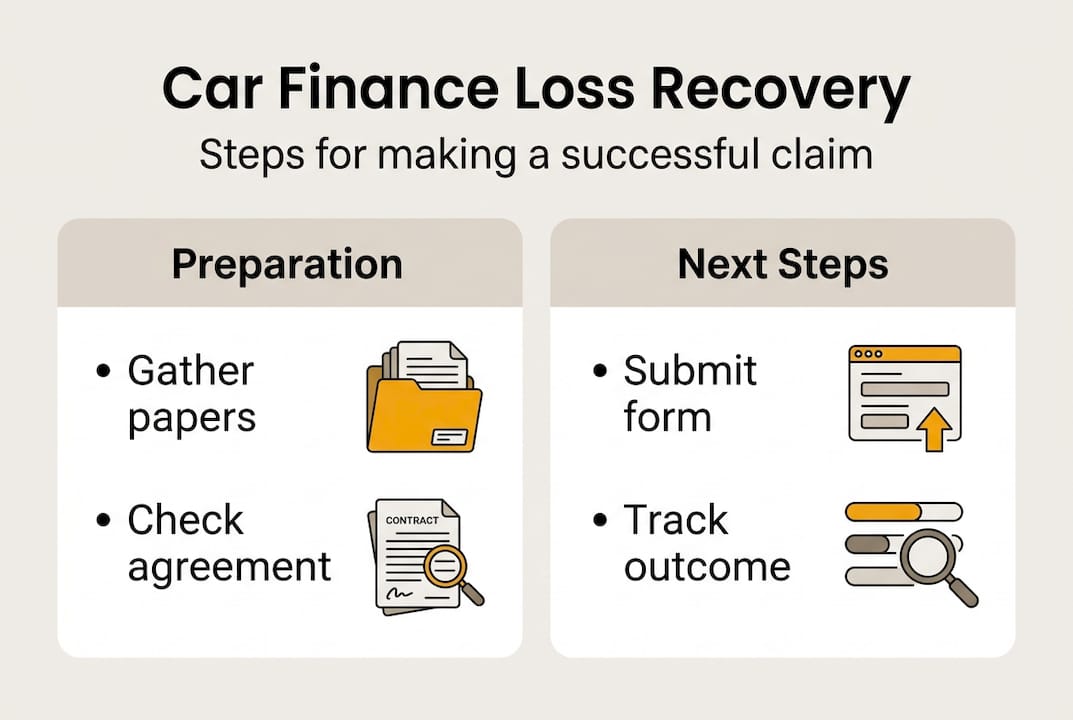
Submitting your complaint directly to the lender or broker is mandatory for redress scheme eligibility. The FCA paused lender responses until 31 May 2026, meaning complaints submitted now will be first in the queue when the scheme launches in early to mid 2026. This pause protects consumers from inconsistent decisions while the industry prepares standardised redress calculations.
Follow this proven sequence to maximise your claim success:
The complaint process follows clear mechanics with built-in consumer protections. Lenders must acknowledge complaints promptly and cannot dismiss them during the pause period. The scheme will assess each complaint using hybrid calculation methods combining average losses and actual commissions paid. The Financial Ombudsman Service monitors scheme compliance, ensuring lenders follow standardised rules rather than making arbitrary decisions.
“Complain now to be first in queue for the upcoming FCA redress scheme launching early to mid 2026, as lenders’ responses are paused until 31 May 2026.”
If your complaint receives an unsatisfactory response after the pause ends, you retain the right to escalate free to the Financial Ombudsman Service. The ombudsman provides independent review of lender decisions and can order higher compensation if evidence supports your case. Escalation deadlines typically allow 6 months from the final lender response, so monitor correspondence carefully and act within timeframes.
Court claims remain possible but involve legal costs, longer timelines, and uncertain outcomes compared to the streamlined scheme process. The redress scheme offers standardised calculations, no upfront costs, and faster resolution for most consumers. Reserve court action for exceptional cases where scheme compensation falls substantially short of proven losses.
Avoiding expensive claims management companies protects your compensation. These firms charge 25% to 30% of any payout despite offering no advantage over free complaint routes. The FCA provides templates, guidance, and direct complaint channels at no cost. MoneySavingExpert offers step-by-step instructions and community support for claimants navigating the process independently. Paying thousands of pounds for services you can access free represents an unnecessary loss.
Scams targeting car finance claimants have proliferated since the FCA announced the redress scheme. Ignore unsolicited contacts offering claims assistance via phone, text, email, or social media. Legitimate lenders will never cold-call about compensation. Fraudsters impersonate official bodies, create fake websites mimicking the FCA, and pressure victims into sharing bank details or paying upfront fees. Verify any contact by independently searching for the organisation’s official website and calling published numbers.
Pro tip: Create a dedicated folder, physical or digital, containing all complaint correspondence, submission confirmations, lender responses, and timeline notes. This organisation proves invaluable if you need to escalate to the ombudsman or query payment amounts.
Key mistakes that delay or derail claims include:
Submitting a complaint carries no credit score impact despite myths suggesting otherwise. Credit reference agencies do not record complaints about historic agreements. Your current credit arrangements remain unaffected. Lenders cannot penalise you for exercising statutory complaint rights. This protection ensures consumers can pursue legitimate claims without fear of financial consequences.
“No credit score impact from complaining; scams are common, so ignore unsolicited contacts claiming otherwise.”
Understanding the distinction between FCA scheme compensation and court claim damages sets realistic expectations. The scheme calculates redress using standardised formulas based on average commission levels and agreement terms. Court claims require proving specific losses, involve legal representation costs, and take years to resolve. The scheme offers certainty, speed, and simplicity for the vast majority of claimants. Exceptional cases involving unusual circumstances or particularly egregious misconduct might justify court action, but most consumers benefit more from the scheme route.
Compensation amounts vary based on your agreement’s size, term, and commission structure. The FCA estimates average redress around £700 per agreement, with typical ranges from £400 to £1,200 depending on loan size and term. The total industry redress reaches £8.2 billion at 85% uptake, reflecting widespread mis-selling across millions of agreements. Your specific compensation depends on the commission your dealer received, the interest you paid, and how these factors interact under scheme calculation methods.

The hybrid calculation method combines two approaches for fairness. Average loss calculations use industry data about typical commission levels and their impact on interest rates. Actual commission calculations examine your specific agreement’s dealer payments. The scheme applies whichever method produces the higher compensation figure, ensuring you receive fair redress regardless of documentation availability. Simple interest at base rate plus 1% compensates for the time you were without this money.
| Agreement type | Typical loan amount | Estimated commission | Average redress |
|---|---|---|---|
| Small PCP | £8,000-£12,000 | £800-£1,200 | £400-£600 |
| Medium PCP | £15,000-£20,000 | £1,500-£2,000 | £700-£900 |
| Large PCP | £25,000-£35,000 | £2,500-£3,500 | £1,000-£1,400 |
| Hire purchase | £10,000-£18,000 | £1,000-£1,800 | £500-£800 |
After your complaint enters the assessment phase post-launch, expect the lender to review your agreement against scheme criteria within 3 to 6 months. This timeline accounts for the volume of complaints and the detailed calculations required. Lenders must explain their decision in writing, showing how they calculated your compensation or why your complaint did not qualify. Transparency requirements prevent arbitrary rejections and allow meaningful ombudsman review if needed.
Receiving your compensation offer triggers a 28-day acceptance window. Review the calculation explanation carefully, comparing it against your agreement terms and the scheme’s published methodology. If the amount seems low, request a detailed breakdown showing commission figures, interest adjustments, and calculation steps. Lenders must provide this information to demonstrate compliance with scheme rules.
Pro tip: Keep a timeline spreadsheet recording complaint submission date, acknowledgement date, expected assessment completion, offer date, acceptance date, and payment date. This tracking helps identify delays, supports ombudsman escalation if needed, and provides evidence for any payment disputes.
Verifying accurate payment involves checking the amount received against the offer letter, confirming the payment includes simple interest as specified, and ensuring any tax implications are correctly handled. Compensation for mis-sold finance typically does not incur income tax as it represents a refund of overpaid amounts rather than new income. However, the interest component might have tax implications depending on your circumstances, so consider consulting a tax advisor for large payments.
If your offer falls short of expectations or the lender rejects your complaint, escalation to the Financial Ombudsman Service provides free independent review. The ombudsman examines whether the lender correctly applied scheme rules, considers any additional evidence you provide, and can order increased compensation if justified. Escalation deadlines typically allow 6 months from the final lender response, giving you adequate time to gather supporting documents and prepare your case.
Navigating car finance claims independently works well for straightforward cases, but specialist support can simplify complex situations and improve success rates. If you held multiple agreements, used vehicles for business purposes, or face lender resistance, professional guidance helps you present the strongest possible claim.

Accessing car finance recovery support provides tailored advice for UK claimants, free resources including templates and timeline trackers, and expert review of lender responses to identify weaknesses. Specialist services understand scheme calculation methods, ombudsman escalation procedures, and how to challenge inadequate offers effectively. Professional assistance proves particularly valuable when lenders dispute commission levels, claim adequate disclosure occurred, or offer settlements below scheme guidelines.
You can start your claim or get initial advice without upfront costs through no-win, no-fee arrangements that only charge upon successful compensation. This approach removes financial barriers while ensuring advisors remain motivated to maximise your payout. Trusted services help you avoid the pitfalls that delay claims, recognise when escalation becomes necessary, and verify that final payments accurately reflect scheme calculations.
Complaints must concern agreements taken between 6 April 2007 and 1 November 2024. You should submit as soon as possible to benefit from the FCA scheme, as lenders will process complaints in the order received once the pause ends in May 2026. No official deadline has been announced yet, but early submission secures your queue position.
Submitting a complaint does not impact your credit score. Credit reference agencies do not record complaints about historic finance agreements. Ignore unsolicited contacts claiming that complaints damage credit ratings, as these are scam attempts to discourage legitimate claims or sell unnecessary services.
Yes, you can claim compensation separately for each qualifying agreement, including those used for business purposes or as a sole trader. Each agreement between April 2007 and November 2024 generates an individual claim assessed on its own merits. Multiple vehicles financed over the years can each produce separate compensation payments.
If your complaint is rejected, you can escalate free to the Financial Ombudsman Service within the deadline specified in the lender’s final response letter, typically 6 months. The ombudsman provides independent review and can order compensation if the lender incorrectly applied scheme rules. Court action remains possible but involves costs and delays compared to ombudsman review.
The FCA scheme uses a hybrid method examining both average industry commission levels and your specific agreement’s dealer payments. Whichever calculation produces the higher figure becomes your compensation. Simple interest at base rate plus 1% is added to account for the time you were without this money. Typical redress ranges from £400 to £1,200 depending on loan size and term.