490,000+ drivers found their agreements with us

TL;DR:
- Many UK consumers face disputes over mis-sold or unfair car finance agreements involving hidden charges and misleading advice. Building a strong, well-organized evidence pack and clearly outlining specific issues are essential steps before escalating complaints to the Financial Ombudsman Service. Timely, precise, and supported claims increase the likelihood of favorable outcomes such as refunds, agreement terminations, or fair compensation.
If your car finance deal has left you confused, overcharged, or simply feeling misled, you are not alone. Thousands of UK car owners discover problems with their agreements every year, from unaffordable payments to hidden commission arrangements they were never told about. This stepwise guide for loan disputes walks you through every stage of the process, from identifying your complaint to escalating it to the Financial Ombudsman Service. Whether you are just starting out or you have already hit a wall with your lender, this guide gives you a clear path forward.
| Point | Details |
|---|---|
| Start with your finance agreement | Understand your contract and identify specific issues like affordability or mis-selling before complaining. |
| Gather all evidence | Collect and organise documents, correspondence, and create a timeline to support your dispute. |
| Follow complaint steps | Complain first to your finance company, then escalate to the Financial Ombudsman if unresolved. |
| Know your possible outcomes | Outcomes include refunds, ending agreements, and compensation through Ombudsman or FCA schemes. |
| Prepare carefully for success | Clear, structured complaints with realistic claims and timely responses improve resolution chances. |
Before you lodge any complaint, you need to know precisely what you are disputing. A vague grievance like “I feel the deal was unfair” will not get you far. You need to identify the specific clause, conduct, or failing that caused you harm.
Start by reading your finance agreement carefully. Pay attention to the interest rate, the total amount repayable, any optional extras or add-ons you may have been pressured into, and the final balloon payment if you took out a Personal Contract Purchase (PCP) agreement. These are the areas where problems most commonly arise.
Common causes of car finance disputes include:
Car finance mis-selling involves misleading advice, unaffordable payments, unexpected final payments, and hard-sell tactics. Knowing which of these applies to your situation is the foundation of any successful dispute.
Understanding your car finance compensation eligibility before you begin saves time and helps you frame your complaint correctly from the outset.
Pro Tip: Write out a one-paragraph summary of your dispute in plain language. If you cannot explain clearly what went wrong and how it affected you financially, the complaint letter will reflect that weakness.
The car finance dispute process UK shares structural similarities with other regulated consumer finance disputes, so the principles of preparation and evidence apply broadly.
To resolve disputes effectively, you must build a proper evidence pack before you write a single word of your formal complaint. Rushing this stage is one of the most common reasons complaints fail.
Here are the core documents you need to gather:
Once you have these documents, create a clear timeline. Write out the key dates: when you signed the agreement, when problems first appeared, when you first raised concerns, and what responses you received. This chronology becomes the spine of your complaint.
The Financial Ombudsman Service requires a structured evidence pack including the agreement, correspondence, timeline, and proof of faults. Submitting a disorganised bundle of papers slows everything down and weakens your case.

Structure your evidence so that each document directly supports a specific dispute point. For example, if you are claiming the payments were unaffordable, attach the relevant payslips and bank statements alongside the section of your agreement showing the monthly repayment amount.
| Document type | Purpose in your dispute |
|---|---|
| Finance agreement | Confirms exact terms, interest rate, and obligations |
| Bank statements | Demonstrates affordability issues or payment history |
| Dealer correspondence | Shows what you were told at point of sale |
| Timeline of events | Creates clear chronological narrative for adjudicators |
| Inspection reports | Supports vehicle condition or fault disputes |
Pro Tip: Keep all originals and send only copies to lenders or the Ombudsman. Label each document with a reference number that matches your timeline so adjudicators can cross-reference quickly.
You can find further guidance on collecting evidence for claims specific to car finance disputes on our blog. Supporting your case with well-organised documentation is equally important in related legal contexts.
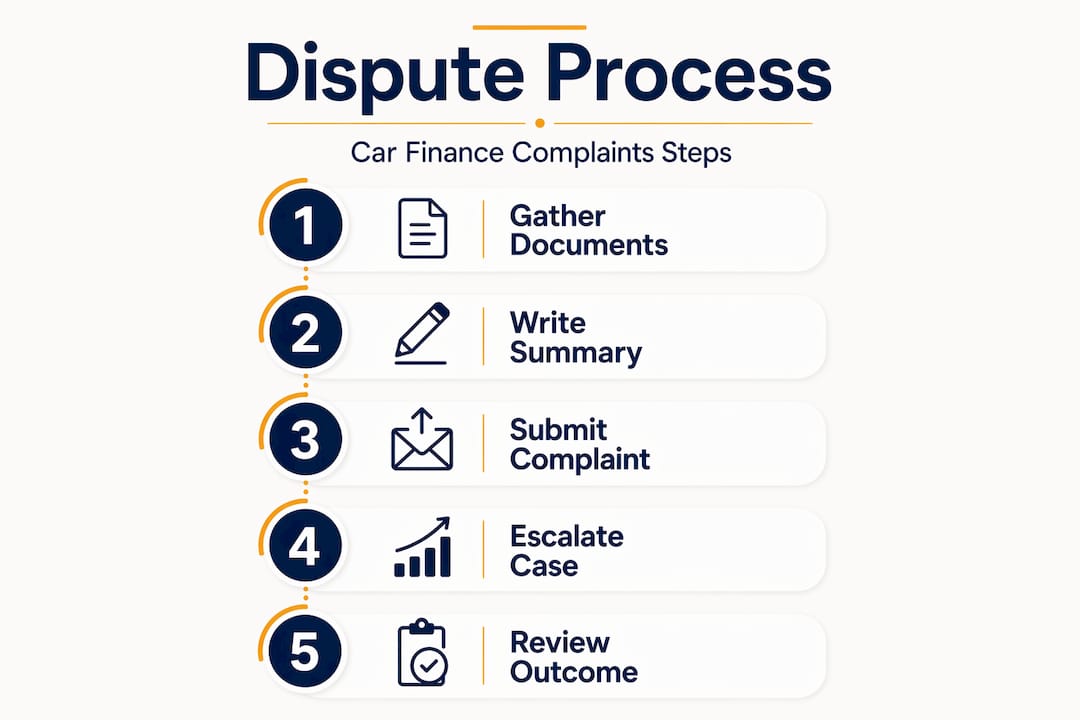
With your evidence in hand, you are ready to raise your formal complaint. This is where the step-by-step loan complaint process really takes shape.
Follow these steps in order:
Your complaint letter should include your name, account number, a clear description of the problem, the dates involved, the specific harm caused, and your preferred remedy. Being precise here matters enormously.
First complain to the finance company and dealer, then escalate to the Financial Ombudsman if unsatisfied after the final response or eight weeks. The Ombudsman will not accept your case until the formal company complaint has been made and either a final response issued or eight weeks have elapsed.
Important time limits to remember:
Pro Tip: When writing to the lender, use the phrase “formal complaint” in the subject line. This triggers their regulated complaints handling process and starts the eight-week clock immediately.
Learn more about the complaint escalation process and what to expect at each stage on our dedicated resource.
Once your complaint has been assessed, knowing what remedies are available helps you decide whether to accept or continue your dispute. This part of the guide to disputing a loan is where many people feel uncertain, so let us be specific.
The Financial Ombudsman Service can order a range of remedies if your complaint is upheld:
The Ombudsman can order refunds, end agreements without further cost, and calculate fair payment adjustments for unaffordable finance. This gives you genuine leverage, not just a symbolic review.
Separately, the FCA motor finance redress scheme provides compensation for eligible agreements with defined timelines and exclusions. This scheme targets agreements where discretionary commission arrangements were used, predominantly between 2007 and 2021. If your agreement falls within this window, you may be eligible for automatic compensation without needing to file a separate complaint.
| Remedy type | When it applies | What you receive |
|---|---|---|
| Interest refund | Mis-selling or undisclosed commission | Overcharged interest returned |
| Agreement termination | Unaffordable lending | Exit without remaining liability |
| Payment recalculation | Affordability failure | Adjusted repayment and arrears cleared |
| FCA redress scheme | Eligible discretionary commission agreements | Direct compensation from lender |
Pro Tip: If you receive a settlement offer, do not accept it immediately. Ask the lender to break down how they calculated the figure. Compare it against what the Ombudsman or FCA scheme might award before signing anything.
More detail on how the motor finance redress scheme works and whether you qualify is available through our blog.
Now that you understand the potential outcomes, here are the loan dispute resolution tips that separate successful complaints from ones that drag on for months without resolution.
Common mistakes to avoid:
FOS decisions rely heavily on clear timelines, structured evidence, and realistic claims. Adjudicators are experienced readers who can spot a padded complaint from a genuine one.
Document-to-issue structuring aligns with the way the Ombudsman makes decisions and directly improves complaint outcomes. In plain terms: match each document to the specific complaint point it supports.
“The strongest complaints are the ones where every paragraph in the complaint letter has a corresponding piece of evidence. Not opinion. Evidence.”
Keep records of every phone call you make, including the date, time, the name of the person you spoke to, and a brief summary of what was said. This record can become crucial if the lender later disputes what was agreed verbally.
Pro Tip: Use a spreadsheet to track every action you take, every response you receive, and every deadline approaching. It takes ten minutes to set up and can save you weeks of confusion later.
Most guides tell you to gather documents and file a complaint. That is necessary. But it is not enough on its own. Here is what experience in car finance claims actually teaches you.
The biggest factor in a failed dispute is not missing documents. It is imprecise framing. Consumers who write “the salesperson pressured me” get far weaker outcomes than those who write “on 12 March 2019, the salesperson stated that the monthly payment was the only cost and did not disclose a £4,500 balloon payment, contrary to FCA CONC 4.5 disclosure rules.” One is a feeling. The other is a claim.
Ombudsman adjudicators are working with dozens of cases at once. They respond to structure and specificity. If your complaint forces them to work out what you are actually disputing, you have already lost ground. Think of it this way: your complaint letter is not a diary entry. It is a legal argument in plain language.
Timing matters in ways people underestimate. The FCA redress scheme has deadlines. The Ombudsman referral window has deadlines. Even your own memory has a shelf life. The longer you wait, the harder it becomes to reconstruct an accurate timeline and the more likely you are to miss a window that cannot be reopened.
We also see consistently that consumers who approach the process with a fair and specific remedy in mind tend to fare better than those who simply ask to “be compensated.” Saying “I am seeking a refund of £1,840 in excess interest charges calculated against the fair rate I should have received” gives the Ombudsman a concrete target to assess. It shows you understand your own case.
Persistence matters too. Finance companies know that many consumers will accept an inadequate initial response. If you receive a poor offer or a dismissive final response, escalating to the Financial Ombudsman is not an aggressive step. It is exactly what the service exists for. Use our insider car finance claims advice to build the strongest possible case from the start.
Understanding your agreement is the first step in any dispute, and that means having access to the actual document. Many people struggle to locate their original finance paperwork, especially for agreements taken out several years ago.

At Make a PCP Claim, our free car finance agreement search retrieves your finance agreement details in under 60 seconds at no cost to you. Knowing the exact terms of your deal, the interest rate, the commission structure, and the total amount repayable gives you the foundation you need to assess your complaint accurately and act quickly. Start your free search today and take the first concrete step towards resolving your dispute with clarity and confidence.
Gather all your finance and purchase documents, then formally complain to your finance company and dealer, giving them the opportunity to investigate and respond.
If you do not receive a satisfactory reply within eight weeks or a final response, you can refer your complaint to the Financial Ombudsman Service, which won’t act until that threshold is met.
Yes. The Ombudsman can direct lenders to end hire purchase agreements without further cost and calculate fair usage payments if your complaint is upheld.
It is a UK scheme to compensate consumers affected by unfair commission arrangements in motor finance, with the FCA confirming eligibility criteria and defined timelines for affected agreements.
Extremely important. Clear timelines and structured evidence are among the most significant factors in whether the Ombudsman upholds your complaint quickly and fairly.