490,000+ drivers found their agreements with us

You’ve got six years to reclaim unfair car finance charges, but many UK drivers don’t realise this strict legal deadline exists until it’s too late. A claims deadline is the maximum time period during which you can legally file a claim for compensation. Understanding your claims deadline for car finance is essential because missing it almost always means losing your right to recover money you’re owed, potentially thousands of pounds in hidden commissions or unfair charges.
| Point | Details | |-------|---------|| | Legal time limit | Claims deadlines impose a strict six-year limit on filing car finance claims under UK law. | | Starting point matters | The countdown begins from either the breach date or when you discovered unfair charges, whichever is later. | | Missed deadlines are final | Once the deadline passes, claims are typically rejected regardless of merit. | | Exceptions exist | Special circumstances like latent misrepresentation can extend deadlines in rare cases. | | Act promptly | Check your individual deadline early and start the claim process without delay. |
A claims deadline represents the legal time limit during which you must initiate a claim for compensation related to your car finance agreement. This isn’t a flexible guideline or administrative preference but a hard legal boundary enforced by UK courts. For car finance claims involving unfair charges, hidden commissions, or mis-sold agreements, understanding this deadline is fundamental to protecting your consumer rights.
The deadline matters enormously because it directly determines whether you can reclaim money owed to you. Once the limitation period expires, lenders and dealers can legally refuse your claim regardless of how strong your evidence is. The typical six-year window might seem generous, but many drivers only discover unfair charges years after signing their finance agreement, leaving a narrow window to act.
Three critical aspects define claims deadlines for car finance:
Recognising these fundamentals helps you approach your car finance claim with urgency and proper planning. The deadline isn’t just bureaucracy; it’s a legal gate that closes permanently if you don’t act in time.
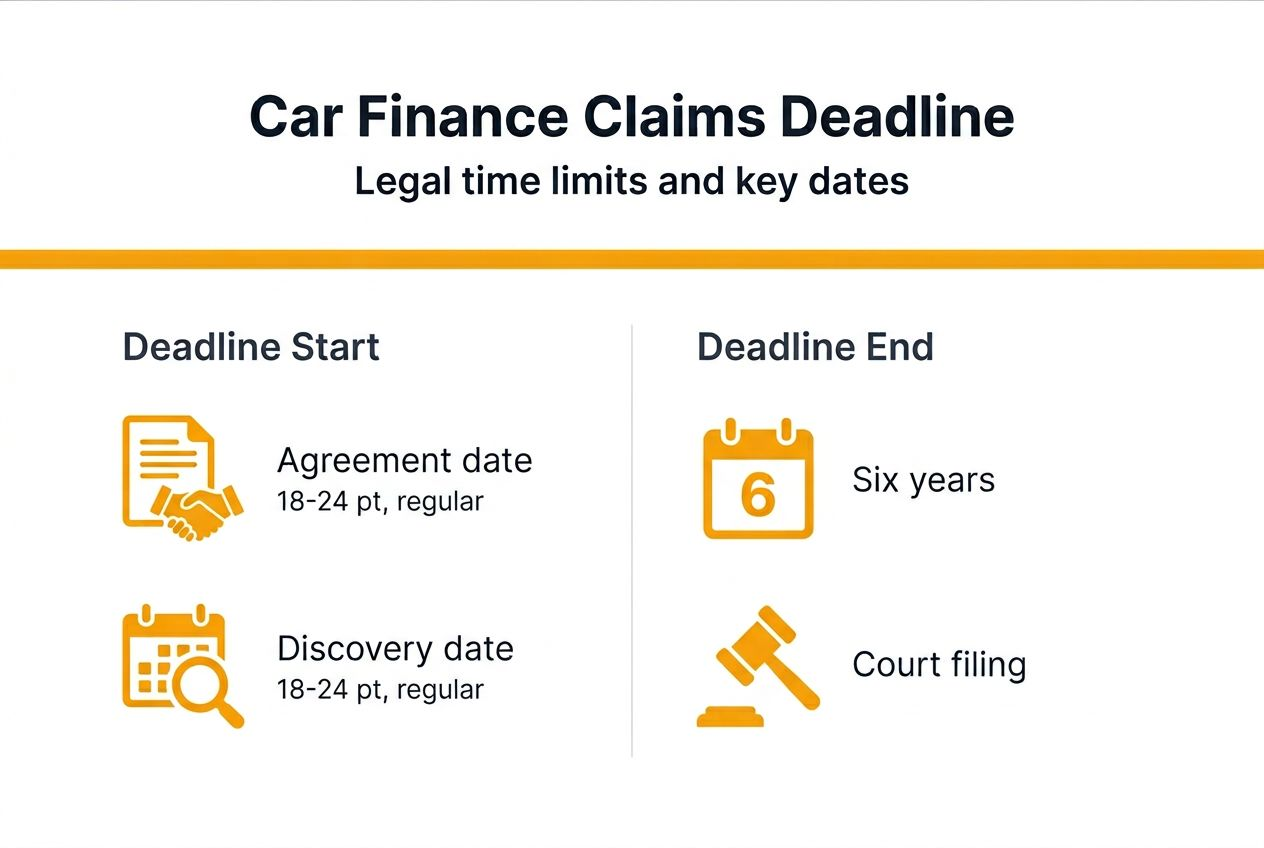
The six-year limitation period for contractual claims forms the cornerstone of claims deadlines in UK car finance cases. This statute creates a fixed timeframe during which claimants must bring legal action for breach of contract, including disputes over car finance agreements. The law applies universally across England and Wales, making it the primary legal reference for determining whether your claim remains valid.
Consumer credit regulations add another layer of protection, particularly regarding unfair relationships and hidden commissions that have plagued the car finance industry. The European Consumer Credit Directive, implemented into UK law, strengthens consumer rights by requiring transparency in lending agreements. When dealers or lenders fail to disclose commissions or misrepresent terms, these regulations provide grounds for claims, but only within the limitation period.
These laws intersect in car finance claims through several key mechanisms:
| Legal framework | Application to car finance | Time limit |
|---|---|---|
| Limitation Act 1980 | Breach of contract claims for finance agreements | Six years from breach or discovery |
| Consumer Credit Act 1974 | Unfair relationship claims against lenders | Six years from agreement end or discovery |
| Consumer Rights Act 2015 | Mis-sold finance and unfair terms | Six years from breach or knowledge |
Understanding which legal basis applies to your specific situation helps determine the exact deadline calculation. Courts interpret these statutes strictly, so relying on professional guidance ensures you identify the correct limitation period for your claim.
The six-year countdown typically starts from one of two dates: when the breach occurred or when you reasonably discovered it. For most car finance claims, the breach occurs when you signed the agreement containing unfair terms or when the lender failed to disclose commissions. However, if you only discovered these unfair practices years later through media reports or regulatory investigations, the clock may start from that discovery date instead.

Identifying your start date requires careful examination of your finance documents and timeline. Check your original agreement date, any correspondence about commissions, and when you first became aware of potential unfairness. The discovery rule protects consumers who couldn’t reasonably have known about hidden charges or mis-selling at the time of signing, but you must demonstrate genuine ignorance rather than simple oversight.
| Scenario | Limitation start date | Deadline calculation |
|---|---|---|
| Obvious unfair charges at signing | Agreement signature date | Six years from signature |
| Hidden commission discovered later | Date of discovery | Six years from discovery |
| Breach during agreement term | Date of specific breach | Six years from that breach |
| Agreement ended recently | Agreement end date | Six years from termination |
Pro Tip: Document the exact date you first learned about potential unfair charges through emails, news articles, or regulatory announcements. This evidence can be crucial if your claim relies on the discovery rule rather than the original agreement date, potentially extending your window to file.
Time calculation becomes more complex when agreements span several years with multiple potential breach points. If your finance agreement included ongoing unfair charges throughout its term, each charge might trigger a separate limitation period. However, courts generally favour a single starting point based on the primary breach or when the unfair relationship began, so seek professional advice to determine your specific deadline accurately.
Latent misrepresentation provides one of the most significant exceptions to standard limitation periods. This occurs when lenders or dealers actively concealed unfair charges or commissions, making it impossible for you to discover the breach through reasonable diligence. Courts recognise that holding consumers to strict deadlines when sellers deliberately hid wrongdoing would be manifestly unfair, potentially extending the limitation period beyond six years.
Delayed discovery also justifies deadline extensions in specific circumstances. If regulatory investigations or media coverage first revealed widespread mis-selling in the car finance industry years after you signed your agreement, you might successfully argue the limitation period should start from your discovery date. The key test is whether a reasonable person in your position could have discovered the breach earlier with normal vigilance.
Key situations where extensions may apply include:
Courts exercise discretion when considering deadline extensions, weighing the claimant’s circumstances against the need for legal certainty. Judges examine whether you acted promptly once you discovered the breach and whether the delay prejudices the defendant’s ability to defend the claim. Strong evidence of genuine ignorance combined with swift action upon discovery significantly improves extension prospects.
A claimant successfully extended their claims deadline after demonstrating that their dealer deliberately failed to disclose substantial commission payments, with the court accepting that the limitation period should run from when regulatory investigations first revealed the practice publicly rather than from the original agreement date.
Despite these exceptions, extensions remain exceptional rather than routine. Most claimants must work within the standard six-year window, making early action essential rather than relying on potential extensions that courts may refuse.
Many drivers mistakenly believe claims deadlines are flexible or negotiable, perhaps expecting lenders to show goodwill beyond legal requirements. The reality is starkly different: limitation periods represent hard legal boundaries that courts enforce rigorously. Once your deadline passes, even the most meritorious claim will fail purely on timing grounds, regardless of how much money you’re owed or how egregious the lender’s conduct was.
Another dangerous misconception centres on when the limitation clock starts ticking. Some consumers assume the six years runs from when they finish paying the finance or when they sell the car, but the actual starting point is usually much earlier. The clock typically begins when you signed the agreement or when the unfair charges first occurred, meaning your window might be nearly closed even whilst you’re still making payments.
Critical misunderstandings to avoid:
Pro Tip: The six-year limitation period is separate from the Financial Ombudsman’s complaint deadlines. You must both file your claim within six years of the breach AND complain to the Ombudsman within six months of your lender’s final response. Missing either deadline can sink your claim.
Procrastination proves particularly costly with claims deadlines because gathering evidence and preparing your claim takes time. Waiting until the final weeks before your deadline creates unnecessary pressure and increases error risks. Misinformation from unofficial sources or outdated advice compounds these problems, leading some drivers to miss deadlines they could have met with accurate information.
Identifying your specific claims deadline starts with locating your original car finance agreement and noting the signature date. This document shows when your contractual relationship began and establishes the earliest possible starting point for the limitation period. Cross-reference this with any correspondence about commissions, charges, or terms to determine whether you discovered unfair practices later, which might extend your window.
Seeking professional claims management or legal support early dramatically improves your chances of meeting deadlines successfully. Specialists understand the complex interplay between different limitation periods and can quickly assess whether your claim remains viable. They also handle the technical aspects of calculating deadlines when multiple breaches or discovery dates complicate the timeline.
Pro Tip: Start your claim at least 12 months before your deadline if possible. This buffer allows time to gather evidence, negotiate with lenders, and escalate to the Financial Ombudsman or courts if needed, without the pressure of an imminent limitation expiry.
Documenting key dates and charges strengthens your claim beyond simply meeting the deadline. Detailed records of every payment, every charge, and every communication create a compelling evidence trail that supports your case. Note when you first questioned any aspect of your finance, when you sought advice, and what responses you received, as this timeline demonstrates you acted reasonably and promptly once you understood your rights.
Claims deadlines represent one of the most critical yet underestimated aspects of car finance claims. The six-year limitation period functions as an absolute barrier: miss it, and your right to compensation vanishes regardless of how strong your case is or how much you’re owed. Understanding this deadline and acting within it separates successful claimants who recover thousands of pounds from those who permanently lose their rights through delay.
The urgency of timely claim submission cannot be overstated. Every day that passes whilst you consider whether to claim is a day closer to your deadline. The limitation period doesn’t pause for research, gathering courage, or waiting to see what others do. It ticks relentlessly from the breach or discovery date, and once it expires, no amount of evidence or deserving circumstances can revive your claim.
Essential actions to take immediately:
Resources available for claim support extend beyond legal professionals to include claims management companies specialising in car finance cases. These experts handle deadline calculations, evidence gathering, and negotiations with lenders, removing much of the complexity and stress from the process. They work on a no-win, no-fee basis in most cases, eliminating financial risk whilst ensuring you don’t miss critical deadlines through inexperience.
The difference between acting today and delaying another month could literally be the difference between recovering your money and losing your right to claim forever. Check your deadline, seek professional guidance, and start your claim whilst time remains on your side.
Navigating claims deadlines and building strong car finance claims requires expertise that most drivers understandably lack. Professional car finance claim support removes the guesswork and stress, with specialists who understand limitation periods, evidence requirements, and negotiation strategies that maximise your compensation.

Don’t let your claims deadline slip away whilst you struggle with complex calculations and legal technicalities. Expert claims managers check your claims deadline accurately, often identifying extensions or special circumstances you might have missed. They handle every aspect of your claim from initial assessment through final settlement, working on a no-win, no-fee basis so you risk nothing.
Time is running out if your car finance agreement is more than four years old. Start your car finance claim today to ensure you meet all deadlines and secure the refund you deserve before your legal window closes permanently.
A claims deadline is the legal time limit during which you must file a claim to recover unfair charges or compensation related to your car finance agreement. Under UK law, this is typically six years from when the breach occurred or when you discovered it. Missing this deadline almost always results in your claim being rejected, regardless of its validity or the amount owed.
Your deadline usually starts from either your finance agreement signature date or when you reasonably discovered unfair charges, whichever is later. Check your original agreement for the signing date, then add six years to establish your provisional deadline. If regulatory investigations or media coverage first revealed hidden commissions years after signing, your deadline might start from that discovery date instead. Seek professional advice if your situation involves delayed discovery or multiple potential starting points.
Extensions are possible but rare, typically requiring exceptional circumstances like latent misrepresentation where lenders deliberately concealed unfair practices. Courts may extend deadlines if you can prove you couldn’t have discovered the breach earlier through reasonable diligence. However, extensions aren’t guaranteed and require legal approval, so never rely on getting one. If you discover unfair charges late, act immediately to maximise your chances of either meeting the original deadline or successfully arguing for an extension.
Missing your claims deadline typically means permanent loss of your right to compensation. Lenders can use the expired limitation period as an absolute defence, and courts will dismiss your claim regardless of merit. Even if you have overwhelming evidence of unfair charges or mis-selling, the deadline operates as a complete bar to legal action once it passes. This makes checking and meeting your deadline absolutely essential.
Informal complaints to your lender don’t stop or pause the six-year limitation period. Only formal legal proceedings, such as filing a court claim or certain regulatory complaints, can halt the clock. You must still meet the limitation deadline even whilst negotiating with your lender or waiting for their internal complaints process to conclude. Always track your deadline independently and be prepared to escalate to formal proceedings before time runs out.