490,000+ drivers found their agreements with us

Rejected car finance claims cause frustration and financial loss for UK car owners who believed they had valid grounds for compensation. Many claims fail because applicants misunderstand FCA requirements, miss critical deadlines, or submit incomplete evidence. This guide explains the common reasons claims get rejected and provides step-by-step advice to help you prepare and submit a strong claim. Understanding these pitfalls and following proper procedures dramatically improves your chances of success and ensures you receive the compensation you deserve for mis-sold finance agreements.
| Point | Details |
|---|---|
| Rejection reasons | Nondisclosure of commissions and missing deadlines are the most common causes of claim rejection. |
| Documentation matters | Proper documentation and following FCA rules significantly boost your claim success rate. |
| Exhaust complaints first | You must complete the finance provider’s internal complaint process before escalating to external bodies. |
| Timeline awareness | Understanding compensation scheme deadlines helps you avoid automatic rejection of valid claims. |
Collecting comprehensive documentation forms the foundation of any successful car finance claim. You need your complete finance agreement, all correspondence with the broker or dealer, purchase documents, and proof of payments. These records demonstrate the relationship between you, the lender, and any intermediaries involved in arranging your finance. Missing even one critical document can weaken your claim or lead to outright rejection.
Understanding discretionary commission arrangements is crucial because consumers should ensure they have documentation proving the lack of disclosure of commission or contractual ties. DCA refers to situations where brokers or dealers had flexibility in setting your interest rate, often earning higher commissions by charging you more. The FCA has found these arrangements created conflicts of interest that disadvantaged consumers. If your finance provider failed to disclose these commission structures clearly, you may have grounds for compensation.
High commission definitions vary, but arrangements where dealers received more than 50% of the interest you paid typically raise red flags. These excessive commissions incentivised dealers to push expensive finance products rather than secure you the best deal. Your finance agreement should clearly state any commission arrangements, but many older agreements omitted this information entirely. Review your paperwork carefully for any mention of dealer fees, arrangement charges, or commission structures.
Missing commission disclosures lead to claim rejection when you cannot prove the lender failed to inform you properly. Without evidence showing what information you received at the point of sale, adjudicators struggle to determine whether the lender breached disclosure requirements. Keep every email, letter, and contract you received during the finance application process. Even seemingly minor documents like initial quotes or promotional materials can support your claim by showing what information was or was not provided.
| Document type | Role in claim | Where to find it |
|---|---|---|
| Finance agreement | Proves terms and commission disclosure | Lender or original paperwork |
| Broker correspondence | Shows information provided at sale | Email archives, letters |
| Purchase invoice | Confirms vehicle price and deposit | Dealer or personal records |
| Payment records | Demonstrates financial commitment | Bank statements, lender portal |
| Complaint responses | Tracks internal complaint process | Email, post from lender |
Organise your documents chronologically and create copies before submitting anything. Digital scans work well for online submissions, but ensure they are clear and readable. Label each document clearly with dates and descriptions so adjudicators can quickly understand what they are reviewing. This organisation demonstrates professionalism and makes it easier for decision makers to assess your claim favourably.
Pro Tip: Request a full copy of your finance file from your lender under data protection laws. This often reveals internal communications and commission structures that strengthen your claim significantly.
Preparing a successful claim requires following a specific sequence of steps, starting with your finance provider’s internal complaints process. You must give your lender the opportunity to address your concerns before escalating to external bodies. Begin by writing a formal complaint letter outlining the specific issues with your finance agreement, particularly any undisclosed commissions or unaffordable lending. Be clear, factual, and include copies of supporting documents.

Your finance provider has eight weeks to investigate and respond to your complaint. Track this timeline carefully because claims can be rejected if the claimant has not exhausted all internal complaints procedures with the finance provider before escalating to the Financial Ombudsman Service. If you receive no response within eight weeks, or if the response is unsatisfactory, you can then approach the Financial Ombudsman Service or wait for the FCA compensation scheme details.
Document every interaction with your finance provider meticulously. Keep records of when you sent your complaint, any acknowledgements received, and the content of all responses. If you speak to anyone by phone, follow up with an email summarising the conversation and asking for written confirmation of any commitments made. This paper trail proves you followed proper procedures and protects you if the provider later claims they never received your complaint.
Deadline awareness prevents automatic rejection by compensation schemes. The FCA has proposed specific timeframes for submitting claims under its motor finance compensation scheme, and missing these cutoff dates means losing your right to compensation regardless of how strong your case is. Set reminders well before deadlines and aim to submit claims early rather than waiting until the last moment. Technical issues or missing information can delay submissions, so build in buffer time.
Following up persistently demonstrates your commitment to resolving the issue. If you hear nothing after four weeks, send a polite reminder asking for an update on your complaint. Finance providers handle thousands of complaints, and yours can get overlooked without regular follow-up. Remain professional and factual in all communications, avoiding emotional language that might undermine your credibility.
Pro Tip: Create a dedicated email folder for all claim-related correspondence and save copies of every document you submit. This organised archive makes it easy to reference previous communications and proves you met all procedural requirements.
Insufficient evidence for unfair practices leads to rejection in approximately 60% of cases because mis-sold car finance claims are often rejected due to insufficient evidence of unfair practices, such as undisclosed commission or unaffordable loans. Adjudicators need clear proof that your lender or broker breached regulations or treated you unfairly. Vague complaints about feeling pressured or believing the finance was expensive are not enough without concrete evidence supporting these claims.
Demonstrating a causal link between provider actions and your financial loss is essential. You must show how the undisclosed commission or unfair practice directly resulted in you paying more than you should have. For example, if a dealer inflated your interest rate to earn higher commission, calculate the difference between what you paid and what a fair rate would have cost. Without this clear connection between wrongdoing and harm, your claim lacks the foundation needed for compensation.
Missing the internal complaint exhaustion requirement causes immediate rejection when claimants jump straight to the Financial Ombudsman Service. Regulators require you to give lenders the chance to resolve issues internally first. Even if you believe your lender will reject your complaint, you must still go through this process. Skipping this step wastes time because your claim will be sent back to complete the internal complaints process before being reconsidered.
Incorrect categorisation of leasing agreements causes delays and rejections because these contracts fall under different regulatory frameworks than hire purchase or PCP agreements. If you had a lease rather than a finance agreement, different rules may apply to your complaint. Check your contract type carefully and ensure you are following the correct claims process for that specific product. Misclassifying your agreement signals to adjudicators that you may not fully understand your situation.
| Pitfall | Consequence | Best practice |
|---|---|---|
| Incomplete evidence | Claim rejected for lack of proof | Gather all documents before submitting |
| Missed deadlines | Automatic rejection regardless of merit | Track timelines and submit early |
| Skipping internal complaints | Claim returned to complete process | Always exhaust lender complaints first |
| Weak causal link | Insufficient grounds for compensation | Clearly calculate financial loss |
| Poor organisation | Delays and requests for clarification | Present information logically and clearly |
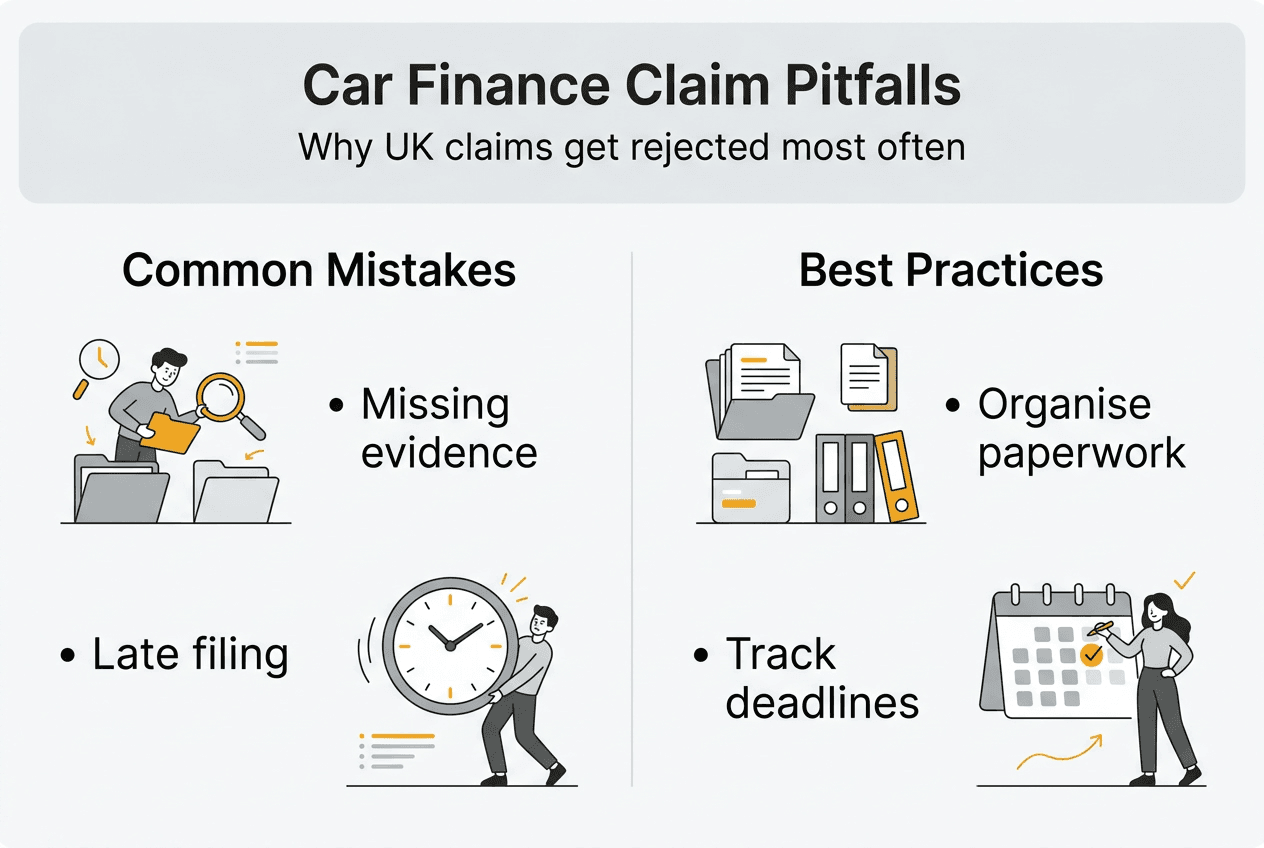
Avoiding these pitfalls requires careful preparation and attention to detail throughout the claims process. Take time to review your submission before sending it, checking that you have included all required information and supporting documents. Ask someone else to review your complaint letter to ensure it clearly explains the issues and your desired outcome. This extra effort significantly improves your chances of success.
Compensation amounts vary significantly based on individual circumstances, but most people would probably get less than £950 per agreement if owed money. The FCA’s estimate reflects typical commission levels and the financial impact of undisclosed arrangements. Your actual compensation depends on factors like your interest rate, loan amount, agreement duration, and how much commission the dealer received. Higher commissions and longer agreements generally result in larger payouts.
Some claims may result in unwinding the finance agreement entirely rather than receiving cash compensation. Unwinding means the lender treats the agreement as if it never existed, potentially requiring you to return the vehicle and receive back all payments made. This outcome impacts your financial loss calculation because you may not be entitled to additional compensation beyond the unwound agreement. Understanding this possibility helps you set realistic expectations about claim outcomes.
Seeking legal advice after receiving a claim decision helps you understand your options and whether to accept the outcome. Independent solicitors specialising in consumer finance can review settlement offers and advise whether they represent fair compensation. If you believe the decision was incorrect or the compensation inadequate, legal professionals can help you navigate the appeals process or escalate to higher authorities.
Escalating to the Financial Ombudsman Service becomes an option if your lender’s final response is unsatisfactory. The Ombudsman provides free, independent dispute resolution for financial services complaints. You typically have six months from receiving your lender’s final response to refer your case to the Ombudsman. They will review all evidence from both sides and make a binding decision on whether you deserve compensation and how much.
Understanding your rights and the claims process empowers you to challenge unfair finance practices confidently. Knowledge of FCA regulations and proper procedures transforms a potentially overwhelming process into a manageable series of clear steps.
Monitoring your claim’s progress requires regular communication with your lender or the body handling your case. Most providers offer online portals where you can check your complaint status and view any updates. If you submitted your claim by post, follow up every few weeks to confirm it is being processed. Persistent but polite communication keeps your claim moving forward and demonstrates your commitment to seeing it through.
Navigating car finance claims can feel overwhelming when you are dealing with complex FCA regulations and tight deadlines. Make a PCP claim offers professional assistance with every stage of the claims process, from initial document collection through to final settlement. Our team understands the common pitfalls that cause rejections and works with you to build the strongest possible case.
We guide you through exhausting your finance provider’s complaint process properly, ensuring you meet all procedural requirements before escalation. Our experts monitor FCA deadlines and complaint progress, sending timely reminders so you never miss critical cutoff dates. This support removes the stress of managing complex timelines whilst you focus on your daily life. Professional claims management significantly improves your chances of success and maximises your potential compensation.
Insufficient disclosure of commission by dealers or brokers tops the list of rejection causes. Many claims also fail because applicants miss crucial FCA deadlines or submit incomplete evidence that fails to prove unfair treatment. Failure to exhaust internal complaint processes before escalating to external bodies results in automatic rejection regardless of claim merit.
Meeting FCA deadlines is absolutely crucial because late submissions get rejected automatically even if you have a valid claim. The compensation scheme will have specific cutoff dates, and missing these means losing your right to any payout. Keep track of final response dates from your finance provider and escalate within the allowed timeframe, typically six months for Ombudsman referrals.
Complete finance agreements showing terms and any commission disclosures form the foundation of your evidence. Collect all communications with dealers and brokers, proof of undisclosed commissions, and documentation of the vehicle purchase. Include your complaint correspondence and any responses from your finance provider to demonstrate you followed proper procedures.
Consider appealing the decision or escalating to the Financial Ombudsman Service if you believe the rejection was incorrect. Review the rejection reasons carefully to understand what evidence or procedures were lacking. Seek independent legal advice to explore further remedies and determine whether you have grounds for a successful appeal.
Leasing complaints may follow separate rules and deadlines compared to hire purchase or PCP agreements. The regulatory framework differs for operating leases versus finance products, affecting how complaints are processed. Misclassification of your agreement type can delay your claim significantly or result in rejection, so verify your contract type before submitting.