490,000+ drivers found their agreements with us

Many UK car owners assume they can make a car finance claim whenever they feel ready. That assumption is wrong, and it could cost you hundreds or even thousands of pounds. Strict time limits govern every route available to you, whether you go through your lender, the Financial Ombudsman Service (FOS), or the courts. With the FCA actively consulting on a major compensation scheme and key deadlines falling in 2026, understanding exactly when you must act is not optional. This guide breaks down every relevant deadline, who qualifies, and the practical steps you need to take right now.
| Point | Details |
|---|---|
| Know the deadline | Missing the set time limit usually means losing your right to claim compensation. |
| Act quickly | Delays cost money as deadlines and evidence can both disappear. |
| Check eligibility window | Only agreements from 2007 to late 2024 or current contracts are usually covered. |
| Follow the correct process | Always complain to your lender first and then escalate if needed. |
| Avoid avoidable fees | Claims companies charge substantial fees but offer no fast-track advantage. |
Missing a deadline in a car finance claim is not a minor inconvenience. It typically means losing your legal right to any redress or compensation, regardless of how strong your case might be. The rules are firm, and regulators do not routinely grant extensions simply because a claimant was unaware of the deadline.
The scale of what is at stake makes this even more pressing. The FCA estimates that 44% of agreements since 2007 may be unfair, with an average redress of around £700 per consumer, up to 14 million people potentially affected, and a total industry cost that could reach £11 billion. These are not small numbers.
“Acting promptly is not just good advice. For car finance claims, it is the difference between receiving compensation and receiving nothing at all.”
Recent policy changes have also shifted the landscape. The FCA paused firm response deadlines to allow for a structured compensation scheme, but that pause has its own end date. Key points to understand:
The volume of affected consumers means the system will be under pressure. Getting your complaint in early, and correctly, puts you in the strongest possible position.
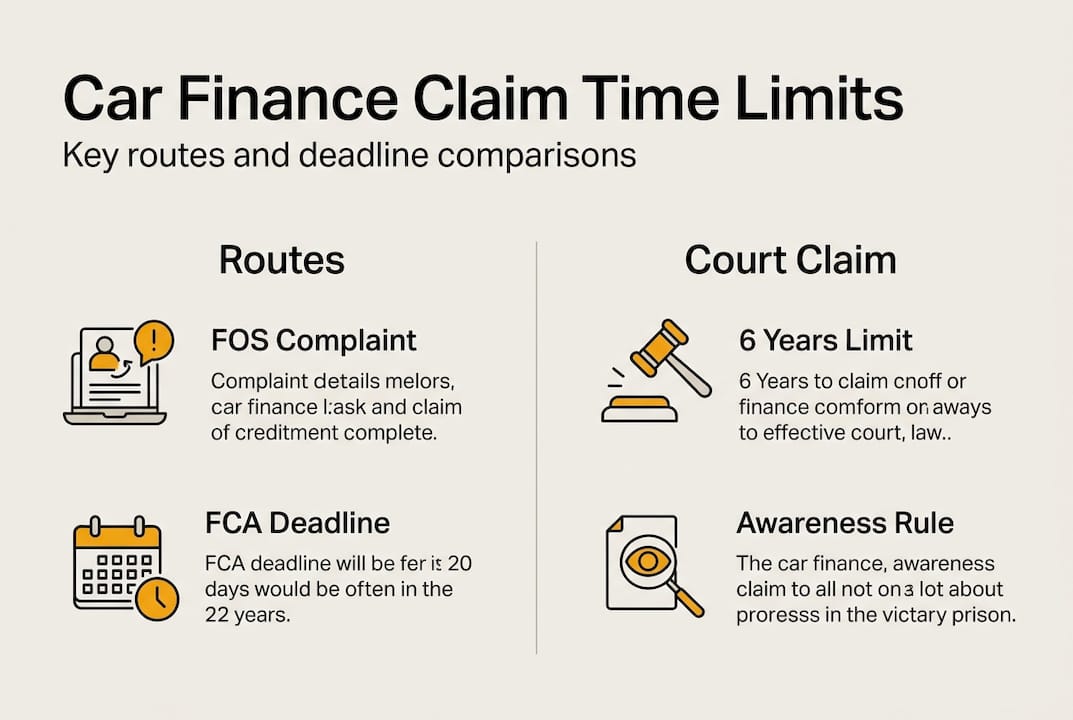
There are three distinct routes for making a car finance claim, and each carries its own deadline. Confusing them is one of the most common mistakes claimants make.
FOS time limits
The Financial Ombudsman Service applies a standard rule: you have 6 years from the event or 3 years from when you became aware of the problem, whichever is later. This is important because it means older agreements are not automatically excluded. If you only recently discovered that your finance included a hidden commission, the 3-year clock starts from that point of awareness.
FCA extended deadlines
For motor finance commission complaints, including both discretionary commission arrangement (DCA) and non-DCA cases, the FCA has extended firm response deadlines to after 31 May 2026. Consumers then have until 29 July 2026, or 15 months from the lender’s final response, to refer their complaint to FOS. These two windows do not overlap neatly, so you need to track both.
Court claims
If you pursue a claim through the courts rather than a regulatory route, the Limitation Act 1980 applies. You generally have 6 years from the date the cause of action arose. This is calculated differently from the FOS awareness rule, so the court route may be open even when the FOS route is closed, or vice versa.

| Route | Time limit | Starting point |
|---|---|---|
| FOS complaint | 6 years or 3 years from awareness | Event date or date of awareness |
| FCA scheme referral | By 29 July 2026 or 15 months from response | Lender’s final response |
| Court claim | 6 years | Date cause of action arose |
Pro Tip: Always complain to your lender first. You cannot go to FOS until the firm has had a chance to respond. Starting with the lender also creates a paper trail that strengthens any later escalation.
For further guidance on car finance complaints, the FCA publishes clear consumer-facing advice on its website.
Knowing the deadlines only helps if your agreement actually falls within scope. The FCA’s current scheme and the associated FOS deadline extensions primarily cover agreements made between 6 April 2007 and 1 November 2024. That is a broad window, covering the vast majority of PCP and HP agreements sold over the past 17 years.
Agreements that are still actively running also qualify. You do not need to have finished paying off your car to make a claim. However, there are important exclusions:
| Agreement type | Likely eligible? | Notes |
|---|---|---|
| PCP (personal contract purchase) | Yes | Core focus of FCA scheme |
| HP (hire purchase) | Yes | Included in scope |
| Personal car leasing | Generally no | Excluded from scheme |
| Business finance | Generally no | Commercial use excluded |
| Pre-2007 agreements | Possibly | Court route may apply |
If your agreement is older than 6 years but you only recently found out about a potential issue, do not assume you are too late. The FOS 3-year awareness rule exists precisely for situations like yours. Check your eligibility carefully before writing off your claim.
A clear process matters here. Following the right order protects your rights and keeps every deadline within reach.
The FCA’s car finance complaints guidance confirms that complaining to the lender first is the required starting point before escalating to FOS.
Pro Tip: Even if you have lost your original paperwork, do not give up. Lenders are legally required to provide copies of your agreement on request. A subject access request under UK GDPR can also retrieve relevant data held about you.
The SRA also offers consumer advice on motor finance claims that is worth reading before you decide whether to use a claims management company.
Even well-informed claimants make avoidable mistakes. Here are the most common ones, and how to sidestep them.
“The FCA has been clear: consumers can complain directly to their lender and then to FOS without using a claims management company. Paying a third party a significant percentage of your redress is rarely necessary.”
If your situation is complex, for example if your agreement is older, involves a non-standard product, or has already been partially addressed, then specialist legal advice may genuinely add value. But for the majority of standard PCP or HP complaints, the process is manageable without paying a fee.
For a detailed breakdown of eligibility and timing, the National Claims guide on time limits is a useful reference point.
The deadlines covered in this guide are real, and 2026 is the year they start to bite. If you had a PCP or HP agreement between 2007 and 2024, there is a genuine chance you were affected by undisclosed commission arrangements. The average redress figure of £700 is meaningful money, and for some consumers it is considerably more.

The smartest move you can make right now is to check whether your agreement qualifies before the window narrows further. At Make a PCP Claim, we help UK car owners understand their position quickly and clearly. Whether you want to handle the complaint yourself or need support navigating the process, checking your eligibility for a car finance claim takes only a few minutes and could be the most valuable thing you do this year. Do not let a missed deadline be the reason you walk away empty-handed.
Yes. Most consumers affected by the FCA pause will have until 29 July 2026 or 15 months from their lender’s final response to refer their complaint to FOS, whichever is later.
You may still be eligible. The FOS 3-year awareness rule means the clock starts from when you became aware of the issue, not when the agreement ended.
No. Most personal car leasing agreements are excluded from the scheme and do not benefit from the extended FOS referral deadlines.
No. Claims management companies charge 30% or more of any redress but cannot accelerate the complaint process. The FCA actively encourages consumers to complain directly.