490,000+ drivers found their agreements with us

Yes, in some cases. Under the Consumer Credit (Early Settlement) Regulations 2004, lenders must generally give borrowers a rebate when a regulated credit agreement is settled early, though several exceptions apply. Your first move should be requesting a formal settlement figure with a full written breakdown. If the numbers don’t add up, the Financial Ombudsman Service is your independent route to challenge them.
TL;DR:
- Settlement figures often include interest accrued during a 28 or 58 day deferment period, which can cause discrepancies with online estimates.
- The right to a rebate applies mainly to unsecured regulated credit agreements like personal loans and PCP deals, but not to most mortgages or credit cards.
- Disputes typically hinge on whether the lender’s calculation and disclosure match the contractual terms, not on unlawful behavior.
- Request a formal settlement figure in writing, compare it to your agreement, and escalate to the Financial Ombudsman if disagreements remain.
- Timely complaint submissions within six months of final responses or three years of discovering a problem are crucial for success.
The Consumer Credit (Early Settlement) Regulations 2004 exist for one reason: to stop lenders profiting twice from a loan you’re paying off ahead of schedule. If you hold a regulated credit agreement, such as most personal loans, hire purchase deals, and PCP agreements, and you settle the balance early, the lender is generally required to reduce the amount you owe by giving you a rebate on future interest you won’t now be paying.
That’s the baseline. It doesn’t mean every early settlement automatically triggers a refund of fees you’ve already paid, and it doesn’t apply universally.
The Regulations carve out some notable exceptions:
In practice, this means a lender must recalculate what you owe once you tell them you’re settling early, factoring in a reduction for interest you’ll no longer pay across the remaining term. Where a lender charges you full-term interest despite early settlement, that’s precisely the scenario the Regulations were written to prevent. Whether you get money back, and how much, comes down to the specific figures in your agreement, not a flat industry rule.
Most disagreements over settlement fees don’t come from lenders acting unlawfully. They come from confusion over what a settlement figure actually includes and when it was calculated.
Lenders typically defer the settlement date rather than calculating it for the day you ask. Standard practice is a 28 day deferment for agreements of 12 months or less, and 58 days for longer agreements, with interest continuing to accrue across that deferred window. That’s not a hidden penalty. It’s built into how the calculation works, though it catches a lot of borrowers off guard.
A formal settlement figure is usually made up of:
A figure that shows up repeatedly in disputes is an additional period of extra interest days applied by some lenders. In FOS decision DRN-4696479, the Ombudsman examined how a lender applied an additional settlement deferment period, adding interest the borrower hadn’t anticipated. The Ombudsman’s reasoning turned on whether the contract’s own wording permitted that extra period, not on a general assumption that lenders are entitled to add days at will.
This is also why the balance shown in your online account almost never matches your formal settlement figure. Online portals typically show an estimate calculated to today’s date, not a true settlement figure that accounts for deferment. In FOS decision DRN-4530804, the Ombudsman found the lender’s calculation and contract terms lawful because the charge had been clearly disclosed in the signed agreement from the outset. Disclosure, not the size of the charge, is usually what decides these cases.
Getting this right is mostly about paperwork discipline. Here’s the order that gives you the strongest position if you end up disputing the figure.
Pro Tip: Before you complain, write out a simple side-by-side reconciliation: what the lender quoted, what your contract says should apply, and where the two diverge. Complaints with a clear numbers-first reconciliation get resolved faster than ones built on general frustration, because the lender’s complaints team can see exactly what to check.
Citizens Advice’s guidance on paying off a credit agreement early confirms this same sequence: check whether the agreement is regulated, request a settlement figure, then follow the lender’s formal complaints procedure if the numbers don’t stack up.
You can complain to the Financial Ombudsman Service once you’ve been through the lender’s own complaints process and either received a final response you disagree with, or heard nothing after eight weeks. There are time limits attached to this, so don’t sit on a final response letter.
The Ombudsman typically reviews:
Outcomes vary. Some complaints result in a full refund with interest added back, some in a partial adjustment, and others in the lender’s original figure being upheld, as happened in DRN-4530804 where the charge was properly disclosed. Expect the process to take weeks rather than days once escalated, and keep your paper trail intact throughout.
Timing matters more than most borrowers realise. Complaints to a lender should ideally be raised as soon as you spot a discrepancy, but the formal clock that matters most is the one governing escalation to the Financial Ombudsman.
Generally, you need to refer a complaint to the Ombudsman within six months of the lender’s final response letter, or, where no final response was given, no later than eight weeks after you first complained. There’s also a longstop rule: complaints usually need to be brought within six years of the event you’re complaining about, or three years from when you reasonably became aware there was a problem, whichever is later.
This is why the paper trail matters so much. If you settled a car finance agreement several years ago and only recently discovered the settlement figure included extra interest days you weren’t contractually liable for, the “three years from awareness” limb often becomes the relevant test, not the six year one. Missing these windows doesn’t necessarily kill a valid complaint outright, but it gives the lender and, eventually, the Ombudsman grounds to decline looking at it. Don’t wait for a “convenient moment” to raise a dispute over a settlement fee. Once you suspect a mismatch, write to the lender the same week.
It does, and this is one of the most misunderstood parts of early settlement refunds. The Consumer Credit (Early Settlement) Regulations 2004 apply most cleanly to unsecured regulated credit agreements: personal loans, hire purchase, PCP, and similar vehicle finance products. If you’re settling a car finance agreement early, the Regulations’ rebate entitlement is generally your starting point.
Secured lending, particularly mortgages, works differently. Many mortgage products carry Early Repayment Charges (ERCs) that are governed by the specific terms of the mortgage contract rather than the 2004 Regulations’ rebate mechanism. Lender pages such as Nationwide’s ERC guidance explain that these charges are disclosed upfront in the mortgage offer and calculated according to a formula set out in the contract, often a percentage of the balance repaid, tapering the closer you get to the end of a fixed or tracker deal.
This doesn’t mean mortgage borrowers have no protection. It means the question shifts from “am I entitled to a statutory rebate” to “did the lender apply the ERC formula correctly, and was it disclosed clearly at the outset.” For car finance and other regulated consumer credit, the question stays closer to the Regulations themselves. Knowing which category your agreement falls into changes which document you need to check first: the Regulations for unsecured credit, the mortgage offer’s ERC schedule for secured lending.
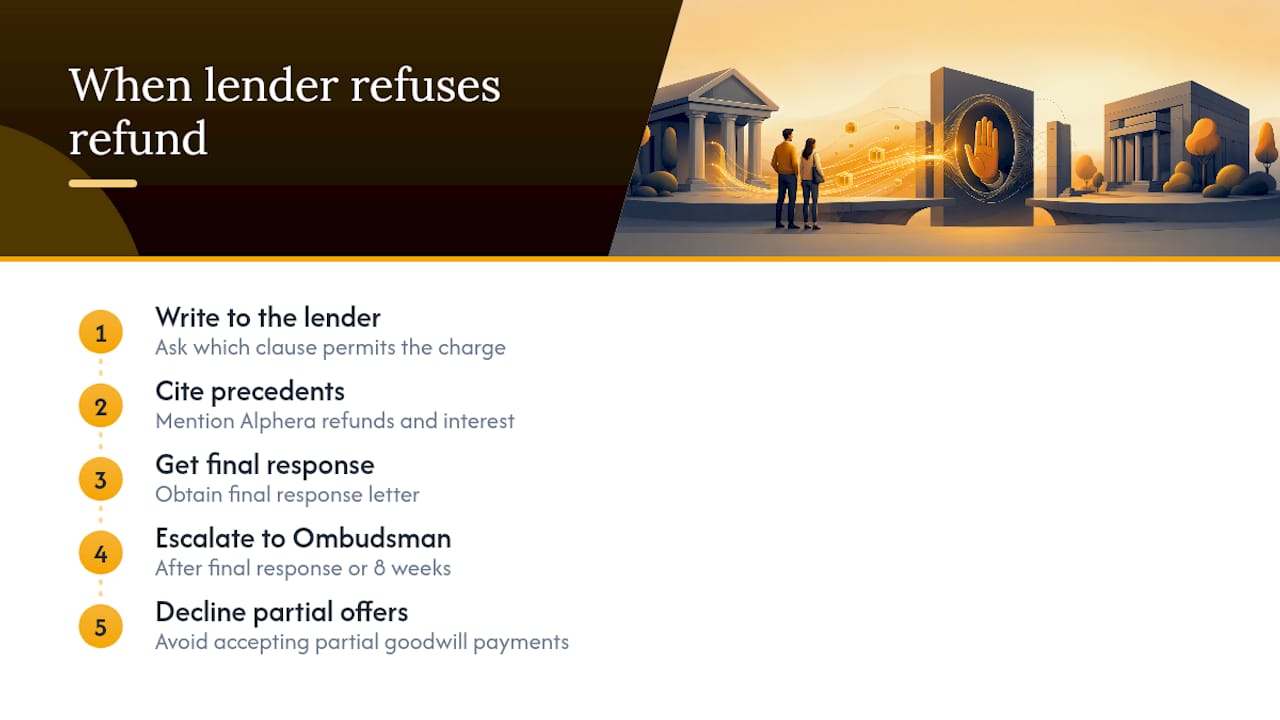
A refusal isn’t necessarily the end of the road, and it’s more common than borrowers expect, particularly where a lender is confident its disclosure was adequate.
Start by asking the lender, in writing, to explain exactly which clause in your agreement permits the charge or calculation you’re disputing. Some lenders will reconsider once pressed on the specific contractual basis, especially if their first response was a generic template rather than a case-specific answer. Alphera Financial Services, for example, has published guidance acknowledging that where settlement calculations were found to be incorrect, refunds with interest were issued to affected customers. That’s a useful precedent to raise: lenders do sometimes correct their own errors once challenged properly.
If the lender maintains its position, request its final response letter and learn about the roles and rights in ombudsman complaints to understand your options. You need this document to escalate to the Financial Ombudsman Service, so don’t let a phone call substitute for it. Once you have a final response, or eight weeks have passed with no resolution, take your full evidence file, including the reconciliation of quoted versus contractual figures, to the Ombudsman.
Throughout this process, resist the temptation to accept a partial goodwill gesture if you believe you’re entitled to the full rebate. Accepting a smaller settlement can sometimes affect your ability to pursue the remainder later, so read any offer letter carefully before agreeing to it.
A settlement refund letter works best when it reads like a reconciliation, not a complaint. Lenders’ complaints teams process hundreds of these, and the ones that get resolved quickly are the ones that make the discrepancy obvious at a glance.
Structure it in four short parts. First, state what you’re disputing and the agreement reference number. Second, set out the lender’s calculation exactly as given to you, including the settlement date used. Third, set out what you believe the figure should be, citing the specific contract clause or the 2004 Regulations where relevant. Fourth, state what you want: a corrected settlement figure, a refund of the difference, or a formal explanation of the calculation basis.
Keep it factual rather than emotional. Avoid vague phrases like “this doesn’t seem right” and instead write “your figure includes 58 days of deferred interest; my agreement states 28 days applies for agreements under 12 months.” Attach copies, never originals, of your settlement quote and the relevant page of your credit agreement. Ask for a written response within the lender’s standard complaints timescale, usually eight weeks, and note that you intend to escalate to the Financial Ombudsman Service if the matter isn’t resolved.
If your dispute relates to a car finance agreement specifically, it’s worth reading Makeapcpclaim’s guide to claiming car finance compensation before you send anything, since mis-sold finance complaints sometimes overlap with settlement fee disputes on the same agreement.
The conventional advice on early settlement disputes tends to focus on your right to complain. That’s true but incomplete. What actually decides these cases, based on how the Ombudsman has ruled, is whether the charge was clearly disclosed in the signed agreement and whether the lender applied its own contract correctly. Emotion doesn’t move these complaints. A clean reconciliation does.
Where most borrowers go wrong is treating the online estimated balance as gospel, then feeling misled when the formal settlement figure comes back higher. That gap is usually explained by the 28 or 58 day deferment, not by wrongdoing. Save the complaint energy for cases where the contract genuinely doesn’t support what you were charged.
If there’s one thing worth prioritising above everything else in this guide, it’s requesting the formal written settlement figure early and reading it against your actual signed agreement, not the summary you were given at point of sale. Everything else, complaint letters, Ombudsman referrals, follows from getting that first document and checking it properly.
— Jake
If you suspect your car finance settlement figure included charges you weren’t contractually liable for, the practical bottleneck is usually finding your original agreement paperwork, not knowing your rights. Makeapcpclaim’s free check finds your car finance agreements and in under 60 seconds, with no car registration or lender paperwork needed from you to get started.

We search for your historic agreements dating back to 2007, then refer eligible cases to partner law firms who handle the claim itself. You don’t pay Makeapcpclaim anything for this. The search is free, and if your case looks eligible for mis-sold car finance compensation, the referral to a partner solicitor is your next step, not an obligation. Start with the free agreement check and see what turns up before you spend time drafting complaint letters yourself.