490,000+ drivers found their agreements with us

If you took out hire purchase car finance between 2007 and 28 January 2024, there is a real chance you were mis-sold it, and the fastest way to find out is to check your paperwork today. A free finder tool can locate your finance agreements in under 60 seconds without needing registration or lender login. Payouts vary, but averages reported by MoneyHelper are typically in the hundreds of pounds per agreement, so the check is worth five minutes of your time.
TL;DR:
- Most hire purchase agreements from 2007 to January 2024 may be mis-sold due to undisclosed commissions or misleading advice, not just interest rates.
- Checking for mis-selling involves reviewing old paperwork, lender online portals, emails, and credit files, or using the Makeapcpclaim tool to find agreements automatically.
- Valid claims can be made regardless of whether the agreement was settled early, sold, or refinanced, with typical payouts in the low hundreds of pounds.
- Claims can be submitted by direct complaint, escalation through the FCA scheme, or via regulated law firms on a no win no fee basis, each with different timeframes.
- Beware of firms asking for upfront fees or applying pressure, and verify their legitimacy before instructing them to avoid scams and unnecessary costs.
HP mis-selling happens when the dealer or broker arranging your finance failed to act fairly, usually by hiding how they were paid or by pushing you towards a deal that suited their commission rather than your budget. It is not the same as simply having a bad interest rate. The problem is what you weren’t told, not just what you paid.
Three categories cover most genuine cases:
Look for phrases like “broker fee”, “commission may be payable”, or vague references to “arrangement fees” in your original documents. If your paperwork never explained how the commission worked or who was paid what, that’s a strong signal worth investigating further. This is the core of what people mean when they talk about hp misrepresentation, and it’s distinct from a simple pricing dispute.
The window that matters most is contracts taken out between 2007 and 28 January 2024, according to MoneyHelper. If your agreement falls inside that range, you’re within scope regardless of whether you’ve since sold the car, settled the finance early, or switched lenders.
A few borderline cases catch people out:
Compensation snapshot: MoneyHelper cites averages in the region of several hundred pounds per agreement, though the actual figure depends heavily on commission size and contract length.
One exception worth flagging early: if you already accepted a refund or redress payment for the same agreement, you generally can’t claim again for identical grounds. That doesn’t always rule out a fresh claim on different grounds, such as a separate discretionary commission issue the earlier payout didn’t cover, so it’s worth double-checking rather than assuming you’re locked out.
Most people don’t have their finance paperwork to hand, which is usually the first hurdle. Here’s where it tends to be hiding, and what to do about it.
If digging through all four sounds like a chore, that’s exactly the gap Makeapcpclaim’s finder closes. Enter a few basic details and it searches for your car finance agreements for free in under 60 seconds, without needing your registration number or lender login. No personal financial data is shared until you choose to move forward with a claim.
Once you’ve found an agreement, photograph or copy the finance schedule, any broker fee disclosure, and correspondence mentioning “commission” or “arrangement fee”. These are the documents that actually build the case for hp product mis selling.
Pro Tip: Save a screenshot of the interest rate section too. If the rate looks unusually high for your credit profile at the time, that’s often a sign discretionary commission was in play.
There are three realistic routes, and picking the right one depends on how much time you want to spend and how confident you feel handling correspondence yourself.
What each route needs from you:
Regulated law firms working on a no win no fee basis take a percentage of any successful payout, agreed upfront in writing, and they’ll typically handle all correspondence with the lender on your behalf. Before signing anything, check the firm’s terms clearly state what percentage they take and confirm there’s no fee if the claim fails. This is the practical mechanism behind most report hp mis selling services you’ll see advertised, and it’s worth understanding before you sign anything.
MoneyHelper and MoneySavingExpert both cite average payouts in the low hundreds of pounds per agreement, though this varies significantly case by case.
Three things tend to move the number up or down:
Timelines vary by route. A direct lender complaint often resolves within two to three months. FCA redress and solicitor-led claims can take longer, sometimes six months or more, particularly where lenders are dealing with high complaint volumes. Delays are usually administrative rather than a sign your claim is weak.
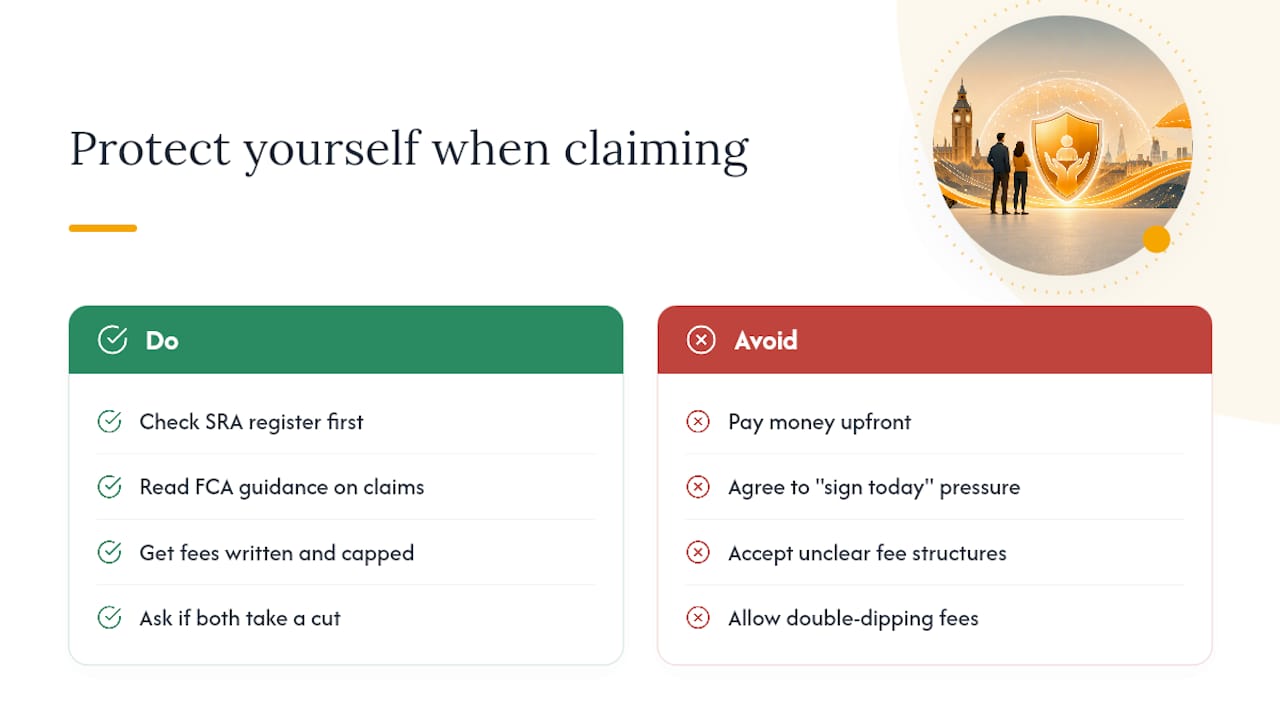
Reject any firm asking for money upfront before doing any work. Legitimate no win no fee arrangements take their cut from your compensation, not from your bank account beforehand. Aggressive cold calls pushing you to “sign today” or claiming you’ll “miss the deadline” are a red flag; there is no reason a genuine claim needs same-day pressure.
Before instructing anyone, check they’re on the Solicitors Regulation Authority register if they’re a law firm, or read the FCA’s own guidance on legitimate claims handling. Fair fee structures are written down clearly, capped as a percentage, and never charged twice, once by a claims management company and again by the solicitor they refer you to.
Pro Tip: If two firms are involved (a claims company and a law firm), ask directly whether both are taking a cut. Double-dipping fees is one of the most common complaints in this market.
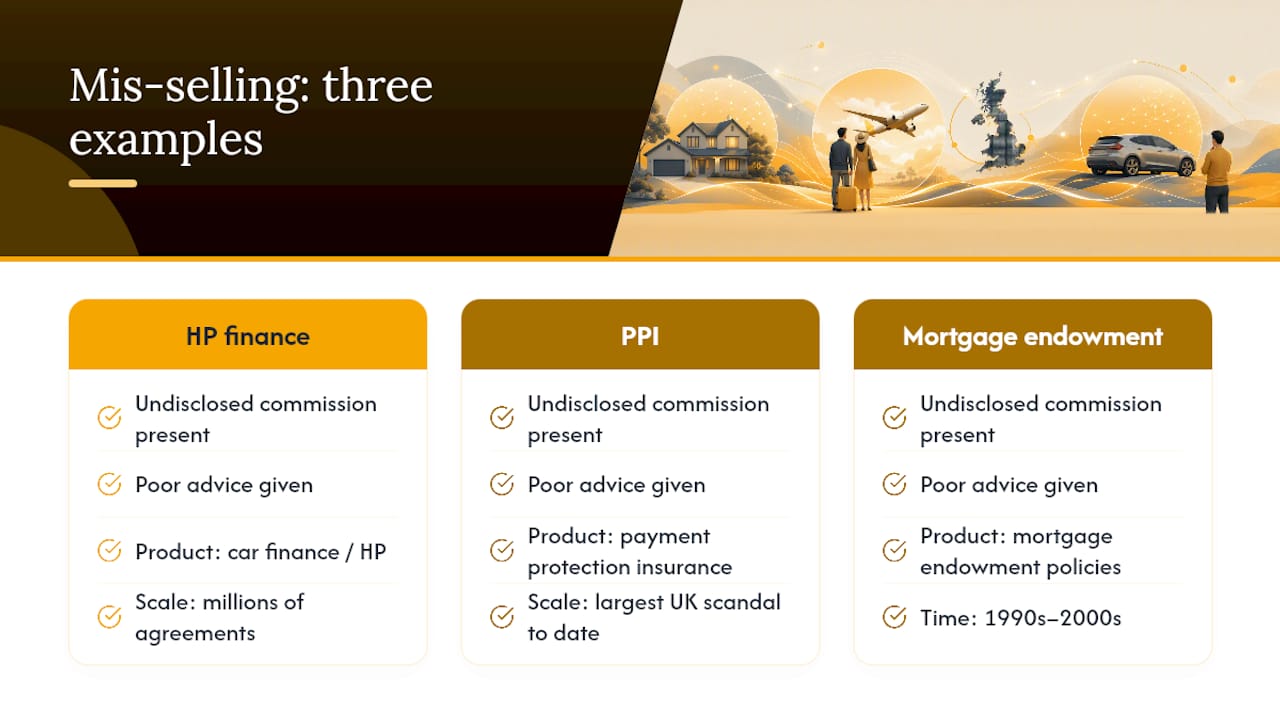
Hidden commission and poor advice aren’t unique to car finance. Payment protection insurance (PPI) was the largest UK mis-selling scandal to date, built on near-identical foundations: undisclosed commission and products sold without proper explanation of what they covered. HP finance mis-selling follows the same pattern, just with a car instead of a loan repayment guarantee attached.
Mortgage endowment mis-selling in the 1990s and 2000s shared the same root cause too: advisers recommending products that paid them well rather than ones that suited the customer. What sets HP claims apart is the sheer volume of agreements involved. Millions of car finance deals were arranged through dealerships acting as credit brokers, often with limited oversight of what commission structures they were using.
There’s also a broader pattern worth understanding: businesses across sectors have faced consequences for misleading customers on pricing and terms. In the US, HP Inc. (the printer and laptop manufacturer, unrelated to hire purchase finance) agreed to a $4 million settlement over allegations it used misleading “strike-through” reference prices on its website. Tech press coverage noted the settlement carried no admission of wrongdoing, which is typical of these cases and worth remembering: a settlement doesn’t always mean guilt, but it does mean a company decided paying out was cheaper than fighting the claim. The pattern is the same whether it’s a laptop price tag or a car finance contract: obscured terms, and a financial incentive to keep customers from noticing.
Most people who come to Makeapcpclaim assume finding old finance paperwork will be the hardest part of a claim, and honestly, they’re usually right. That’s precisely why the free finder tool exists: enter a few basic details and it searches for matching car finance agreements for free in under 60 seconds, without needing a registration number or lender password to hand.
What tends to surprise people is how many had no idea a discretionary commission arrangement even existed on their deal. It’s not printed anywhere obvious, and dealers had little reason to explain it. Once an agreement is found, referral to a regulated law firm to assess the case properly is the next step, and that part is handled without the reader needing to chase paperwork themselves.
— Jake
Makeapcpclaim is the practical shortcut for readers who’ve just realised they might be one of the millions still sitting on an unclaimed HP mis-selling case. Instead of hunting through old emails or ringing your lender’s call centre, our finder searches for your car finance agreements for free in under 60 seconds, with no registration number or lender paperwork required.

Once your agreements are found, basic eligibility is checked and, where it looks like a genuine case, referral is made to a regulated law firm to take it from there. There is no charge to you for this service. If you choose to instruct a solicitor, they will explain no win no fee terms in writing before anything is signed, and your details remain private until you actively choose to proceed. If you’re wondering whether your old HP agreement is worth a second look, start your free check now and find out in under a minute.
For the eligibility window and payout context, MoneyHelper’s mis-sold car finance guide is the clearest government-backed explainer available. MoneySavingExpert’s reclaim tool offers a free, independent way to double-check your own case. For wider consumer protection context around misleading pricing tactics, this guide to consumer identity and pricing law is a useful background read.
This article is general information, not a substitute for advice from a qualified financial advisor. Consult a qualified financial professional about your own circumstances before acting on anything here.