490,000+ drivers found their agreements with us

Buying a car is one of the biggest financial decisions you’ll make, yet many UK motorists remain uncertain about their legal protections when things go wrong. Whether you’re purchasing outright or through finance, understanding your rights under UK law can save you thousands of pounds and considerable stress. This guide clarifies the Consumer Rights Act 2015, explains the Financial Conduct Authority’s redress scheme for unfair finance deals, and provides practical steps to protect yourself throughout the car buying process.
| Point | Details |
|---|---|
| Consumer Rights Act 2015 | Vehicles must match their description, be fit for purpose, and meet satisfactory quality standards |
| FCA redress scheme | Up to 14 million unfair car finance deals may qualify for compensation totalling £11 billion |
| Compensation timeline | Lenders have three to five months to disburse approved payments to affected customers |
| Direct complaints | Contact your finance provider directly rather than using third party claims management firms |
| Document everything | Keep detailed records of all communications and paperwork related to your purchase |
The Consumer Rights Act 2015 forms the cornerstone of your protection when purchasing a vehicle in the UK. This legislation replaced previous consumer protection laws and applies to all car purchases, whether you buy from a dealership, independent trader, or private seller operating as a business. The Act establishes clear standards that every vehicle must meet, giving you concrete grounds for complaint if problems arise.
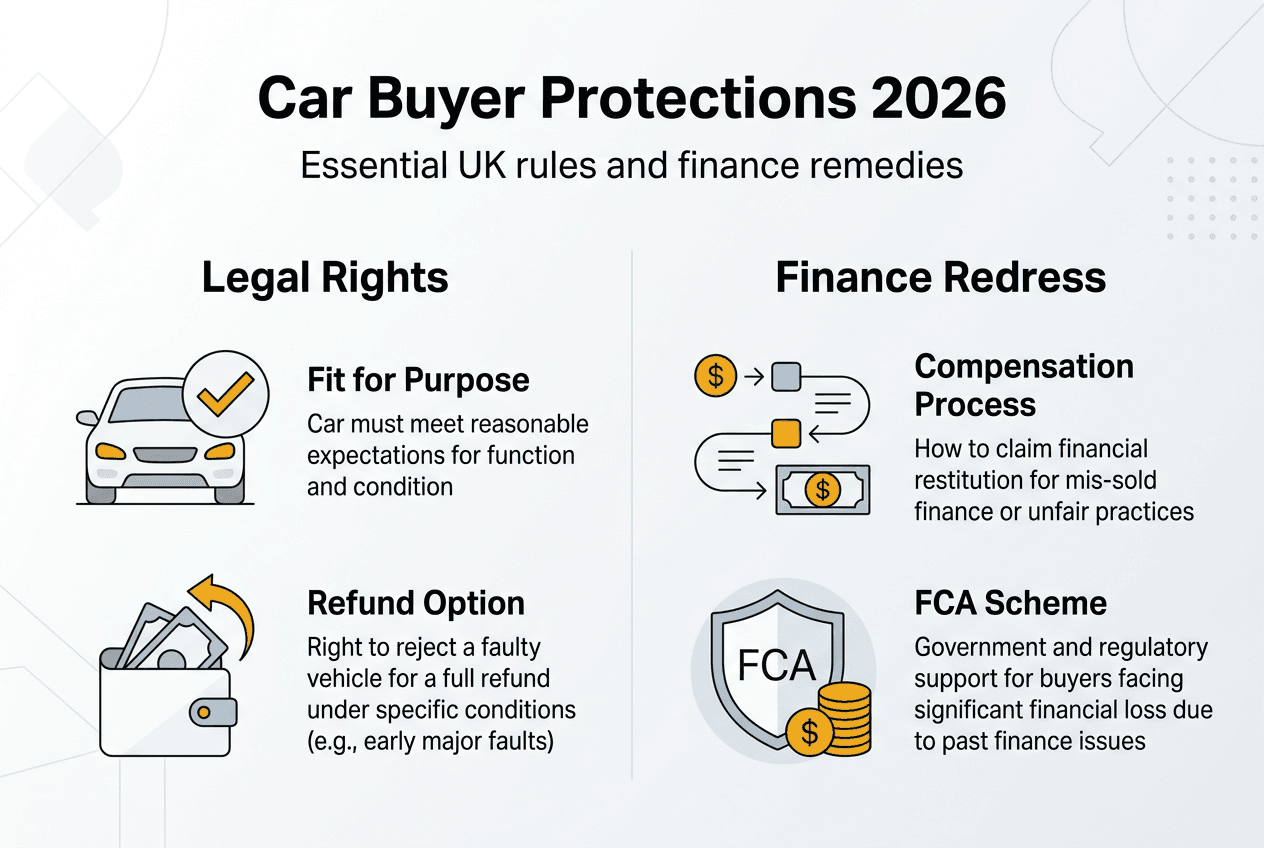
Under this legislation, any vehicle you purchase must satisfy three fundamental requirements. First, it must match the description provided in advertisements, listings, or verbal representations made by the seller. Second, the vehicle must be fit for its intended purpose, meaning it should function safely and reliably as a car. Third, it must be of satisfactory quality, taking into account factors like age, mileage, and price. A nearly new premium vehicle carries higher quality expectations than a decade old budget model.
When a vehicle fails to meet these standards, you have specific rights depending on how quickly you identify the problem. Within the first 30 days, you can reject the vehicle and claim a full refund if it’s faulty or doesn’t match the description. Between 30 days and six months, the seller must repair or replace the vehicle, and you can claim a refund only if repair proves impossible or impractical. After six months, the burden of proof shifts to you to demonstrate the fault existed at purchase.
Your protections under the Consumer Rights Act include:
Pro Tip: Before finalising any purchase, verify every detail in the advert matches the actual vehicle, including mileage, service history, and specification. Take photographs and keep all correspondence, as these become crucial evidence if you need to prove the vehicle didn’t match its description.
The Act applies differently depending on who you buy from. Purchases from registered dealers or traders carry full protection, whilst private sales between individuals offer limited rights. However, if someone regularly sells vehicles, they may be classified as a trader regardless of how they present themselves, bringing the full force of consumer protection law into play.
The Financial Conduct Authority launched a comprehensive review of motor finance practices after concerns emerged about how commission structures influenced lending decisions. This investigation uncovered widespread issues with discretionary commission arrangements, where brokers and dealers could adjust interest rates to increase their earnings, often without customers’ knowledge or informed consent. The resulting redress scheme represents one of the largest consumer compensation programmes in UK financial services history.

The FCA estimates its redress scheme could cost lenders about £11 billion, reflecting the scale of potential misconduct across the motor finance industry. This figure encompasses compensation payments, administrative costs, and the expense of reviewing millions of individual agreements. The scheme specifically targets discretionary commission arrangements used between 2007 and 2021, during which dealers could increase customer interest rates to boost their commission payments.
According to industry analysis, the scheme could address up to 14 million unfair motor finance deals, covering various agreement types including personal contract purchases, hire purchase, and conditional sale arrangements. Not every agreement will qualify for compensation, as the FCA focuses on cases where commission arrangements created clear conflicts of interest or where customers weren’t properly informed about how their rates were determined.
The sheer scale of this redress scheme underscores how widespread unfair practices became within motor finance, affecting millions of ordinary car buyers who trusted dealers to arrange fair financing without realising commission structures created inherent conflicts of interest.
The compensation process follows a structured timeline. If approved, lenders would have three to five months to disburse compensation once the scheme’s final parameters are established. This timeframe allows lenders to review agreements, calculate appropriate compensation amounts, and process payments whilst managing the administrative burden of handling millions of claims simultaneously.
| Scheme Element | Detail |
|---|---|
| Estimated total cost | £11 billion across all participating lenders |
| Affected agreements | Up to 14 million motor finance deals |
| Target period | Finance agreements from 2007 to 2021 |
| Payment timeline | 3 to 5 months after scheme approval |
| Agreement types | PCP, hire purchase, conditional sale |
Compensation amounts vary based on how much extra interest you paid due to inflated rates. The FCA calculates redress by comparing what you actually paid against what you would have paid at a fair rate without discretionary commission inflation. This includes both the excess interest charged and a statutory interest payment on that amount, recognising you’ve been deprived of that money for years.
Pro Tip: Don’t wait for lenders to contact you proactively. Whilst firms must review their records, taking initiative by submitting your own complaint ensures your case receives attention and starts the compensation clock running, particularly important given the volume of claims lenders must process.
The FCA continues refining the scheme’s scope and methodology, with potential changes to the compensation framework still under consideration. Staying informed about developments helps you understand whether your specific circumstances qualify and what evidence you’ll need to support your claim.
Successfully claiming compensation or exercising your legal rights requires following proper procedures and avoiding common mistakes that derail legitimate claims. The process differs slightly depending on whether you’re addressing a vehicle quality issue under the Consumer Rights Act or pursuing finance compensation through the FCA scheme, but certain principles apply universally.
For finance related claims, follow this systematic approach:
The FCA explicitly advises that consumers should complain directly to their finance provider, rather than using claims management companies. These firms typically charge 30% or more of any compensation you receive, despite adding little value to straightforward claims. Direct complaints cost nothing and often resolve faster, as lenders prioritise customer complaints over third party submissions.
Common pitfalls that undermine otherwise valid claims include:
Pro Tip: Create a dedicated folder, physical or digital, for every document related to your car purchase and finance agreement from day one. Include photographs of the vehicle, copies of advertisements, email exchanges, service records, and payment confirmations. This organised evidence base proves invaluable if problems emerge months or years after purchase.
For vehicle quality claims under the Consumer Rights Act, act quickly. The 30 day rejection period passes faster than you might expect, particularly if you’re trying to resolve issues through informal discussion with the seller. Put everything in writing, even if you’ve spoken by phone, as written records carry far more weight in disputes. Be specific about faults, referencing the Act’s requirements that vehicles must match description, be fit for purpose, and meet satisfactory quality standards.
Time limits vary depending on your claim type. Consumer Rights Act claims generally must be brought within six years of purchase, though practical considerations often make claims difficult after significant time has passed. Finance claims fall under different limitation rules, but the FCA scheme focuses on agreements from 2007 onwards, providing a practical boundary for most claims.
The regulatory landscape continues evolving, with the FCA indicating possible changes to the compensation framework as it analyses feedback and assesses the scheme’s impact. Monitor official FCA communications and reputable consumer rights organisations for updates that might affect your claim strategy or eligibility. Staying informed ensures you don’t miss opportunities or deadlines as the scheme develops.
Navigating car finance claims can feel overwhelming when you’re facing large financial institutions with extensive legal resources. Whilst direct complaints work well for straightforward cases, complex situations or unresponsive lenders sometimes require professional assistance to secure the compensation you deserve. Specialist claims services understand the intricacies of motor finance regulations and can advocate effectively on your behalf.

Our team at Make a PCP Claim specialises exclusively in UK car finance claims, combining deep regulatory knowledge with practical experience handling thousands of cases. We manage the entire process from initial assessment through final settlement, dealing directly with lenders and the Financial Ombudsman Service so you can focus on your daily life rather than bureaucratic procedures.
Key benefits of professional claims support include:
If you financed a vehicle between 2007 and 2021 and suspect unfair commission arrangements inflated your costs, make a PCP claim today to discover whether you’re entitled to compensation. Our specialists review your case at no cost and provide clear advice about your options, ensuring you understand your rights before committing to any course of action.
You can reject the vehicle for a full refund within 30 days of purchase if it fails to match its description, isn’t fit for purpose, or lacks satisfactory quality. After 30 days, you’re entitled to repair or replacement, with refund rights available only if repair proves impossible. The seller cannot charge you for repairs addressing faults that existed at purchase.
Yes, if your agreement involved discretionary commission arrangements where dealers could adjust interest rates to increase their earnings without your informed consent. The FCA redress scheme covers agreements from 2007 to 2021, potentially affecting up to 14 million deals. Contact your lender directly to start the claims process, providing details of your agreement and explaining why you believe it was unfair.
Lenders have three to five months to disburse compensation once the scheme’s final parameters are confirmed and your claim is approved. Initial complaint investigation typically takes up to eight weeks. If you escalate to the Financial Ombudsman Service, resolution may take several additional months depending on case complexity and the Ombudsman’s workload.
The FCA explicitly recommends complaining directly to your finance provider rather than using claims management firms. These companies typically charge 30% or more of your compensation for work you can complete yourself at no cost. Direct complaints often resolve faster and ensure you receive your full entitlement without deductions for unnecessary fees.
Consumer Rights Act claims generally must be brought within six years of purchase under standard limitation rules. However, practical considerations like proving faults existed at purchase become increasingly difficult as time passes. For finance claims, the FCA scheme focuses on agreements from 2007 onwards. Act promptly when you identify problems to preserve your strongest legal position and maximise your chances of successful resolution.