490,000+ drivers found their agreements with us

TL;DR:
- Most UK drivers sign car finance agreements without fully understanding key terms.
- The FCA offers a redress scheme for agreements impacted by undisclosed commissions from 2007 to 2024.
- Being informed about contract details enables better decisions and stronger leverage in negotiations.
The majority of UK drivers never read their car finance agreement in full. With 80–90% of new cars in the UK bought on finance and average monthly repayments sitting around £244, the stakes are high. Yet most people sign on the dotted line without fully understanding what they have agreed to. Terms like APR, balloon payment, GMFV, and discretionary commission can feel deliberately opaque. This article cuts through that complexity. By the end, you will know the main agreement types, what the key terms actually mean, the rights you hold as a consumer, and what to do if something feels wrong.
| Point | Details |
|---|---|
| Know your agreement type | Understanding the difference between HP, PCP and personal loans can save you confusion and cost later. |
| Scrutinise key terms | Look beyond the monthly payment to the total repayable, interest rates, and conditions that affect ownership. |
| Check your rights | You may be entitled to redress if your agreement included hidden commissions or was mis-sold. |
| Act quickly on concerns | Timely action makes it easier to correct unfair finance terms and improves your chances for compensation. |
Before you can spot a problem in your agreement, you need to understand which type of agreement you actually have. There are three main routes UK drivers use to finance a vehicle, and each works very differently.
Hire Purchase (HP) is the most straightforward. You pay a deposit, then fixed monthly instalments over an agreed term, typically two to five years. At the end, you own the car outright. There is no large final payment and no mileage restriction. The catch is that the lender legally owns the vehicle until your very last payment.
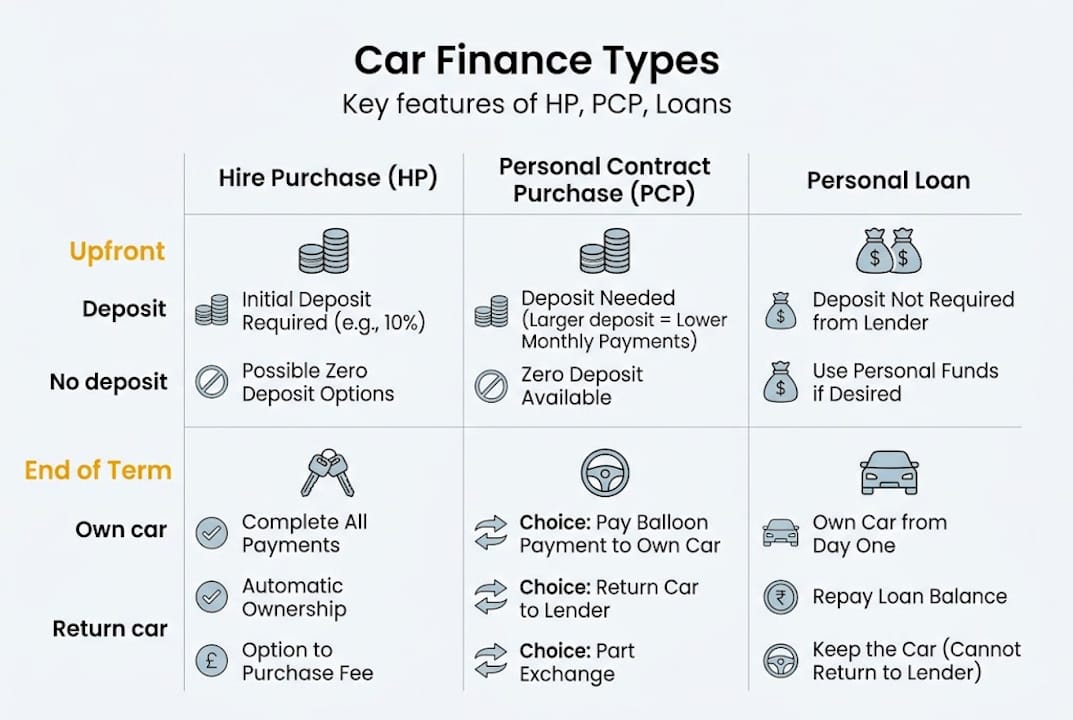
Personal Contract Purchase (PCP) is the most popular option on the market today. Monthly payments are lower than HP because you are only financing the depreciation of the car, not its full value. However, at the end of the term you face a choice: return the car, use any equity as a deposit on a new deal, or pay a large final sum called a balloon payment to keep it. As What Car? explains, HP means you own the car at the end, PCP gives flexibility but includes that significant balloon payment, and a personal loan means you own the car from day one.
Personal loans from a bank or building society give you immediate ownership. You borrow a fixed sum and repay it with interest. There are no mileage limits or end-of-term decisions to make. The downside is that interest rates on unsecured personal loans can be higher than dealer-arranged finance.
| Feature | HP | PCP | Personal loan |
|---|---|---|---|
| Typical term | 2–5 years | 2–4 years | 1–7 years |
| Deposit required | Usually 10% | Usually 10% | None |
| Ownership | At end of term | Optional (balloon) | Immediate |
| Mileage limits | No | Yes | No |
| Monthly payments | Higher | Lower | Variable |
Key terms to watch out for in any agreement include:
Pro Tip: Always calculate the total amount repayable, not just the monthly figure. A low monthly payment stretched over five years can cost far more than a higher payment over three.
Now that you know the types of agreements, let us break down what the small print really means and how to spot red flags before they cost you money.
APR (Annual Percentage Rate) is the yearly cost of your borrowing expressed as a percentage. It includes interest and mandatory fees. A higher APR means a more expensive agreement overall. Critically, APRs can be 17% higher where a discretionary commission arrangement (DCA) has been applied, and average agreement values sit around £28,000 for new cars and £15,000 for used.

GMFV (Guaranteed Minimum Future Value) is the figure the lender guarantees the car will be worth at the end of a PCP deal. This becomes the balloon payment if you choose to buy. If the car is worth more than the GMFV, you have equity. If it is worth less, the lender absorbs that risk, not you.
Discretionary commission arrangement (DCA) is where a broker or dealer was allowed to set the interest rate within a range, earning more commission the higher the rate they set. This practice was banned by the FCA in 2021 but affected millions of agreements before that.
Voluntary termination (VT) is a legal right under the Consumer Credit Act 1974. Once you have paid at least half of the total amount payable, you can return the car and walk away with no further obligation, provided the vehicle is in reasonable condition.
| Term | New car example | Used car example |
|---|---|---|
| Agreement value | £28,000 | £15,000 |
| Typical APR | 6–9% | 9–14% |
| Monthly payment | £350–£500 | £200–£350 |
| Balloon (PCP) | £10,000–£14,000 | £4,000–£7,000 |
How to decode a typical car finance agreement summary page:
Pro Tip: Always check the voluntary termination threshold before signing. Knowing exactly when you can exit the agreement without penalty gives you a safety net if your circumstances change.
Detailed understanding of terms leads directly to protecting your rights. Here is what current law and recent history mean for you.
The biggest scandal in UK car finance history centres on undisclosed commissions. For years, dealers and brokers used DCAs to quietly inflate the interest rate on your agreement, earning themselves a larger cut without telling you. You paid more. They earned more. You had no idea.
The scale of the problem is significant. The FCA redress scheme covers agreements from 2007 to 2024, with a 44% breach rate found across finance agreements reviewed, and an estimated 12.1 million agreements potentially eligible for compensation.
The FCA estimates the mean redress payout at £830 per eligible agreement, with total industry payouts expected to reach £7.5 billion.
If you think you may have been affected, here is what to do:
Going to court can sometimes yield a higher payout, but it carries greater cost, risk, and time. For most car owners, the FCA scheme offers a more practical route to fair compensation.
Armed with this knowledge, here is how you can use it to get a better deal and avoid regret.
The single most powerful thing you can do before signing any finance agreement is to slow down. Dealers rely on the excitement of a new car to rush decisions. Do not let the moment override your judgement.
For used car buyers, checking the vehicle via HPI is essential. This confirms whether the car has outstanding finance against it, which would mean the previous owner’s lender still has a legal claim on it. Buying a car with undisclosed finance attached can leave you without the vehicle and without your money.
Always ask the dealer or broker directly: “Is there a commission arrangement on this finance product?” Since the FCA ban on DCAs, dealers must now disclose commissions. If they are evasive, that is a warning sign.
Here is a practical checklist before you sign anything:
Pro Tip: If you suspect mis-selling or have concerns about your current agreement, act now. The FCA redress scheme has a defined window, and delays can limit your options.
There is a common belief among UK car buyers that finance small print is designed to confuse. In a sense, that frustration is understandable. But here is the more useful truth: the moment you understand even the basic terms, the dynamic in the showroom shifts entirely.
Dealers and brokers are far more transparent when a customer asks informed questions. Knowing what a GMFV is, or asking about commission arrangements, signals that you are not someone to be rushed. That alone can change the terms you are offered.
Most finance regret does not come from buying the wrong car. It comes from missing a detail in the agreement. An unexpected mileage penalty. A balloon payment that was never fully explained. An interest rate quietly inflated by a commission arrangement. These are not small errors. Over a three or four year term, they can add up to thousands of pounds.
Even modest knowledge creates real leverage. You do not need to be a financial expert. You just need to know the right questions to ask and the right figures to compare. That is what separates a good finance deal from an expensive one.
If any of the warning signs or confusion we have discussed applies to your contract, here is what you can do next.

Navigating a car finance complaint on your own can feel overwhelming, especially when lenders use complex language to push back. If you believe your agreement included undisclosed commission, unclear terms, or costs that were never properly explained, you may be entitled to compensation under the FCA redress scheme. The team at makeapcpclaim.co.uk can help you understand your eligibility and guide you through the claims process clearly and professionally. This is not legal advice, but it is a practical, low-stress next step for anyone who suspects their finance deal was not as fair as it should have been. Do not wait until the window closes.
A balloon payment is the large final sum due at the end of a PCP contract if you want to own the car rather than return it. Known as the GMFV, this final payment is set at the start of the agreement based on the car’s predicted future value.
If costs were unclear, commissions were not disclosed, or the terms were not fully explained at the point of sale, you may have grounds for a complaint. The FCA scheme covers agreements with undisclosed commission or unfair costs between 2007 and 2024.
Voluntary termination is your legal right to return the car once you have paid at least half the total amount owed. It will not directly damage your credit score, but it is recorded on your credit file and is visible to future lenders.
The FCA estimates the mean redress payout at £830 per eligible agreement, though your individual amount will depend on the specifics of your contract and the interest rate applied.