490,000+ drivers found their agreements with us

TL;DR:
- Understanding your financial claim category is essential for a successful car finance complaint because it defines your legal rights and available remedies.
- Accurately identifying whether your agreement falls under FCA redress schemes or other legal frameworks guides you toward the correct evidence and claims process.
A financial claim category is defined as the classification of the legal rights you hold in a financial relationship, determining your repayment priority, available remedies, and the evidence you need to pursue a claim. For anyone exploring car finance rights in the UK, understanding this classification is the difference between knowing what you can claim and filing a complaint that goes nowhere.
Financial claim categories classify your legal position as a debt holder, equity holder, or hybrid claimant, each carrying distinct rights and obligations. In regulated car finance disputes, the category shifts to reflect the legal theory: mis-selling, unfair lending, or inadequate commission disclosure. The FCA’s redress scheme PS26/3 and the Consumer Credit Act 1974 both operate on this principle. Makeapcpclaim helps thousands of people identify exactly which category their car finance agreement falls into, and the process starts free in under 60 seconds.
A financial claim category identifies the type of legal right or repayment priority attached to a financial instrument or product. The three core categories are debt claims, equity claims, and hybrid claims. Each one defines what you are owed, when you are owed it, and what legal tools you can use to recover it.
Debt claims create a creditor-debtor relationship. The issuer is obliged to repay principal and interest regardless of business performance, which is why bonds carry fixed repayment obligations independent of the issuer’s success. In a car finance context, a Personal Contract Purchase (PCP) or Hire Purchase (HP) agreement is a regulated debt instrument, meaning your rights as a consumer are governed by debt claim principles and consumer credit law.
Equity claims relate to ownership and residual interests. An equity claimant receives what remains after all debt obligations are satisfied, which means higher potential reward but lower priority in any dispute. Hybrid claims combine features of both. A convertible bond, for instance, starts as debt but can convert into equity under defined conditions. This matters in financial disputes because the category determines which legal remedies are available to you and in what order they apply.

Pro Tip: Start every claim assessment by identifying the product type and the legal theory behind your grievance. Claim category determines the evidence you need and the remedies you can seek, not just the amount of money at stake.
The practical implication is direct: if you misidentify your claim category, you may pursue the wrong remedy or submit evidence that does not support your legal theory. Getting this right at the outset is the single most effective way to strengthen a car finance complaint.
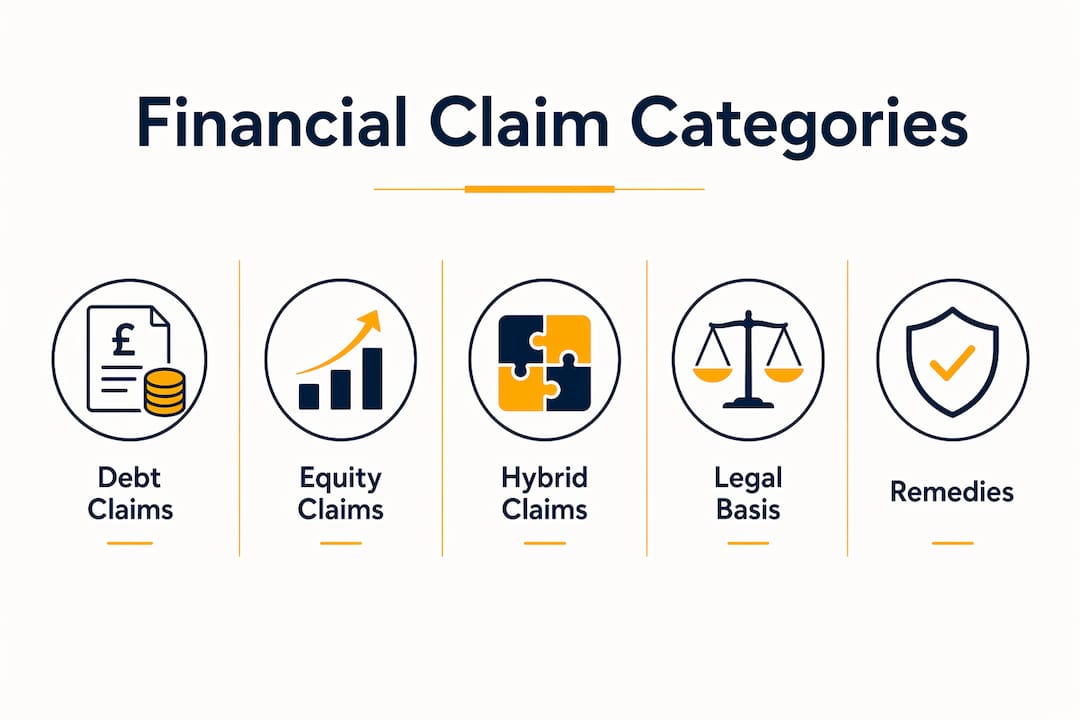
UK car finance disputes operate within a specific regulatory framework that maps broadly onto the three core claim categories, but with important distinctions shaped by the FCA and the Consumer Credit Act 1974.
The FCA’s motor finance redress scheme PS26/3 covers mis-selling claims for PCP and HP agreements where dealer commissions were inadequately disclosed. The scheme applies to agreements signed between 6 April 2007 and 1 November 2024. This date range is not arbitrary. It reflects the period during which discretionary commission arrangements were most prevalent and least transparent.
Within this scheme, commission arrangements fall into three categories: discretionary commission arrangements, high commission arrangements, and exclusivity ties. Each category carries specific eligibility criteria and determines the scope of any remedy. A claim under a discretionary commission arrangement, for example, typically supports a refund of the excess interest paid as a result of the inflated rate.
Here is how the main regulated claim categories compare:
| Claim category | Product type | Legal basis | Typical remedy |
|---|---|---|---|
| Discretionary commission mis-selling | PCP, HP | FCA CONC, PS26/3 | Interest refund, contract variation |
| Unfair lending relationship | PCP, HP | Consumer Credit Act 1974, s.140A | Debt reduction, contract variation |
| Affordability failure | PCP, HP | FCA CONC 5 rules | Compensation, debt write-off |
| Excluded products | PCH, lease | Not covered by PS26/3 | No FCA scheme remedy |
The exclusion of Personal Contract Hire (PCH) and standard leases from the FCA scheme is significant. These products do not create a credit relationship in the same legal sense, so they fall outside the debt claim framework that underpins the redress scheme. If your agreement is a lease, your claim category and your legal options are materially different.
To identify your claim category correctly, work through these steps:
The legal architecture behind car finance claim categories rests on two pillars: the Consumer Credit Act 1974 and the FCA’s CONC (Consumer Credit sourcebook) rules. Together, these frameworks define what constitutes an unfair relationship, what disclosure obligations lenders and brokers carry, and what courts can order as a remedy.
Sections 140A to 140D of the Consumer Credit Act 1974 give courts the power to reopen credit agreements where the relationship between lender and borrower is unfair. This is the legal basis for claims involving undisclosed commissions, excessive interest rates, and inadequate affordability checks. Courts can grant remedies including refunds, interest reductions, and outright contract variations.
The FCA’s CONC rules add a regulatory layer. CONC 4 governs pre-contractual disclosure, and CONC 5 covers responsible lending and affordability. A breach of either rule can form the basis of a regulated complaint, and understanding your claim category guides which evidence to prioritise: contract terms, commission disclosure schedules, or affordability assessment records.
Pro Tip: Request a Subject Access Request (SAR) from your lender under UK GDPR. This forces them to disclose all data held about you, including internal commission records and affordability notes, which are critical for claim evidence.
The remedy available to you depends directly on the claim category you establish. A mis-selling claim under the FCA scheme typically yields an interest refund. An unfair relationship claim under the Consumer Credit Act can go further, potentially removing debt or restructuring the entire agreement. Knowing which category applies means you can set realistic expectations and target the right outcome from the start. You can read more about how to claim compensation for car finance in the UK on the Makeapcpclaim blog.
The principle of claim categorisation extends across all financial disputes, from investment broker misconduct to banking complaints. The mechanics differ, but the underlying logic is identical: identify the misconduct type, map it to a legal theory, and build your evidence around that framework.
In broker disputes, claim categories depend on misconduct types such as unsuitable recommendations, misrepresentation, or unauthorised trading. Each misconduct type maps to a specific legal theory and determines the forum, the process, and the damages available. In the United States, FINRA arbitration handles the majority of investor-broker disputes, and the statement of claim must map misconduct type to specific losses and relief sought. Vague claims that fail to specify the misconduct category are routinely dismissed or result in reduced awards.
Financial litigation covers specific claim types including securities fraud, FINRA arbitration, and banking disputes, each governed by unique procedural rules and statutory deadlines. Missing a deadline because you misidentified your claim type is a recoverable error in some jurisdictions, but not in others. The cost of that mistake can be the entire claim.
| Dispute type | Claim category | Key evidence | Forum |
|---|---|---|---|
| Car finance mis-selling (UK) | Regulated debt, mis-selling | Commission records, contract terms | FCA scheme, Financial Ombudsman |
| Broker misconduct (US) | Securities fraud, unsuitable advice | Trade records, suitability assessments | FINRA arbitration |
| Banking dispute (UK) | Unfair relationship, mis-selling | Correspondence, product terms | Financial Ombudsman Service |
The comparison highlights a consistent pattern. Whether you are disputing a PCP agreement in Manchester or a brokerage account in New York, precise misconduct categorisation linked to documented losses is what separates a successful claim from an unsuccessful one. For UK car finance claimants, this means the FCA scheme and the Consumer Credit Act are your primary frameworks, and the claim category you establish at the outset shapes every subsequent decision. You can also explore financial compensation claims within the broader UK legal context for additional perspective on how categories affect outcomes.
Understanding your financial claim category is the foundation of any successful car finance complaint, because it determines your legal basis, your evidence requirements, and the remedy you can realistically pursue.
| Point | Details |
|---|---|
| Claim category defines your rights | Debt, equity, and hybrid categories each carry distinct legal rights and repayment priorities. |
| FCA PS26/3 covers PCP and HP only | The redress scheme applies to regulated agreements signed between April 2007 and November 2024, excluding leases and PCH. |
| Legal basis shapes the remedy | Consumer Credit Act sections 140A to 140D and FCA CONC rules determine whether you can claim a refund, debt reduction, or contract variation. |
| Evidence must match the claim type | Commission records, contract terms, and affordability documents are each relevant to specific claim categories, not all claims equally. |
| Categorisation applies universally | Whether in car finance or broker disputes, mapping misconduct to a precise claim category is the critical first step in any financial dispute. |
Most people approaching a car finance complaint focus on the financial loss first and the legal category second. That instinct is understandable, but it is backwards. The category determines the remedy, and the remedy determines whether the loss is recoverable at all.
I have seen cases where someone had a legitimate unfair relationship claim under the Consumer Credit Act but filed it as a general complaint about poor service. The outcome was a goodwill gesture of a few hundred pounds rather than a full interest refund worth several thousand. The facts were identical. The framing was not.
The other common error is assuming that any car finance agreement qualifies under the FCA scheme. PCH and lease agreements are excluded, and that exclusion is absolute. If your agreement is a lease, pursuing it through the PS26/3 route wastes time and creates false expectations. The correct approach is to confirm the product type before anything else, then identify the commission arrangement, and only then build the evidence file.
What I find most telling is how often the commission disclosure issue is buried in the small print of the original agreement. Lenders were not required to make it prominent, and many did not. That is precisely why the FCA intervened. If you signed a PCP or HP agreement before November 2024 and were never clearly told how your dealer was being paid, there is a strong probability your claim falls into a category that the redress scheme was designed to address.
The practical advice is simple: do not guess your claim category. Use a tool that identifies your agreement type and maps it to the correct legal framework before you invest time in building a case.
— Jake
If you are trying to work out whether your car finance agreement falls into a category covered by the FCA redress scheme, Makeapcpclaim removes the guesswork entirely.

The site locates your car finance agreements for free in under 60 seconds, identifying whether your PCP or HP agreement falls within the regulated window and whether the commission arrangements suggest a viable mis-selling claim. There is no fee to check, no obligation to proceed, and no paperwork required at the initial stage. Makeapcpclaim covers all regulated car finance claim categories, from discretionary commission arrangements to unfair lending relationships under the Consumer Credit Act 1974. If you want to know where you stand, start your free check at Makeapcpclaim today.
A financial claim category classifies the type of legal right you hold in a financial relationship, such as a debt claim, equity claim, or a specific regulated complaint type like mis-selling. It determines what remedies you can pursue and what evidence you need.
The FCA PS26/3 scheme covers PCP and HP agreements signed between 6 April 2007 and 1 November 2024 where dealer commissions were inadequately disclosed. Personal Contract Hire and standard lease agreements are excluded from the scheme.
Confirm the product type (PCP or HP), check the agreement date, and identify whether commission arrangements were disclosed at the point of sale. The legal basis will be either FCA CONC rules or Consumer Credit Act 1974 sections 140A to 140D, depending on the specific misconduct.
Mis-selling claims under the FCA scheme typically result in an interest refund. Unfair relationship claims under the Consumer Credit Act can lead to debt reduction or full contract variation, making the claim category the primary factor in determining the financial outcome.
You can submit a Subject Access Request to your lender to recover all data held about you, including the original agreement and commission records. Makeapcpclaim can also locate your agreements for free in under 60 seconds, removing the need to search your own records.