490,000+ drivers found their agreements with us
Millions of UK drivers signed car finance agreements believing the deal they got was fair. It wasn’t always. 44% of car finance agreements since 2007 may have been affected by undisclosed commissions, with average redress sitting around £700 per deal and total potential redress across the UK market exceeding £18 billion. If you took out a Personal Contract Purchase (PCP) or Hire Purchase (HP) agreement through a dealer, there’s a real chance you were overcharged without ever being told. This guide explains what happened, why it matters, and what you can do about it right now.
| Point | Details |
|---|---|
| Average payout | Most UK drivers reclaiming hidden commission receive around £700 per eligible car finance agreement. |
| Multiple claims possible | You can claim for each car finance agreement you had since 2007, which can add up to thousands. |
| Direct claims are best | Filing directly with the lender is free, fast, and avoids losing up to 40 percent to claims firms. |
| Eligibility is broad | Drivers with PCP or HP from a dealer (2007-2024) are often eligible, even if deals were settled or repossessed. |
| FCA scheme launching soon | A new redress system is planned for 2026 to make the claims process easier and more consistent. |
When you bought a car on finance through a dealership, the dealer didn’t just sell you a car. In many cases, they also arranged your loan and earned a commission from the lender for doing so. The problem is that most drivers had no idea this was happening.
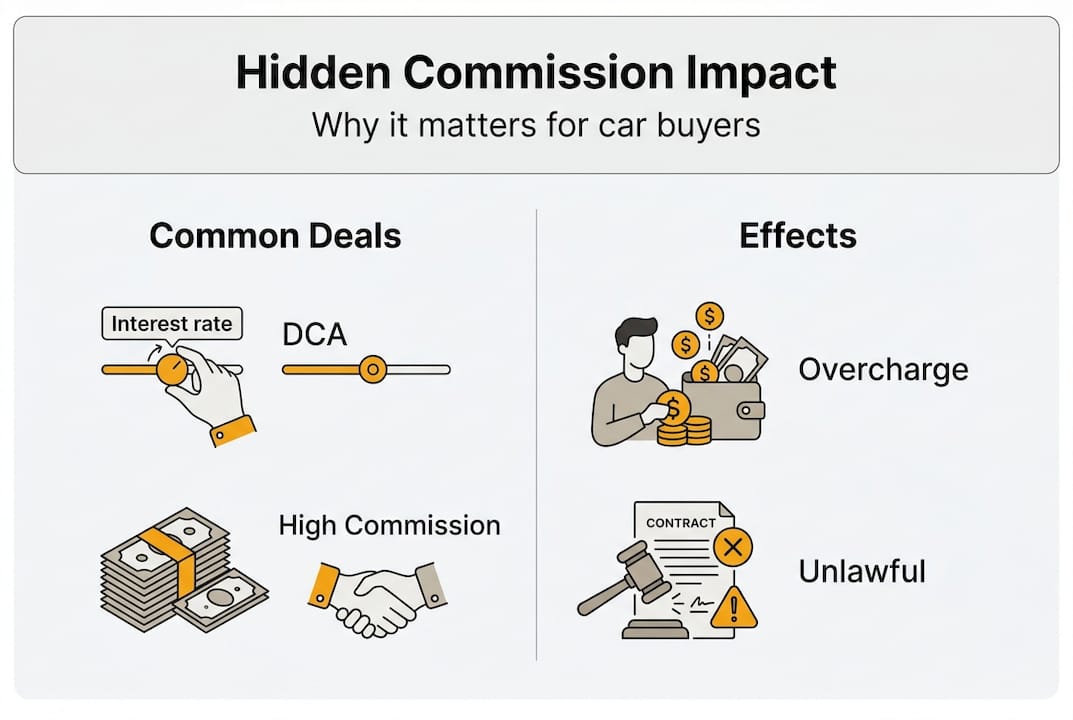
Three main arrangements caused the most harm. Discretionary Commission Arrangements (DCAs) let dealers set your interest rate within a range, meaning the higher they pushed your rate, the more commission they earned. High-commission deals paid dealers a fixed but undisclosed fee. Tied lender arrangements meant dealers were incentivised to steer you towards specific lenders regardless of whether that lender offered you the best deal.
| Arrangement type | Prevalence | Typical overcharge |
|---|---|---|
| Discretionary Commission Arrangement (DCA) | Very common pre-2021 | £250 to £1,100+ |
| High-commission fixed deal | Common | £150 to £600 |
| Tied lender arrangement | Moderate | £100 to £400 |
Many agreements contained vague phrases such as “a commission may be paid” buried in the small print. That single line was often the only disclosure drivers received, and it told you nothing about how much was being paid or how it affected your rate.
The FCA found that these hidden commissions arose from DCAs, high-commission deals, and tied arrangements, leading to inflated costs for millions of drivers across the UK. On a typical £10,000 loan, the overcharge could reach £1,100 or more.
Knowing how hidden commissions worked is one thing. Understanding what’s at stake if you act, or if you don’t, is another matter entirely.

The financial case is straightforward. The average redress per deal is around £700, and many drivers had two, three, or even more finance agreements between 2007 and 2024. Those amounts stack up quickly. Beyond the money, there’s a fairness argument. You were charged more than you should have been, without your knowledge or consent, so that a dealer could earn a larger cut.
Here’s who is likely eligible to claim:
The FCA review and Supreme Court decision confirmed that many of these non-disclosures were unlawful, with cumulative claims potentially reaching £18 billion across the UK market. If you had multiple agreements, each one is a separate potential claim.
Pro Tip: Before approaching a claims management company (CMC), check whether you can submit your complaint directly to your lender. It’s free, and you keep every penny of any redress you receive.
For further guidance, checking your agreements before you submit a claim can help you identify exactly what to look for.
Eligibility isn’t complicated, but the details matter. Here’s a clear breakdown of what qualifies and what doesn’t.
| Finance type | Eligible? | Notes |
|---|---|---|
| Personal Contract Purchase (PCP) | Yes | Main focus of FCA review |
| Hire Purchase (HP) | Yes | Included in scheme |
| Personal Contract Hire (PCH) | No | Leasing excluded |
| Direct bank loan | No | Must be via dealer |
| Lease agreements | No | Not covered |
Importantly, you can still claim even if your agreement has already been settled, if the car was repossessed, or if it was a used vehicle. The key factor is whether a hidden commission was paid.
Here’s how lenders typically calculate redress once a claim is assessed:
The FCA confirmed that eligible agreements cover PCP and HP deals arranged via a dealer between 2007 and November 2024, with average overcharges of around £1,100 on a £10,000 loan. For more on eligibility criteria, the FCA’s diagnostic report sets out the full picture.
Pro Tip: If you had more than one PCP or HP agreement since 2007, submit a separate claim for each one. The redress from multiple agreements can add up to several thousand pounds in total.
Exclusions to be aware of: leasing and PCH agreements are generally outside the scheme. Affordability complaints, where you argue the loan was unaffordable, are a separate type of claim and follow a different process.
Knowing you’re eligible is only half the battle. Here’s how to actually move forward.
One important point for 2026: the FCA has ordered a pause in the handling of most motor finance complaints until after 31 May 2026. This is to allow a coordinated mass redress scheme to be designed and launched. You can still submit your complaint now, and it will be processed once the pause lifts.
“90% or more of drivers were unaware that commissions were added to their car finance agreements.”
Common myths worth dismissing:
The FCA’s complaint process is clear that complaints go directly to the lender for free. CMCs typically charge 25 to 40% of any redress you receive, which on a £700 payout means losing up to £280 unnecessarily.
Not every voice in this debate agrees that all claims are straightforward or that broad compensation is the right outcome. It’s worth understanding both sides.
Consumer advocates and legal experts broadly agree on several points:
The industry perspective is more cautious. Some lenders and dealer groups argue that commissions funded dealer services and that not every arrangement was inherently unfair. They warn that overly broad compensation could raise future borrowing costs for all consumers.
“Not all hidden commission is unlawful, but new rules target unfair practices that caused real harm to consumers.”
The FCA is walking a careful line. Its goal is to deliver meaningful redress to affected drivers while avoiding outcomes that destabilise the motor finance market or make car loans significantly more expensive going forward. Consumer groups estimate that hidden commissions cost UK drivers over £300 million per year before the ban on DCAs came into force in 2021. That figure alone illustrates the scale of what was happening.
The nuance matters here. A claim that is well-evidenced and relates to a genuine DCA or undisclosed arrangement is on solid ground. Speculative or poorly documented claims are less likely to succeed and could slow down the process for everyone.
You now have a clear picture of what happened, why it matters, and how the process works. The next logical step is to find out whether you have a valid claim and, if so, to get it submitted before the FCA’s new redress scheme launches.
At Make a PCP Claim, we help UK drivers assess their eligibility quickly and without unnecessary complexity. Whether you had one agreement or several, our team can guide you through the process and help you understand what you could realistically reclaim. With billions in potential redress on the table and a clear legal framework now in place, there has never been a better time to check your position. Don’t leave money behind that is rightfully yours.
Most drivers can expect around £700 per deal on average, but Financial Ombudsman Service cases have seen awards of £1,300 to £1,900 plus interest, depending on the loan size and the terms of the arrangement.
Yes. If you had multiple PCP or HP deals since 2007 arranged via a dealer, you can submit a separate claim for each agreement, and the totals are cumulative.
No. You can complain directly to your lender for free and avoid CMC fees of 25 to 40% of any redress you receive.
Making a complaint or pursuing a reclaim has no impact on your credit score or your eligibility for future finance agreements.
Leasing and Personal Contract Hire agreements are typically excluded from the scheme, as are loans taken out directly with a bank rather than arranged through a dealer.