490,000+ drivers found their agreements with us

TL;DR:
- Consumers who financed cars between April 2007 and November 2024 may be owed compensation due to undisclosed commissions in their agreements.
- They should use free tools to identify their agreements, file complaints directly with lenders, and escalate if necessary.
You may be owed money. If you financed a car between 6 April 2007 and 1 November 2024, there is a real chance your agreement included a hidden commission arrangement that the lender never properly disclosed. The FCA estimates that around 37% of motor finance agreements from that period, roughly 12.1 million, may be eligible for redress. That is not a small number. The Financial Ombudsman Service (FOS) handles escalations when lenders refuse to pay, and the August 2025 Supreme Court ruling has sharpened the legal boundary between valid and invalid commission claims. Here is what to do right now:
Pro Tip: Complaining to your lender yourself, rather than waiting for the FCA scheme to contact you, often results in faster inclusion and payment. MoneySavingExpert recommends this approach for exactly that reason.
The scope is broader than many people assume. The FCA redress scheme covers consumer motor finance agreements, not just personal contract purchase (PCP) deals. Hire purchase (HP) agreements are also included, as are other forms of consumer vehicle finance taken out within the qualifying date range.
| Agreement type | In scope? | Notes |
|---|---|---|
| Personal Contract Purchase (PCP) | Yes | Most commonly affected by discretionary commission |
| Hire Purchase (HP) | Yes | Included in FCA scheme |
| Other consumer motor finance | Yes | Assessed case by case |
| Personal Contract Hire (PCH / leasing) | No | You never owned the vehicle |
| Business finance agreements | No | Scheme covers consumer agreements only |
| Agreements already decided by FOS | No | Cannot reopen a settled matter |
| Claims where compensation was accepted | No | Acceptance closes the claim |
PCH, or personal contract hire, is a lease arrangement where you return the car at the end. Because you never own or finance the purchase of the vehicle, it falls outside the scheme. Business loans are also excluded: the protections here are for consumers, not commercial borrowers.
The FCA estimates around 37% of motor finance agreements entered between 6 April 2007 and 1 November 2024 may be eligible for redress, covering approximately 12.1 million agreements.
FCA, Car Finance Claims
The date range matters. An agreement signed on 5 April 2007 falls outside the window. One signed on 1 November 2024 is the last day included. Agreements after that date are not covered by the current scheme.
Use this to decide whether your agreement is likely in scope before spending time on paperwork:
If you answered yes to all four, your agreement is likely worth checking further.
The core issue is commission. When you arranged finance through a car dealer, the dealer typically acted as a credit broker, introducing you to a lender. What most consumers were never told is that the dealer often received a commission from the lender, and in many cases that commission was directly tied to the interest rate you were charged.
A discretionary commission arrangement (DCA) allowed the dealer to set your interest rate within a range, and the higher they set it, the more commission they earned. You paid more; they earned more. The lender knew this was happening. You did not. The FCA banned DCAs in January 2021 precisely because of this conflict of interest, but the agreements signed before that ban remain in scope for redress.
Beyond DCAs, some lenders used what are called “high commission arrangements” or contractual ties that linked dealer pay to the rate you received. The effect was the same: an undisclosed financial incentive that influenced the cost of your credit.
The August 2025 Supreme Court ruling clarified that some commission disclosure arrangements are unlawful, while others are not. Whether a specific claim succeeds depends on the individual facts of that agreement, including what was disclosed and how the commission was structured.
SRA, Motor Finance Commission Compensation Claims
The Solicitors Regulation Authority’s guidance on the ruling is clear: this is not a blanket win for all claimants. Each case turns on its own evidence. That said, the ruling did establish a firmer legal foundation for claims where commission was genuinely hidden from the consumer.
Say you financed a £15,000 car on a PCP agreement in 2018. The dealer offered you a rate of 9.9% APR. Unknown to you, the lender’s minimum rate was 6%, and the dealer chose 9.9% because it maximised their commission. Over four years, that difference in rate could add hundreds of pounds to your total repayment. The lender received the extra interest; the dealer received a higher commission; you received no explanation of either. That is the scenario the FCA scheme is designed to address.
Finding your agreements is the first practical step, and it is easier than most people expect. Many consumers have forgotten the name of their lender, lost their paperwork, or financed multiple vehicles over the years.
Pro Tip: Lenders typically retain finance records for around six to seven years after an agreement ends. For agreements from 2007 to 2012, the lender may no longer hold full paperwork. Gather whatever supporting details you can, including bank statements and any correspondence, before you complain.
Once you have identified an agreement, pull together the following before submitting a complaint:
Even partial records help. The lender is obliged to hold information about the agreement itself, and the FCA scheme accounts for cases where consumers cannot produce full documentation.
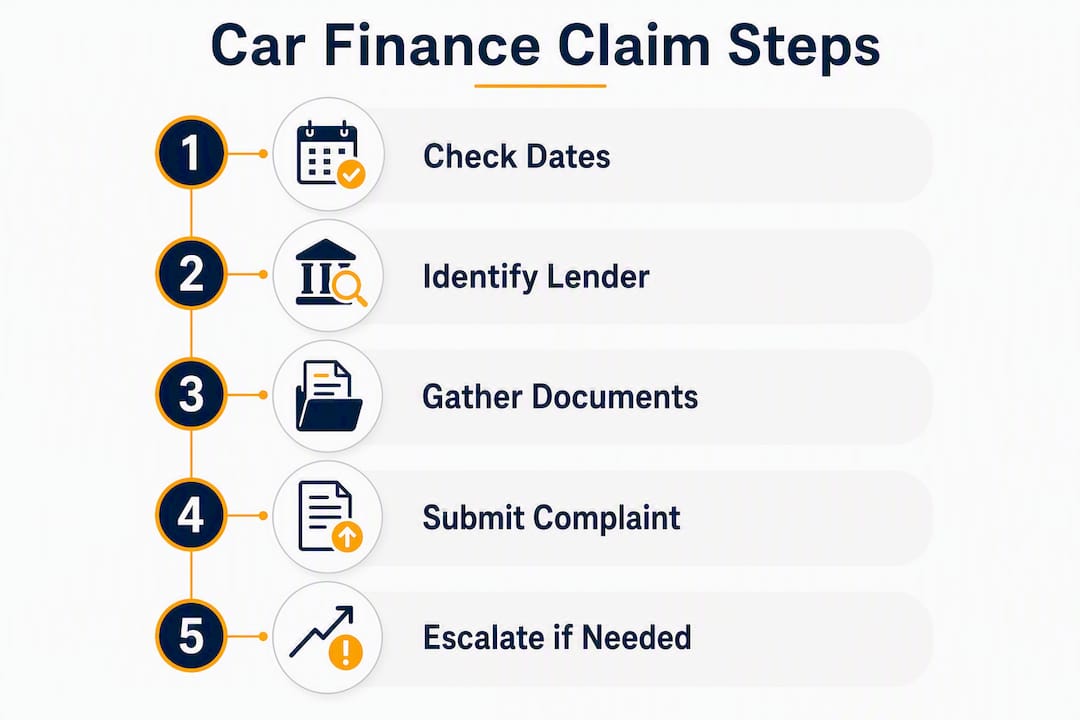
The complaint process has a defined structure. Following it correctly keeps your options open and starts the formal clock on the lender’s response obligations.
Step 1: Identify your lender. Use the agreement finder or your credit report to confirm the lender’s name and contact details. Most major lenders have a dedicated complaints team and a postal or online complaints address.

Step 2: Write a formal complaint. Your complaint should include your full name, address, agreement number (if known), the vehicle details, the approximate date of the agreement, and a clear statement that you believe your agreement included an undisclosed commission arrangement. You do not need to prove the commission existed at this stage; you are asking the lender to investigate.
Step 3: Send the complaint in writing. Email or recorded post both create a paper trail. Keep a copy of everything you send.
Step 4: Wait for the lender’s response. Under the FCA redress scheme, lenders are required to acknowledge complaints and work through the scheme’s process. The scheme sets out a one-month window in which consumers can accept or challenge a lender’s redress offer once it is made.
Citizens Advice confirms there is no charge to use the FCA compensation scheme. Consumers can complain directly to their lender at no cost, and the Financial Ombudsman Service is also free to use.
Step 5: Escalate to the Financial Ombudsman Service. If your lender rejects your complaint, or does not respond within the required timeframe, you can refer the matter to the FOS. The FOS is independent, free to use, and its decisions are binding on lenders.
Parts of the FCA redress scheme have been legally challenged and some elements are currently paused pending court hearings. This means that while lenders are still required to acknowledge and process complaints, actual payment of redress may be delayed until the legal challenge is resolved. The FCA has confirmed that consumers who have complained will be included in the scheme once it proceeds. Complaining now still protects your position.
The FCA expects firms to try to contact eligible consumers, but consumers who complain themselves are often processed faster. Submitting your own complaint is a sound tactical move regardless of the scheme’s current status.
MoneySavingExpert
Compensation amounts vary considerably depending on the size of the original loan, the interest rate applied, the length of the agreement, and which calculation method the lender uses.
The FCA allows lenders to use different methods, some involving discounts to estimated overpaid interest and others based on commission amounts or total cost comparisons. Interest is added to any redress figure at a rate linked to the Bank of England base rate with a minimum floor, accruing from the date of the original agreement, which can increase final payouts for older agreements.
The FCA estimates average compensation of around £830 per agreement, but that figure covers a wide range. A short agreement on a modest car might produce a few hundred pounds. A longer PCP on a higher-value vehicle, with a significant rate differential, could produce considerably more.
Under normal scheme operation, the process from complaint submission to payment would typically take several months. The current legal challenge has introduced uncertainty. Once the courts resolve the outstanding issues, the FCA expects lenders to move through the redress process. Consumers who have already complained will not need to resubmit. Those who have not yet complained should do so now to secure their place in the queue.

If your lender has gone into administration or been dissolved, the position is more complicated. You can still register as a creditor, but any recovery may be a small distribution from the administrator rather than a full redress payment.
There are three realistic routes to pursuing a car finance claim, and the right one depends on how much time you have, how comfortable you are with paperwork, and how much of any payout you want to keep.
Complaining directly to your lender costs nothing. The FCA scheme is free, the FOS is free, and Citizens Advice confirms there is no charge to participate. You keep 100% of any compensation. The process requires a written complaint, some basic documentation, and patience while the scheme works through its backlog. For most straightforward cases, this is the most financially sensible route.
The FCA and consumer bodies warn that using a claims management company can cost a significant portion of any compensation, often up to 30% or more of the final payout.
FCA, Car Finance Claims
A CMC handles the complaint process on your behalf, typically on a no-win, no-fee basis. The trade-off is a success fee, which can reach 30% or more of your compensation. On an average payout of around £830, that is over £249 gone before you see a penny. CMCs are regulated by the Financial Conduct Authority, but regulation does not cap their fees at a level that always favours the consumer. They are most useful when you genuinely cannot manage the process yourself.
A regulated solicitor, overseen by the Solicitors Regulation Authority (SRA), can handle more complex cases, particularly where the lender disputes liability or the claim involves a larger sum. Solicitors typically charge on a no-win, no-fee basis for these claims, with success fees subject to SRA conduct rules. For straightforward cases, the cost may not be justified. For contested or high-value claims, legal representation can make a real difference to the outcome.
Pro Tip: Check the FCA register to confirm any claims management company is authorised before sharing personal information or signing anything.
Makeapcpclaim’s agreement finder is built for speed and simplicity. You do not need your car registration number, your lender’s name, or any paperwork to hand. Enter your basic personal details, and the finder searches for your car finance agreements in under 60 seconds, returning the lender name, agreement dates, and agreement type.
The referral model is straightforward: Makeapcpclaim earns a fee from partner law firms for eligible referrals. You, as the consumer, do not pay Makeapcpclaim directly. The partner law firms are regulated and handle the legal process from that point.
Pro Tip: Never share your full banking login credentials with any third party claiming to check your finance agreements. A legitimate agreement finder needs your personal details, not access to your bank account.
Makeapcpclaim does not require access to your online banking. The finder uses identity-based matching, not financial account access. If you are ever asked for banking passwords or full account login details by any service claiming to find your agreements, treat that as a red flag and do not proceed.
The scale of the car finance mis-selling issue has attracted fraudsters. Knowing the warning signs protects both your money and your personal data.
Before sharing any personal information with a claims management company, check the FCA register to confirm it is authorised. For solicitors, the SRA’s online register confirms whether a firm is regulated. Ask for written terms, including the exact fee percentage, what happens if you cancel, and how your data will be used. Any legitimate firm will provide this without hesitation.
If you have already signed up with a firm and want to cancel, check your agreement for the cooling-off period. Under FCA rules, regulated CMCs must provide a 14-day cooling-off period.
Most UK consumers who financed a vehicle between 6 April 2007 and 1 November 2024 should check their agreements now, because the FCA estimates around 37% may be eligible for redress averaging approximately £830 per agreement.
| Point | Details |
|---|---|
| Who is likely eligible | Consumers with PCP or HP agreements signed between 6 April 2007 and 1 November 2024 where commission was undisclosed. |
| Fastest first step | Use Makeapcpclaim’s free agreement finder to identify lenders and agreement dates in under 60 seconds. |
| Average compensation | The FCA estimates approximately £830 per agreement, though amounts vary widely by case. |
| Legal context | The August 2025 Supreme Court ruling confirmed some commission claims are valid; each case turns on its own facts per SRA guidance. |
| Makeapcpclaim’s role | Makeapcpclaim finds your agreements for free and can refer eligible cases to regulated partner law firms at no direct cost to you. |
The conventional wisdom around mis-selling claims is to wait and see: let the regulator sort it out, let the lenders come to you. That approach has a real cost here. The FCA has said it expects firms to contact eligible consumers, but the scheme’s legal challenges mean the timeline for proactive outreach is genuinely uncertain. Consumers who have submitted a formal complaint are already in the queue. Those who have not are waiting for a letter that may take considerably longer to arrive.
There is also a subtler point about documentation. Lenders retain finance records for roughly six to seven years after an agreement ends. For agreements from 2007 to 2012, some lenders may no longer hold full records. The consumer who acts now, gathers their own supporting documents, and submits a formal complaint is in a stronger position than one who waits and finds the paper trail has thinned.
The fee question is where I think many people get tripped up. The instinct to use a claims firm because it feels easier is understandable, but on an average payout of around £830, a substantial success fee leaves you with significantly less. The DIY route, or a referral through a service like Makeapcpclaim where you do not pay the finder directly, preserves considerably more of that money. The process is not complicated. A written complaint to your lender, a copy kept for your records, and a willingness to escalate to the FOS if needed. That is genuinely all it takes for most cases.
The Supreme Court ruling matters, but not in the way some headlines suggested. It did not open the door to automatic payouts for every financed car. It clarified the legal boundary. Some claims are strong; others are not. The strength of yours depends on the specific commission arrangement in your agreement, what was disclosed, and how the lender structured the deal. That is exactly why finding your agreement details first is the right starting point, before anyone can tell you whether you have a case worth pursuing.
Finding out whether you have a valid car finance claim does not require a solicitor, a stack of paperwork, or an hour of your time. Makeapcpclaim’s free agreement finder does the heavy lifting: enter your basic details and it returns your lender names, agreement dates, and agreement types in under 60 seconds. No car registration number needed. No lender paperwork required upfront.

The service is free because Makeapcpclaim earns a referral fee from regulated partner law firms, not from you. If your agreements are identified and you choose to proceed, you are referred to a partner law firm that handles the legal claim from complaint through to resolution. Your personal data is used only to locate your agreements; you are never asked for banking login credentials or passwords.
To get started, check your car finance agreements now. The whole process takes under a minute, and knowing whether you have a potential claim costs you nothing.
This article provides general information about the FCA car finance redress scheme and is not legal or financial advice. For guidance specific to your situation, consult a regulated solicitor or check the official FCA and Citizens Advice pages.
The following official and authoritative sources were used in preparing this article. Check them directly for the most current information, particularly regarding the FCA scheme’s legal challenge timetable.
For an immediate practical step, use Makeapcpclaim’s free agreement finder to identify your agreements before reviewing the official guidance above. Knowing which lenders and agreements are in your name makes every subsequent step, whether you proceed yourself or with legal help, considerably more straightforward.