490,000+ drivers found their agreements with us

If you took out a PCP or hire purchase agreement between 2007 and 2024, there is a strong chance you are owed a broker fee refund. The FCA’s PS26/3 redress scheme covers roughly 12.1 million agreements and projects £7.5 billion in total compensation, with an average payout of around £829 per agreement. The single most important thing you can do right now is complain formally to your lender in writing. That complaint locks in your place before the 31 August 2027 longstop deadline. If you cannot find your paperwork, Makeapcpclaim locates your car finance agreements for free in under 60 seconds, with no registration number or lender documents required.
Your 48-hour checklist:
The FCA confirms that regulated consumer PCP and hire purchase agreements signed between 6 April 2007 and 1 November 2024 are in scope. Personal contract hire (PCH, or leasing) and most business finance contracts are excluded.
Three categories of mis-selling can make you eligible:
A few edge cases trip people up. Agreements where the commission fell below certain small thresholds before or after April 2014 may be excluded. Zero-interest promotional deals and manufacturer-branded captive finance where the arrangement was clearly visible can also fall outside the scheme. If the lender can demonstrate you suffered no financial loss, your claim may not succeed, though the FCA’s redress formula is designed to estimate loss at a population level rather than requiring you to prove it individually.
A discretionary commission arrangement worked like this: the broker (usually a car dealer) had a band of interest rates they could offer you. The higher the rate they chose, the more commission the lender paid them. You had no idea this was happening. The FCA’s March 2026 diagnostic report found that many brokers told customers only that commission “may” be payable, which falls well short of meaningful disclosure. Telling someone a fee might exist is not the same as telling them the broker had a direct financial incentive to charge them more.
The FCA’s economic analysis found a positive association between higher broker commission and greater total cost of credit, supporting the scheme’s design to return overpaid amounts to consumers.
The FCA banned DCAs in January 2021, but that ban is not retrospective. Agreements signed before that date are precisely what the redress scheme addresses. Court of Appeal and Supreme Court guidance on unfair relationships under the Consumer Credit Act 1974 has reinforced the regulator’s position: a lender who benefits from an undisclosed commission arrangement may have created an unfair relationship with the borrower, regardless of whether the broker acted dishonestly.
The economic harm is straightforward. If your broker nudged your rate up by even one percentage point over a four-year PCP, the extra interest you paid could easily exceed the average £829 payout figure. The scheme’s redress formula is designed to return that overpayment.

Complaining directly to your lender is free, legally protected, and the fastest route to getting your claim registered. The FCA advises that lodging a complaint is the most reliable way to ensure you are formally registered for later redress, even while parts of the scheme remain legally challenged.
The scheme is currently subject to a legal challenge, so lenders are not required to calculate or pay compensation immediately, but your complaint still matters. Lenders are expected to contact eligible customers by early 2027. The deadline for submitting a complaint if you have not been contacted is by late summer 2027.
Most people do not have their original agreement to hand, and that is fine. MoneySavingExpert’s reclaim guide recommends checking your credit file first, since Experian, TransUnion, and Equifax typically hold records of credit agreements. If the lender’s name appears there, you can submit a Subject Access Request (SAR) to obtain your full account history.
Evidence checklist:
Compensation under PS26/3 uses discount percentages to estimate overpaid interest, differentiated by agreement date ranges. The average estimated payout across qualifying agreements is in the hundreds of pounds range, though individual amounts vary significantly depending on the agreement value, term, and interest rate applied.
If a claims management company (CMC) or law firm is acting for you, check your contract carefully. CMC fees may be a significant portion of any compensation awarded. Law firms operating on a no-win, no-fee basis may charge fees for work already done if you end the agreement.
Never share your bank account details with a CMC or law firm until you have received a written offer from your lender and confirmed the firm’s fee deduction in writing.
The SRA’s guidance on motor finance claims is clear that consumers have the right to understand exactly what they will be charged and when. If a firm tells you your claim no longer exists due to a change in case law, ask for that in writing and seek a second opinion before accepting it.
Pro Tip: Before signing with any CMC, ask them to confirm in writing: their exact fee percentage, what triggers a fee, and what happens to your claim if you change your mind after the cooling-off period.
The right route depends on your case complexity and how much of the process you want to manage yourself.
For most people, the sensible default is: complain directly to your lender first (it costs nothing and protects your place). If the lender rejects your complaint or the case is complex, a regulated solicitor adds real value. If you want to locate your agreement quickly and get a no-obligation eligibility check before deciding, Makeapcpclaim is the fastest starting point.
Understanding the difference between regulated legal representatives and non-attorney options matters when choosing who handles your claim, since consumer protections differ significantly between regulated solicitors and unregulated representatives.
Makeapcpclaim does not charge you directly. Partner law firms operate under agreed fee terms, which are disclosed before you commit to anything. Your data is handled securely and the referral is entirely without obligation.
Pro Tip: Even if you think your agreement was too old or too small to matter, run the free check. Agreements from 2007 are in scope, and the scheme’s formula often produces larger figures than people expect for longer-term HP deals.
Use this as a starting point. Adapt the bracketed fields and send by email with a read receipt or by recorded post.
Dear [Lender Name] Complaints Team,
I am writing to make a formal complaint regarding a motor finance agreement I held with you. My details are as follows: [Full Name], [Address], [Date of Birth], [Account Reference if known], [Vehicle Registration if known], [Approximate Agreement Start and End Dates].
I believe that when this agreement was arranged, the broker or dealer received a commission from you that was not disclosed to me. I further believe this commission may have been discretionary, meaning the broker had the ability to set or influence my interest rate in a way that increased their commission at my expense.
I am requesting that you investigate this complaint under the FCA’s motor finance redress scheme (PS26/3) and provide a full response within eight weeks. Please confirm receipt of this complaint in writing.
Yours sincerely, [Your Name]
Keep a copy of this letter and note the date you sent it.
The Financial Ombudsman Service can award compensation, interest, and remedies for distress where it finds you were treated unfairly. If the FOS rules against you or takes longer than expected, you have further options.
If the FOS decision is unfavourable:
If the FOS is delayed:
A few things that catch people out, worth stating plainly.
Never share your bank account details with any firm until you have a written, confirmed offer from your lender and you have verified the firm’s fee deduction in writing. Legitimate law firms and CMCs do not need your account number to submit a complaint on your behalf.
Complaining directly to your lender costs nothing and produces the same gross outcome. The Citizens Advice guidance on car finance claims is explicit: you do not need a CMC to make this claim.
Watch for unsolicited contact from firms claiming to know you have a claim. No firm can know this without checking your specific agreement details. If someone contacts you out of the blue, verify their FCA or SRA registration before engaging.
The honest answer is: longer than most people expect, and the current legal challenge has extended timelines further.
A typical sequence under normal scheme conditions would run: complaint submitted, lender acknowledges within a few days, lender issues a final response within eight weeks, you accept the offer, payment follows within 28 days of acceptance. That is a best-case scenario of roughly three to four months.
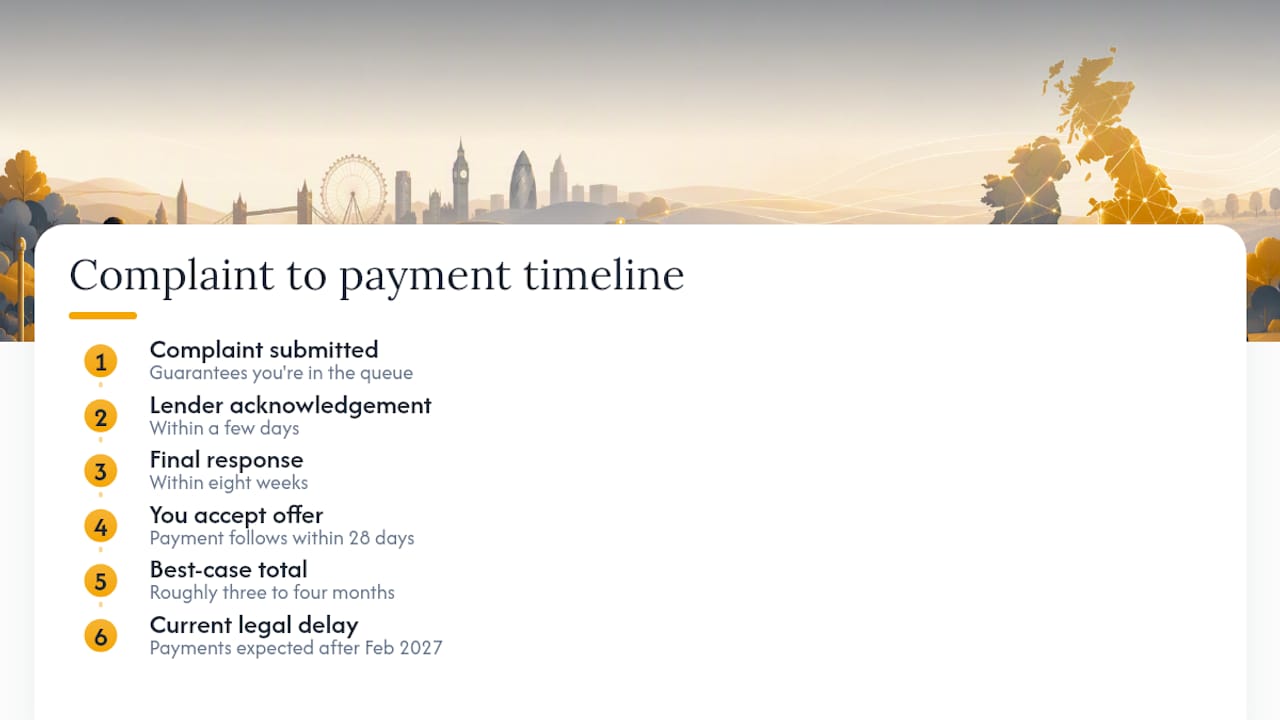
Under the current position, lenders are not required to calculate or pay redress while parts of the scheme face legal challenge. The FCA expects lenders to contact eligible customers by February 2027, with payments following after that. Realistically, most claimants should plan for resolution in 2027 or later. Submitting your complaint now does not speed up the legal process, but it does guarantee you are in the queue.
Complaining directly to your lender is free. Escalating to the Financial Ombudsman Service is also free for consumers. There are no upfront charges in either route.
Law firms operating on a no-win, no-fee basis work similarly, though their fee percentage may differ. Some firms charge a fixed fee for drafting and submitting the complaint; this must be disclosed before you sign anything.
Makeapcpclaim’s agreement finder costs you nothing. If you proceed to a referral, the partner law firm’s fees are disclosed before you commit. No money changes hands between you and Makeapcpclaim at any point.
There are no court filing fees for FOS escalation. If you pursue a claim through the courts independently (rare, and usually only for very high-value or complex cases), small claims track fees apply for amounts under £10,000; above that, county court fees scale with the claim value.
The claimants who fare best are the ones who act early and keep records. Time and again, the people who struggle are those who waited for a letter from their lender that never came, or who signed with a CMC before checking whether they could simply complain direct. The scheme is designed to be accessible without representation. For most straightforward PCP or HP agreements, a well-worded complaint letter and a bit of patience is genuinely all it takes.
That said, if your agreement is complex, involves multiple vehicles, or your lender has already rejected a complaint, getting a regulated solicitor involved makes sense. The car finance compensation guide on the Makeapcpclaim site walks through the full process in detail. Use the free finder to locate your agreement first, then decide whether you want to proceed alone or with support.
Makeapcpclaim gives you the fastest way to find out whether you have a qualifying agreement, without needing a single piece of paperwork upfront. The free 60-second agreement finder at Makeapcpclaim identifies your car finance agreements using your basic personal details alone.

No registration number. No lender name. No documents. If the check finds a qualifying agreement and you choose to proceed, Makeapcpclaim passes your details to a regulated partner law firm who handles everything from the formal complaint to any FOS escalation. You are never charged directly by Makeapcpclaim. Partner firms disclose their fees before you commit to anything. Start the free check now at Makeapcpclaim and get your eligibility indication in under a minute.
Most people with a PCP or HP agreement signed between 2007 and 2024 have a realistic claim for a broker fee refund, and complaining to your lender now is the single most important step to protect it before the 31 August 2027 deadline.
| Point | Details |
|---|---|
| Complain to your lender now | A formal written complaint registers your place in the scheme before the 31 August 2027 longstop. |
| Average payout is around £829 | The FCA’s PS26/3 scheme covers ~12.1 million agreements; individual amounts vary by agreement value and term. |
| Direct complaints are free | Complaining to your lender and escalating to the Financial Ombudsman Service costs you nothing. |
| Locate agreements in 60 seconds | Makeapcpclaim’s free finder identifies your agreements without paperwork, registration numbers, or lender details. |
| CMC fees reduce your net payout | Fees of 25–36% are common; complaining direct first preserves your full award. |
Keep copies of all correspondence. Use lender contact details from their official websites only, never from unsolicited emails or letters.
This article provides general information about the FCA motor finance redress scheme and is not legal or financial advice. Confirm your specific position with the FCA, Financial Ombudsman Service, or a regulated solicitor.
This article is general information, not a substitute for advice from a qualified financial advisor. Consult a qualified financial professional about your own circumstances before acting on anything here.