490,000+ drivers found their agreements with us

Yes, you can make a car finance claim without lender-appointed help or a claims firm doing it for you. The FCA’s redress scheme is free to join, and you send your complaint straight to the lender yourself. Eligibility depends on your specific agreement (dates, commission type, and how it was arranged), so check the basics before you start.
Three things to do today:
Pro Tip: Claims firms can take up to 36% of your payout in fees, including VAT. The scheme itself costs nothing to enter.
Most car finance claims can be filed directly with the lender at no cost, and doing so keeps the full payout rather than losing up to 36% to a claims firm.
| Point | Details |
|---|---|
| DIY is genuinely viable | The FCA scheme is free to enter and complaints go straight to your lender, no firm required. |
| Eligibility window matters | Agreements between 6 April 2007 and 1 November 2024 fall under the scheme; check your dates first. |
| Supreme Court adds nuance | The August 2025 ruling means outcomes depend on your agreement’s specific facts, not a blanket rule. |
| Timeline is fixed | Lenders get 3 months for a provisional decision, then 1 month to pay once you accept. |
| Makeapcpclaim speeds up step one | Its free finder locates likely agreements in under 60 seconds with no registration or paperwork needed. |
The FCA’s redress scheme covers motor finance agreements taken out between 6 April 2007 and 1 November 2024, and it applies mainly to PCP and HP deals arranged through a car dealer or broker. If your agreement falls inside that window, you’re already past the first hurdle.
What the scheme actually examines:
Here’s the catch most guides skip: the Supreme Court’s ruling in August 2025 means entitlement depends on the specific facts of your agreement. Some commission structures turned out to be lawful. Not every DCA case will succeed, and no amount of paperwork changes that if the underlying arrangement wasn’t unfair. That’s not a reason to skip claiming. It’s a reason to be realistic about the outcome.
Plenty of people can’t remember who financed their car five, ten, or fifteen years ago. That’s normal, and it’s fixable.
One limitation worth flagging early: credit files typically retain records for several years, so very old agreements may not show up at all. If that’s you, the dealer and your bank statements become your best routes.
Pro Tip: Don’t wait until you’ve found every document before contacting the lender. A bank statement showing payments and a rough agreement date is often enough to get a complaint moving.
Filing a car finance claim without lender-side assistance is more straightforward than most people expect. Here’s the sequence.
What happens next follows a fixed timeline once the lender receives your claim:
The Ombudsman is free to use and doesn’t require legal representation. Most people manage the whole process, from first email to Ombudsman referral if needed, without ever paying a fee.
Living outside the UK doesn’t stop you claiming. The agreement was made under UK law, tied to a UK finance company, and that’s what determines eligibility, not your current address.
Practical points for claimants abroad:
This is the decision most guides gloss over. A claims management company can take up to 36% of your compensation once VAT is included. On a £2,000 payout, that’s over £700 gone before it reaches your account, for work you can largely do yourself with a free template.
Paid help earns its cost in narrower situations:
If you do go down the paid route, vet the firm properly first:
For most straightforward DCA claims, the maths favours doing it yourself.
Most people abandon a claim at the very first step: they simply can’t remember who financed the car, or they’ve lost the paperwork entirely. That’s the exact problem Makeapcpclaim’s free agreement finder solves.
The tool locates likely finance agreements without needing your car registration or any original paperwork, and it takes under 60 seconds to run. You don’t need a document trail to find out whether you had a qualifying agreement.
The biggest barrier to claiming isn’t eligibility. It’s not knowing where to start looking. Removing that barrier is what actually gets people to submit a claim rather than give up at step one.
If you’d rather handle the whole complaint yourself using the steps above, that’s genuinely the route that keeps the most money in your pocket. But if you’d prefer a hands-off option once your agreement is found:
The conventional advice on this topic leans too hard towards caution. Plenty of coverage treats car finance claims as legally complicated territory that needs a professional, when for most straightforward DCA cases, it genuinely isn’t. The FCA built the scheme to be usable without representation, and free tools now do most of the heavy lifting that used to justify paying someone else.
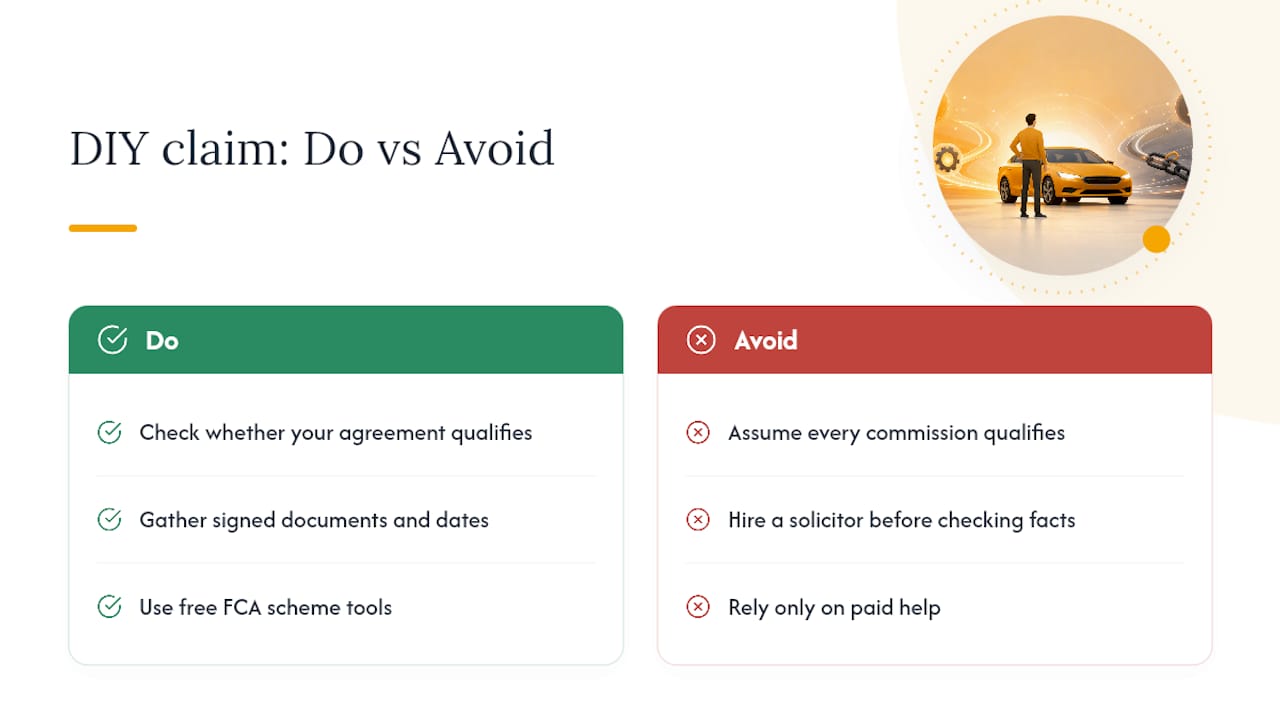
Where the advice falls short is in downplaying the Supreme Court’s nuance. Some commentators still write as if every commission arrangement automatically qualifies. It doesn’t, and pretending otherwise sets people up for disappointment when a claim gets rejected on the facts rather than on a technicality they could have fixed.
What should come first, always, is finding out whether you even had a qualifying agreement. Not drafting the perfect letter, not researching solicitors. Just establishing the basic facts of what you signed and when. Everything else follows from that one answer.
— Jake
Makeapcpclaim is built for exactly the moment most people get stuck: not knowing where to even begin. Instead of digging through old paperwork or ringing dealerships, Makeapcpclaim’s free agreement finder checks for likely car finance agreements against your name in under 60 seconds with no car registration and no original documents required.
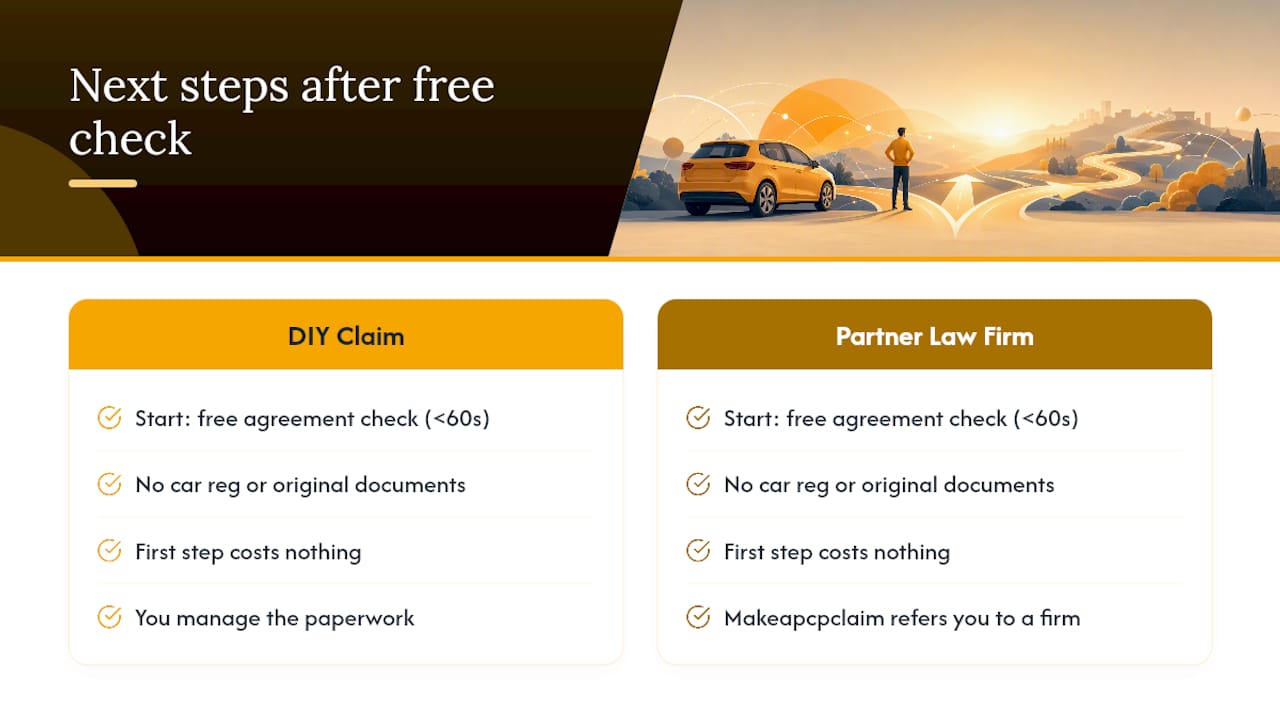
Once you know what’s there, you choose your next move. Handle the complaint yourself using the steps above and keep the entire payout, or let Makeapcpclaim refer you to a partner law firm if you’d rather have someone else manage the paperwork from here. Either way, the first step costs nothing and takes less time than making a cup of tea. Run the free check now and see what turns up.
This article is general information, not a substitute for advice from a qualified financial advisor. Consult a qualified financial professional about your own circumstances before acting on anything here.
Before you send anything, bookmark these: