490,000+ drivers found their agreements with us

TL;DR:
- Many UK drivers believe dealer finance is complex or expensive, but understanding it can save thousands of pounds. Car finance options include HP, PCP, personal loans, and leasing, each suited to different needs and ownership preferences. If mis-sold since 2007, consumers may claim compensation through the FCA scheme by directly contacting lenders, without paying costly claims management companies.
Most UK drivers assume dealer finance is either a rip-off or impossibly complicated. The truth is more nuanced. Car finance is actually straightforward once you strip away the jargon, and understanding it properly can save you thousands of pounds over the life of an agreement. What’s more, millions of people who took out car finance between 2007 and 2024 may be entitled to compensation they don’t yet know about. This guide walks through every major finance type, how the application process actually works, what it all costs, and crucially, what to do if you were mis-sold a deal.
| Point | Details |
|---|---|
| Understand your options | Each finance type suits different needs so matching the product to your plans is key. |
| Watch total costs | Lowest monthly payments are not always the cheapest option overall due to interest and charges. |
| Mis-selling redress | Millions with old car finance could be owed compensation from the FCA’s scheme. |
| Claim direct | You do not need a claims company to seek redress and can claim for free. |
| Don’t overlook the risks | Penalties and ownership rules can cost more than expected unless you read the fine print. |
Car finance in the UK primarily operates through four routes: Hire Purchase (HP), Personal Contract Purchase (PCP), personal loans, and Personal Contract Hire (PCH, also called leasing). Each one works differently, suits different drivers, and carries its own ownership rules.
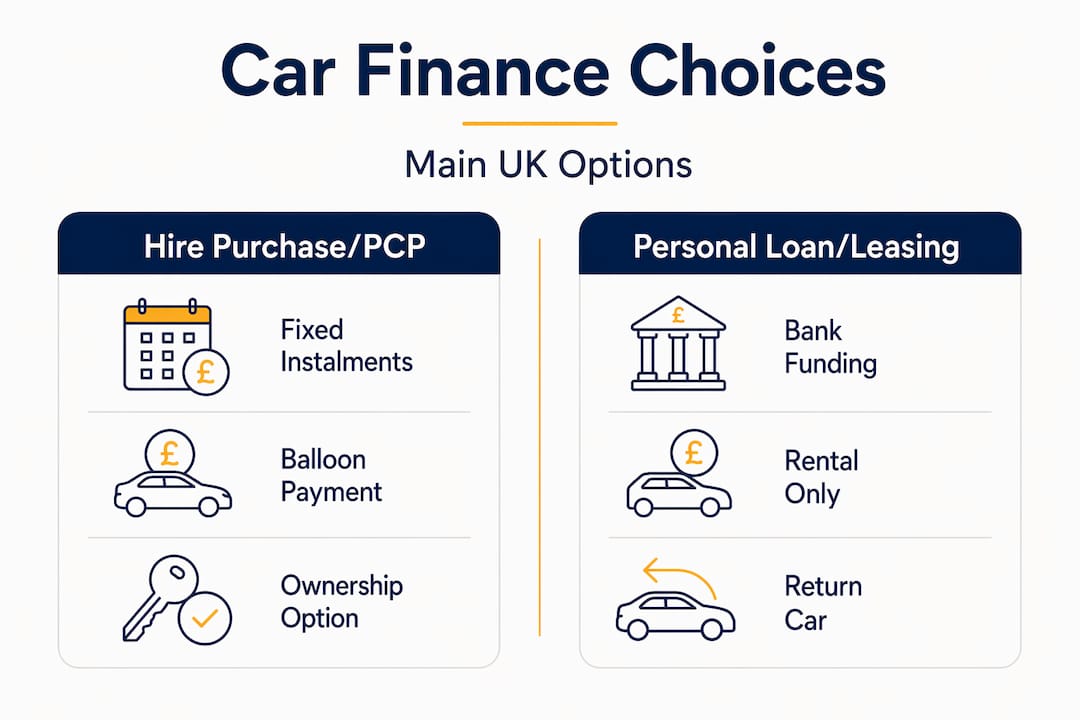
Hire Purchase (HP) is the most straightforward. You pay a deposit, then fixed monthly instalments that cover the full car value plus interest. The lender legally owns the vehicle until you make the very last payment, at which point ownership transfers to you automatically. There are no mileage restrictions, no end-of-term decisions, and no balloon payments. You simply pay it off and it’s yours.
Personal Contract Purchase (PCP) is more complex but enormously popular. Monthly payments are lower than HP because PCP covers only the predicted depreciation of the car (the difference between its purchase price and its Guaranteed Minimum Future Value, or GMFV) rather than the whole vehicle cost. At the end of the term, you face three choices: hand the car back, pay a large “balloon payment” (the GMFV) to own it outright, or use any equity to part-exchange into a new deal.
Personal loans work very differently to dealer finance. A bank or lender pays funds directly into your account, and you buy the car outright, owning it from day one. Because the loan is unsecured, interest rates are often lower, typically 3 to 7% APR, compared with 5 to 12% on dealer finance. This is frequently the cheapest route for buyers who intend to keep the car long-term.
Leasing (PCH) is effectively a long-term rental. You pay fixed monthly amounts for use of the vehicle, return it at the end with no option to buy, and are bound by strict mileage limits and condition requirements. It suits drivers who always want a newer car and never intend to own.
Here is a quick comparison across the four types:
| Finance type | Monthly cost | Own the car? | Mileage limit? | Best for |
|---|---|---|---|---|
| HP | Higher | Yes, at end | No | Long-term keepers |
| PCP | Lower | Optional (balloon) | Yes | Frequent upgraders |
| Personal loan | Varies | Yes, immediately | No | Budget-conscious buyers |
| Leasing (PCH) | Lowest | Never | Yes | Always-new drivers |
Key things to know at a glance:
Pro Tip: If owning the car outright is your goal, run the total payable figures for both HP and a personal loan side by side before signing anything. The difference in total interest can easily exceed £1,500 over a five-year term.
Once you know the main types, it’s helpful to see how the finance application and payment journey works from start to finish. The process differs slightly depending on whether you apply through a dealer or go directly to a lender.
Here is how a typical application unfolds:
“The total cost of finance is what matters most, not just the monthly figure. A low monthly payment on PCP can disguise a far higher total if you choose to own at the end.”
Typical APRs vary significantly by product: PCP and HP generally run between 5 and 12%, while personal loans from banks and credit unions often land between 3 and 7%. Total cost on PCP can be substantially higher than it first appears if you intend to make the balloon payment to own the car, because you are paying interest throughout the term on a debt that does not reduce at the same rate as a standard loan.
Pro Tip: Use the APR (Annual Percentage Rate), not just the flat monthly payment, to compare deals. APR reflects the true annual cost of borrowing and allows like-for-like comparisons across different products and lenders.

Understanding the cost and risk differences is crucial for making an informed choice. Here is how the three main borrowing routes compare across the factors that matter most.
| Factor | PCP | HP | Personal loan |
|---|---|---|---|
| Monthly payment | Lowest | Medium | Varies |
| Total amount payable | Highest (if owning) | Medium | Lowest |
| Ownership at end | Optional | Automatic | Immediate |
| Mileage penalties | Yes | No | No |
| Negative equity risk | Yes | Lower | No |
| Early exit | Complex | 50% rule | Easier |
PCP accounts for roughly 60 to 80% of new car finance in the UK, making it by far the most common product. HP is simpler for those focused on ownership. Personal loans offer the lowest total cost for buyers who intend to keep the car, because there is no balloon payment and interest rates are typically lower.
Key risks to be aware of with each product:
The right choice depends on your driving habits, how long you plan to keep the vehicle, and whether ownership matters to you. Drivers over 30 with stable mileage patterns and a preference for long-term ownership consistently find HP or personal loans cheaper over time, despite the higher monthly figure on HP.
If you bought a car with finance since 2007, you might be owed money due to past mis-selling. This is not a niche legal technicality. It is one of the largest consumer redress events in UK financial history.
What is mis-selling? Mis-selling occurred through Discretionary Commission Arrangements (DCAs), where car dealers were given the power to set the interest rate on finance deals. The higher the rate, the more commission the dealer earned. This arrangement was not disclosed to customers. It was banned by the Financial Conduct Authority (FCA) in January 2021. Mis-selling also occurred where commissions exceeded 39% of the total credit cost or where financial ties between lenders and dealers were hidden.
Who qualifies for redress? The FCA redress scheme covers HP and PCP agreements taken out for personal use between 6 April 2007 and 1 November 2024. Around 12.1 million people are estimated to be eligible, with average payouts estimated between £700 and £829 and a projected total industry bill of approximately £7.5 billion. The scheme is split into two periods (pre and post January 2014) because of different legal considerations around disclosure obligations.
How to make a claim:
“You do not need to pay a claims management company to get your money back. Claiming directly is free, straightforward, and keeps every penny of any payout in your pocket.”
Claims management companies (CMCs) typically charge between 25 and 40% of any compensation received. On a £750 payout, that could mean losing £300 in fees for work you could do yourself in under an hour. The FCA explicitly advises that you can claim directly without paying a CMC. If you want guidance on the process, our detailed guide on how to claim compensation walks through each step clearly.
Here is the uncomfortable truth that most car finance guides will not tell you. The finance product is rarely the problem. The problem is that most buyers focus entirely on the monthly payment and completely ignore what they are actually agreeing to pay overall.
Dealers know this. The sales process around PCP is specifically designed to anchor your attention on the monthly figure. A £300 per month payment sounds manageable. A total payable of £22,500 on a £17,000 car, with a £7,000 balloon on top to actually own it, does not sound as attractive. But that is exactly what some PCP deals look like when you lay them out in full.
For UK owners over 30 who value stability, HP and personal loans are almost always the smarter long-term choice. You pay more each month, but you build equity, face no mileage penalties, and know exactly where you stand at the end of the term. PCP absolutely suits frequent upgraders who want a newer car every three years, but you need to go in with eyes open about balloon payments and total costs.
On the mis-selling issue: claiming is not opportunism. It is responsible consumer action. The DCA scandal caused real financial harm by artificially inflating interest rates without customers’ knowledge. If you paid more interest than you should have, you are entitled to the difference. The FCA’s scheme is designed to make this straightforward, with eligible lenders expected to contact customers by mid-2026. But submitting a complaint now puts you at the front of the queue.
The broader lesson: understanding how car finance actually works, from product types to total costs to your legal rights, puts you in a far stronger position than relying on a dealer to guide you. That knowledge is worth more than any cashback offer at the showroom.
If you took out HP or PCP finance between 2007 and 2024, there is a real chance you are owed money. The FCA redress scheme is one of the biggest consumer compensation events in recent UK history, and the process of claiming does not have to be complicated.
At Make a PCP Claim, we help UK car owners understand their rights and navigate the claims process with confidence. Whether you want to check your eligibility, understand what your agreement means, or get clear guidance on next steps, we make it straightforward. Visit makeapcpclaim.co.uk to find out whether your finance agreement qualifies and what you could be owed. Getting started takes just a few minutes and costs nothing to check.
PCP involves lower monthly payments covering only the car’s predicted depreciation, with a large balloon payment due if you want to own it at the end; HP spreads the full car cost into fixed payments with ownership transferring automatically once the final payment is made.
No. The FCA confirms you can complain directly to your lender for free, without involving a CMC, which typically charges 25 to 40% of any compensation received.
Both PCP and leasing carry penalties for excess mileage and poor condition, and PCP additionally carries the risk of negative equity if the car’s market value falls below the guaranteed future value.
Anyone who took out HP or PCP finance for personal use between 6 April 2007 and 1 November 2024 is likely eligible, with around 12.1 million consumers covered by the scheme and an average estimated payout of £700 to £829.