490,000+ drivers found their agreements with us

TL;DR:
- If you financed a car between 2007 and 2024, you may be owed money due to undisclosed commission practices.
- Checking your agreements is quick and free with Makeapcpclaim, which can refer you to a law firm if eligible.
If you financed a car between 6 April 2007 and 1 November 2024, there is a strong chance you are owed money. The Financial Conduct Authority’s mass redress investigation covers an estimated 12.1 million agreements worth around £7.5 billion in total redress, with an average payout of roughly £830 per agreement. The mechanism behind most of these claims is a Discretionary Commission Arrangement (DCA), where your broker could quietly inflate your interest rate to earn a higher commission, without telling you. Millions of drivers paid more than they should have, and most never knew.
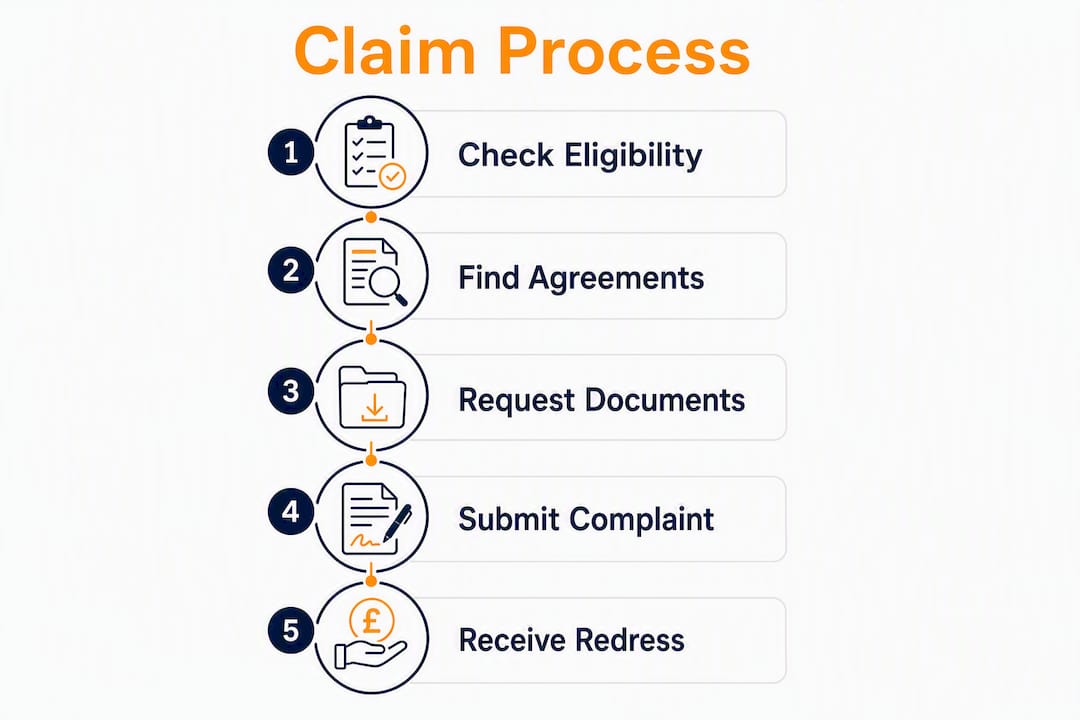
Your immediate next steps are straightforward:
Pro Tip: Don’t wait for your lender to contact you. Submitting a complaint now puts you in the queue for faster contact under the FCA mass redress scheme, which could mean an earlier payout.
The eligibility window is precise: agreements entered into during the FCA’s defined period fall within the FCA’s scope. Agreements signed after that period are not part of this redress process.
The agreement types covered include:
| Agreement type | Covered? | Quick eligibility check |
|---|---|---|
| Personal Contract Purchase (PCP) | Yes | Check for a balloon payment at the end |
| Hire Purchase (HP) | Yes | Monthly payments with ownership at the end |
| Conditional sale | Yes | Similar to HP; ownership transfers on final payment |
| Personal loan used to buy a vehicle | Likely yes | Check if the loan was arranged through the dealer or broker |
| Lease / personal contract hire | Generally no | No ownership option; different regulatory treatment |
The complaint goes to the lender, not the broker. This matters because the broker acted as an intermediary, but the lender is the regulated firm responsible for the credit agreement. A DCA, in plain terms, meant the broker had the power to set your interest rate within a range, and the higher they set it, the more commission they earned. You were never told this was happening. That lack of disclosure is the core of the mis-selling allegation.
The FCA has placed obligations on firms to identify affected customers and make contact. MoneyHelper’s guidance on mis-sold car finance confirms that lenders must proactively work through their records. Filing your own complaint, however, still gives you more control over timing.
Statistic: MoneySavingExpert estimates that around 12.1 million agreements are potentially affected, with total redress expected to reach approximately £7.5 billion.
You do not need the original finance agreement to start a claim. That surprises most people, but it is genuinely true.

The most useful details to have to hand are:
If you have none of this, a vehicle registration plus your name and a past address is often enough. Claims services and credit-reference aggregators can match records via creditor account references reported to Equifax even when the consumer has no paperwork at all.
Makeapcpclaim’s free agreement finder searches credit-reference records in under 60 seconds using just a few personal details. No car registration is required, and no paperwork needs to be uploaded. For a more manual route, you can contact Equifax, Experian, or TransUnion directly to request your credit report, which will typically show historical finance accounts. Old bank statements showing regular payments to a finance company are also useful supporting evidence.
Once you have identified the lender, write to them and ask for:
A simple written request works. You can say: “I am writing to request a copy of my original credit agreement, a full statement of account, and any documentation relating to broker commission arrangements connected to my agreement [reference number if known], entered into on approximately [date].”
Pro Tip: If your name or address changed during the agreement period, include both your current and former details in any request to the lender. Older records are often filed under the name and address held at the time of the agreement, and a mismatch is one of the most common reasons lenders fail to locate accounts quickly.
If you want to check your full credit history across all three agencies, Equifax, Experian, and TransUnion each offer free statutory reports. Old bank statements showing direct debits to a finance company can corroborate dates and payment amounts even when the lender cannot immediately locate the account.
The compensation available is not a fixed sum. It depends on the size of your original agreement, the interest rate you paid, and the commission arrangement your broker had in place. That said, the figures involved are meaningful.
| Scenario | Estimated redress range | Notes |
|---|---|---|
| Average affected agreement | Around £830 | Based on MSE/FCA estimates across all claim types |
| Higher-value PCP (e.g. £20,000 vehicle) | Potentially several thousand pounds | Depends on rate inflation and agreement length |
| Smaller HP agreement (e.g. £10,000 vehicle) | Potentially a few hundred pounds | Lower base, but still worth claiming |
These are illustrative figures, not guarantees. The MoneySavingExpert free reclaim tool provides a more personalised estimate once you enter your agreement details.
A critical point that many people miss: closed agreements are still claimable. If you finished paying off a car on finance years ago, the commission practices that applied at the time are still compensatable. The fact that the agreement has ended does not extinguish your right to redress.
Statistic: MoneySavingExpert estimates the total redress pot across all affected agreements as very substantial, covering agreements from the FCA’s eligibility period.
The process has a clear sequence. Following it in order avoids the most common delays.
Keep it factual and brief. State: your name and address, the agreement reference (if known), the vehicle registration, the approximate start date, and a clear statement that you are complaining about the possibility of an undisclosed commission arrangement affecting your interest rate. You do not need to prove the DCA existed at this stage. The lender is obliged to investigate.
For a template covering pre-action correspondence, the letter before action guide from Debt Recovery Hub sets out the standard format for formal written complaints in England and Wales, which is useful context when drafting your initial letter.
Under the FCA’s mass redress framework, firms that receive complaints are required to prioritise contact with affected customers. Filing early puts you ahead in that queue.
These are the situations that cause the most confusion, and they all have workable answers.
A completed agreement is not a barrier. The mis-selling occurred at the point the agreement was entered into, and the commission practices that inflated your rate are compensatable regardless of whether you have since paid the loan off in full. MoneySavingExpert confirms that eligibility does not depend on the agreement still being active.
If you were declared bankrupt while the finance agreement was live, or if a potential claim arose during a period of insolvency, the right to pursue that claim may have passed to the Official Receiver as part of your estate. In that situation, the redress would typically belong to the estate rather than to you personally. The GOV.UK guidance on motor vehicle finance mis-selling and the Official Receiver sets out the position clearly and is worth reading if this applies to you.
The standard limitation period for a contract claim in England and Wales is six years from the date you knew, or ought reasonably to have known, about the mis-selling. For older agreements, the FCA redress scheme and Ombudsman processes have their own timeframes, and the FCA has signalled that firms must handle complaints going back to April 2007. Acting promptly is still advisable: the sooner a complaint is filed, the sooner you enter the redress queue.
The practical message is simple. Do not assume that age, a closed account, or a lender you can barely remember rules you out. The eligibility window is wide, and the tools to locate old agreements are better than most people expect.
Makeapcpclaim’s free agreement finder is built around one idea: most people do not have their old finance paperwork, and they should not need it to start a claim.
Here is how it works:
The referral model means the process is genuinely hands-off for you. Rather than chasing lenders for paperwork, drafting complaint letters, and tracking responses, the partner law firm handles all of it. For a detailed breakdown of the evidence and documentation involved in a claim, the Makeapcpclaim guide on how to claim car finance compensation covers the process step by step.
Pro Tip: Running the free check takes less time than making a cup of tea. Even if you are not sure whether you had a PCP or HP agreement, or cannot remember the lender’s name, start the check. The system is designed to surface agreements you may have forgotten entirely.
Your data is used solely to search for and match finance agreements; it is not shared beyond the referral process.
UK car finance customers who financed vehicles within the FCA’s eligibility period may be entitled to redress averaging a meaningful amount per agreement, covering PCP, HP, conditional sale, and personal loans used to buy vehicles.
| Point | Details |
|---|---|
| Eligibility window | Agreements from 6 April 2007 to 1 November 2024 are in scope, including closed and fully repaid agreements. |
| Average estimated payout | MoneySavingExpert estimates the average payout per agreement as roughly £830, with approximately 12.1 million agreements affected. |
| No paperwork needed | Makeapcpclaim finds your agreements in under 60 seconds using just your name, date of birth, and address. |
| Escalation route | If your lender rejects your complaint, escalate to the Financial Ombudsman Service, whose decisions are binding on lenders. |
| Makeapcpclaim’s role | Run the free 60-second check at Makeapcpclaim to locate your agreements and, if eligible, receive a referral to a partner law firm at no direct cost to you. |
Most people who financed a car between 2007 and 2024 had no idea their broker could set their interest rate within a range and earn more commission the higher they pushed it. That is not a technicality buried in the small print. It is a structural conflict of interest that the FCA has since banned outright, precisely because it was so widespread and so damaging.
What strikes me about this situation is how many people are still sitting on a valid claim and doing nothing, not because they are lazy, but because they assume the process is complicated, that they need paperwork they no longer have, or that the agreement being finished means the opportunity has passed. None of those assumptions are correct.
The FCA’s mass redress scheme is one of the largest consumer financial recovery exercises the UK has seen. The fact that lenders are obliged to identify and contact affected customers sounds reassuring, but in practice, waiting for a letter that may or may not arrive is a passive strategy. Filing a complaint yourself is the active one, and it costs nothing.
The DIY route is genuinely viable for anyone who is organised and comfortable writing a formal letter. The referral route, through a service like Makeapcpclaim, suits people who want the process handled without the back-and-forth. Neither is wrong. The mistake is doing neither.
Spending weeks hunting for old finance documents is not the only way to start a claim. Makeapcpclaim’s free agreement finder locates your car finance agreements in under 60 seconds, using just your name, date of birth, and address. No paperwork, no car registration, no prior knowledge of your lender required.

Once your agreements are identified, Makeapcpclaim refers eligible clients to partner law firms who take over the entire process: drafting the complaint, gathering evidence, liaising with the lender, and escalating to the Financial Ombudsman Service if the lender rejects the claim. You do not pay Makeapcpclaim directly. The referral fee comes from the partner law firm, keeping the initial check genuinely free for you.
Compared with the DIY route, where you are responsible for tracking down lenders, requesting paperwork, and managing correspondence yourself, the referral model removes the administrative burden entirely. The law firm handles it; you simply confirm your details and wait for updates.
To find out whether you have eligible agreements, start your free check at Makeapcpclaim now. The whole process takes under a minute, and it is the fastest practical first step available.
These are the most authoritative resources for UK car finance redress claims:
This article provides general information about the UK car finance redress process and is not legal or financial advice. Eligibility, timelines, and outcomes vary by individual circumstance. Confirm current rules with the FCA, Financial Ombudsman Service, or a qualified legal professional before making decisions based on your specific situation.