490,000+ drivers found their agreements with us

TL;DR:
- A settlement breakdown is a detailed written statement showing your final payout, including all fees and deductions. It is your legal right to receive this document before signing any release or accepting funds. Reviewing and verifying this breakdown ensures you receive the correct amount and prevents errors or inflated charges.
A settlement breakdown is a detailed written statement showing exactly how your final payout is calculated after a financial claim, including all fees, costs, and deductions taken before you receive a penny. Also known as a closing statement or disbursement sheet, this document is your legal right to receive before signing any release or accepting funds. For UK car owners pursuing a car finance claim, understanding how to request a settlement breakdown is the difference between knowing what you are owed and simply accepting whatever figure you are handed. The gross settlement figure is rarely what lands in your account, and this guide explains why.
A settlement breakdown request is a formal ask for a written, itemised statement from your legal representative or claims handler. You are legally entitled to receive this document before you sign any release or disbursement authorisation, and no representative should withhold it. The document typically covers four core areas: the gross settlement amount, legal or claims management fees, case costs, and your net payout.
Understanding the terminology before you make your request puts you in a far stronger position. The gross settlement is the total amount agreed with the other party. Contingency fees are the percentage your representative takes, typically ranging from 33.3% to 40% depending on whether the case went to litigation. Liens are third-party claims against your settlement, such as outstanding finance balances or medical costs. Case costs cover disbursements like court fees, expert reports, and administrative charges.
Knowing these terms means you can read the breakdown critically rather than passively. A car owner who understands what a lien is will immediately spot whether one has been applied correctly. Makeapcpclaim recommends that every client familiarise themselves with these definitions before their settlement is finalised.
Preparation makes the process faster and gives you a clear reference point when reviewing the figures you receive.
Having these documents to hand means you can compare figures line by line the moment the breakdown arrives. Without them, you are reviewing numbers in isolation, which makes errors far easier to miss.

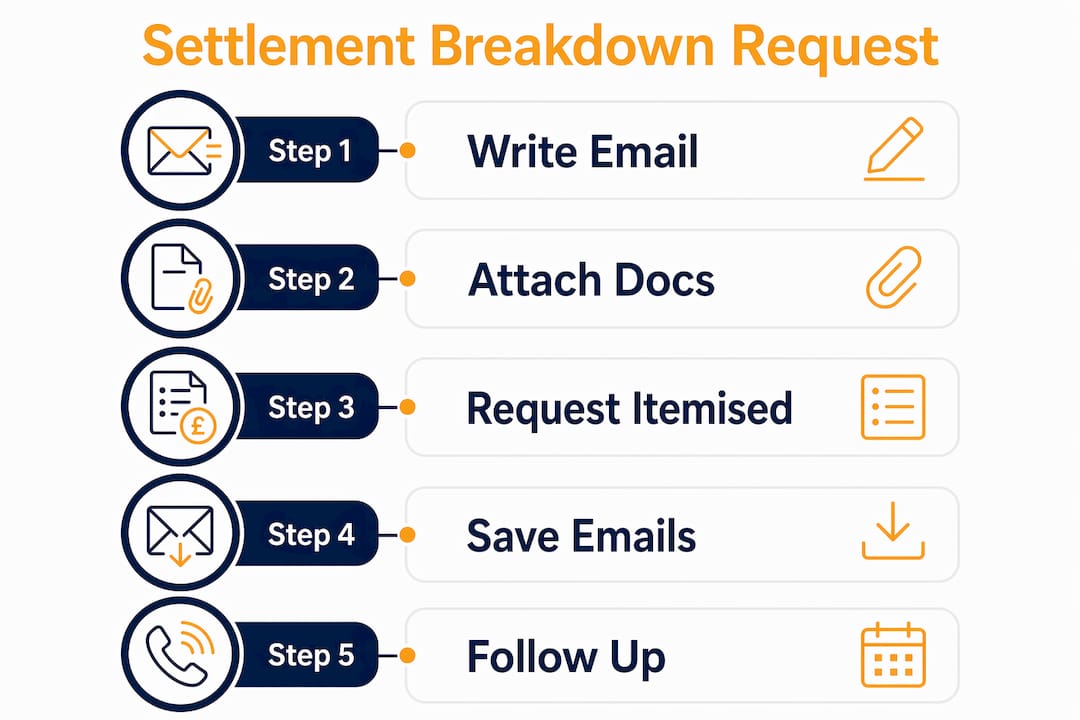
A written request sent by email is the most effective method. Email creates a documented audit trail that protects you if a dispute arises later. A telephone call leaves no record and gives your representative room to be vague.
Your request should be specific. A general ask for “the breakdown” is easy to answer with a summary figure. A precise request forces a detailed response.
Pro Tip: Save every email in a dedicated folder labelled with your claim reference. If you ever need to escalate a complaint, a clean paper trail is your strongest asset.
Thorough review is not optional. Skimming your settlement statement risks missing errors that could cost you hundreds or thousands of pounds. Read every line against your original fee agreement.
Start with the fee percentage. If your agreement states 33.3% and the breakdown shows 36%, that discrepancy needs an explanation before you sign anything. Then check each case cost individually. Vague entries like “disbursements” or “administrative charges” without a figure attached are not acceptable. You are entitled to receipts for any expense that is unclear.
| Component | What to check |
|---|---|
| Gross settlement | Matches the figure confirmed in writing by your representative |
| Claims management fee | Percentage matches your signed fee agreement exactly |
| Case costs | Each item is named and a receipt is available on request |
| Lien deductions | Creditor is named and the amount is verifiable |
| Net payout | Gross minus all deductions equals the figure shown |
Medical liens and subrogation payments are common deductions in personal injury and finance claims. Crucially, medical liens are often negotiable, and actively negotiating these before finalisation can increase your net payout. If a lien appears on your breakdown that you were not told about, ask your representative when it was identified and why you were not informed earlier.
Pro Tip: Write the agreed fee percentage from your retainer at the top of the breakdown before you start reviewing. Having that number visible makes it immediately obvious if the applied percentage is wrong.
Discrepancies are more common than most claimants expect. Attorney fees and case costs are where calculation errors most often occur. The right response is structured, not reactive.
“Clients should not sign releases or disbursement authorisations without receiving and fully understanding the settlement breakdown. Failure to provide this document is a significant red flag and may breach professional conduct obligations.”
If you are dealing with a car finance claim specifically, Makeapcpclaim can help you locate your original finance agreements quickly, giving you the documentation needed to challenge any figures you believe are incorrect.
Timelines vary, but there are reliable benchmarks. Insurance companies typically take 2–4 weeks to issue a settlement cheque after an agreement is reached. Once issued, the cheque may take an additional week to clear, depending on the amount and your bank’s processing procedures. The full disbursement process from agreement to money in your account therefore commonly takes 30–60 days.
Several factors can extend that window:
Request a written timeline from your representative at the same time as your settlement breakdown. If a deadline passes without payment or explanation, follow up in writing and ask for a revised date with a reason for the delay.
Requesting a detailed settlement breakdown before accepting funds is your legal right, and reviewing it carefully against your original agreement is the most effective way to protect your net payout.
| Point | Details |
|---|---|
| Request in writing | Send your breakdown request by email to create a documented audit trail. |
| Know your fee agreement | Keep your retainer handy; fee percentage errors are the most common discrepancy. |
| Check every deduction | Verify each line item, including liens and case costs, before signing any release. |
| Negotiate liens | Medical and finance liens are often negotiable and can increase your net payout. |
| Escalate if stonewalled | Refusal to provide a breakdown may breach professional conduct rules; report to the FCA or SRA. |
From what I have seen working with claimants over many years, the clients who fare best are not necessarily those with the largest gross settlements. They are the ones who ask questions early and keep asking until they get clear answers.
Most people receive their settlement breakdown and feel a quiet pressure to accept it without question. The figures look official. The document is dense. Signing feels like the path of least resistance. That instinct is understandable, but it is also how errors go unchallenged and how inflated case costs slip through unchecked.
The single most useful thing you can do is request the breakdown before you are asked to sign anything. Do not wait for your representative to volunteer it. Ask for it the moment a settlement figure is agreed. Active dialogue about fees and liens improves client understanding and, in many cases, the final net figure too.
Patience matters as well. Timelines stretch. Lien negotiations take longer than expected. The process rewards those who follow up consistently rather than those who chase aggressively and then go quiet. A calm, documented, persistent approach almost always produces a better outcome than frustration.
Review every document carefully before you sign. That single habit protects more money than any other step in this process.
— Jake
Understanding your settlement starts with having the right paperwork. Makeapcpclaim finds your car finance agreements for free in under 60 seconds, giving you the documentation you need to review your settlement breakdown with confidence.

If you are a UK car owner working through a finance claim, having your original agreement to hand means you can verify every deduction against what was actually agreed. Makeapcpclaim’s free tool removes the guesswork from that first step, so you can focus on reviewing the figures rather than hunting for paperwork. Start your search today and know exactly what you signed up for.
A settlement breakdown is a written statement showing the gross settlement amount, all fees and deductions, and the net payout you will receive. It is also called a closing statement or disbursement sheet.
Yes. You are legally entitled to a detailed written settlement statement before signing any release or receiving funds. Withholding it may breach professional conduct obligations.
Send a written email to your representative requesting an itemised statement that covers all fees, case costs, lien deductions, and your net payout, along with a written payment timeline.
Put your concern in writing, reference the specific line item, and request a receipt or explanation. Do not sign any release until every figure is resolved to your satisfaction.
Insurance companies typically take 2–4 weeks to issue a cheque, with an additional week for clearing. The full process commonly takes 30–60 days from the date of agreement.