490,000+ drivers found their agreements with us

If you recognise pressure selling, no commission disclosure, or a suspiciously “best rate” pitch from your dealer, these are classic mis-sold car finance signs, and you should check your eligibility under the FCA scheme now. Makeapcpclaim’s free check locates agreements in under 60 seconds, with no paperwork needed. Keep paying your finance while you look into this. Missing a payment now could damage your credit file regardless of how strong your claim turns out to be.
TL;DR:
- Many mis-sold car finance deals involved quick signing with little explanation, often to hide high or undisclosed commissions.
- If your agreement included a fixed rate with no comparison, or tied discounts and extras to dealer finance, it may have been mis-sold.
- The FCA scheme covers agreements from April 2007 to November 2024 that involved discretionary, high, or undisclosed commissions, or contractual ties.
- Running a free eligibility check takes less than a minute and helps identify if your finance agreement qualifies for compensation.
- Do not stop monthly payments during the claims process to avoid repossession or credit damage, even if you suspect mis-selling.
Most mis-selling didn’t look like fraud at the time. It looked like a slightly rushed Saturday afternoon at the dealership, a friendly salesperson, and a deal that felt too convenient to question. That’s exactly the problem. Here’s what to look for.
The paperwork moved fast, and questions felt unwelcome. If your finance agreement was signed within minutes of test-driving the car, with little explanation of how the rate was calculated, that speed was often deliberate. Dealers earning commission on the interest rate had every incentive to keep you focused on the car, not the maths.
The conversation was all about the monthly figure. “£249 a month” sounds manageable. It also conveniently hides the total cost of the car, the APR, and how much of that monthly figure was padding the dealer’s commission. If nobody mentioned the interest rate out loud, that’s worth flagging.
You were offered one rate, presented as fixed. A genuine broker shops around. If the salesperson quoted a single “best” rate with no comparison, no explanation of how it was set, and no mention that the rate was negotiable, you likely never saw the real range of options available to you.
There was no meaningful commission disclosure. Somewhere in your paperwork should be a Standard European Consumer Credit Information (SECCI) sheet, which is meant to explain how commission works. If you don’t remember seeing one, or it was buried and never explained, that’s a documented FCA concern, not just a feeling.
You suspect a discretionary commission arrangement. Under a discretionary commission arrangement (DCA), the dealer could set your interest rate themselves, and earn more commission the higher they set it. You have no way of knowing this happened just by looking at your monthly payment, which is exactly why the FCA built a scheme around it.
Discounts or extras were tied to using dealer finance. If a trade-in bonus, service package, or discount evaporated the moment you mentioned an outside loan or your own bank, that’s a contractual tie. It suggests the finance deal was the product being sold, not a convenience for you.
You’ve rolled over multiple PCP deals, or felt pushed into add-ons. Repeated Personal Contract Purchase (PCP) rollovers, GAP insurance you didn’t ask for, or paint protection bundled in “because everyone takes it” are common pressure-selling patterns worth revisiting with fresh eyes.
Pro Tip: Try to recall the exact words used, not just the gist. “This is the only rate we can offer” is very different from “I can check if there’s a better rate,” and that phrasing can matter later if you complain.
The FCA’s scheme covers finance agreements on cars, vans, and motorbikes taken out between 6 April 2007 and 1 November 2024. If your agreement falls inside that window, you’re in scope regardless of which lender or dealer arranged it.
The scheme centres on three specific faults:
There are exceptions. If the dealer clearly disclosed the commission arrangement and you knowingly accepted it, or if the link between dealer, lender, and manufacturer was made obvious at the point of sale, your case is weaker. That said, Citizens Advice notes that even a previously rejected complaint is worth revisiting, since guidance has shifted since the scheme was set up.
MoneyHelper reports average payouts in the hundreds of pounds, though individual awards swing widely depending on how much your APR was inflated and how long you held the agreement. A three-year PCP with a heavily loaded rate could produce a very different figure to a short-term hire purchase deal.
Recognising the signs is only step one. Here’s the practical order of operations.
Run a free eligibility check. Makeapcpclaim’s free check locates your car finance agreements for you in under 60 seconds, without needing your car registration or old lender paperwork to hand. It simply tells you whether you have agreements worth investigating.
Gather your documents. Pull together the finance agreement itself, the SECCI, the dealer’s order form, and any receipts for add-ons like GAP insurance or paint protection.
Complain to the lender or broker directly. Be specific: name the sign you spotted (undisclosed commission, contractual tie, pressure selling) and attach whatever evidence you have. Keep a copy of everything you send and the date you sent it.
Escalate if you’re not satisfied. If the lender rejects your complaint or you hear nothing within eight weeks, take it to the Financial Ombudsman Service, which handles these disputes independently and free of charge.
Pro Tip: Never stop your monthly payments while your complaint is live. Citizens Advice is clear on this: missed payments can trigger repossession and credit damage that no compensation payout will undo.
A claim built on memory alone is weak. A claim built on paperwork is far stronger, and most of it is easier to find than you’d expect.
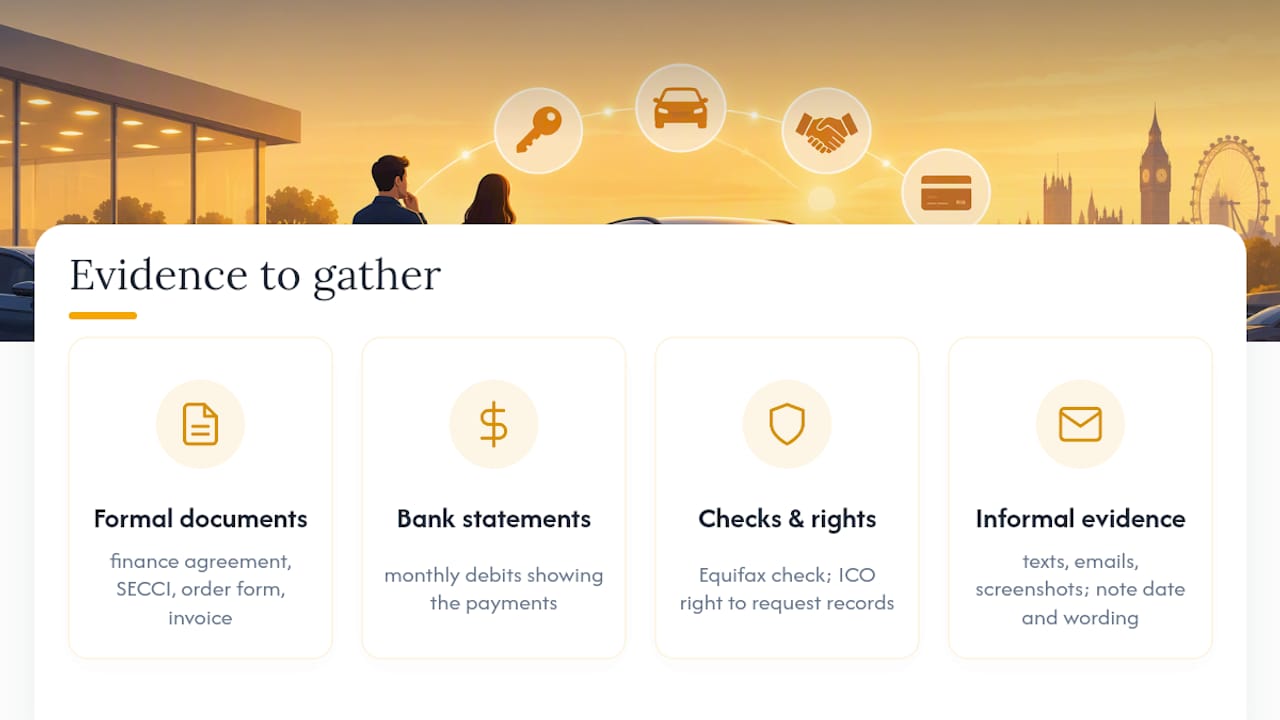
Start with the finance agreement, the SECCI, the dealer’s order form, the sales invoice, and any trade-in paperwork. Bank statements showing the monthly debits back up the numbers. If you’ve lost documents entirely, an Equifax car finance check can help identify which lender was involved, and the ICO’s guidance on credit data explains your rights to request records directly from the firm.
Beyond formal paperwork, informal evidence carries real weight: a text message where the salesperson promised “this is the only deal we can do,” an email confirming the monthly figure with no mention of APR, or a screenshot of an advert stating a discount was only available “with our finance.” Note the exact date and wording wherever you can. Specifics beat vague recollection every time a complaint gets reviewed.
Genuine compensation claims have, unfortunately, attracted a wave of copycat scams. Watch for unsolicited calls or texts claiming to be from the FCA or your lender, especially any that ask for your bank PIN, online banking password, or an upfront “processing fee” to release a refund.
Consumer bodies have repeatedly flagged this pattern of fake refund messages as one of the fastest-growing scams tied to genuine compensation schemes, precisely because so many people are now actively checking their eligibility.
Most people assume they’d remember being mis-sold finance if it happened to them. In practice, the customers I hear about most often don’t remember a dramatic sales pitch at all. They remember a friendly conversation about monthly payments, and nothing else, which is exactly the pattern the FCA scheme was built around.
The other mistake is assuming a free check is complicated or requires paperwork you’ve long since lost. It isn’t, and it doesn’t. Makeapcpclaim’s process is deliberately hands-off: once an agreement is identified, everything from there runs through independent partner law firms, checked properly rather than rushed.
— Jake
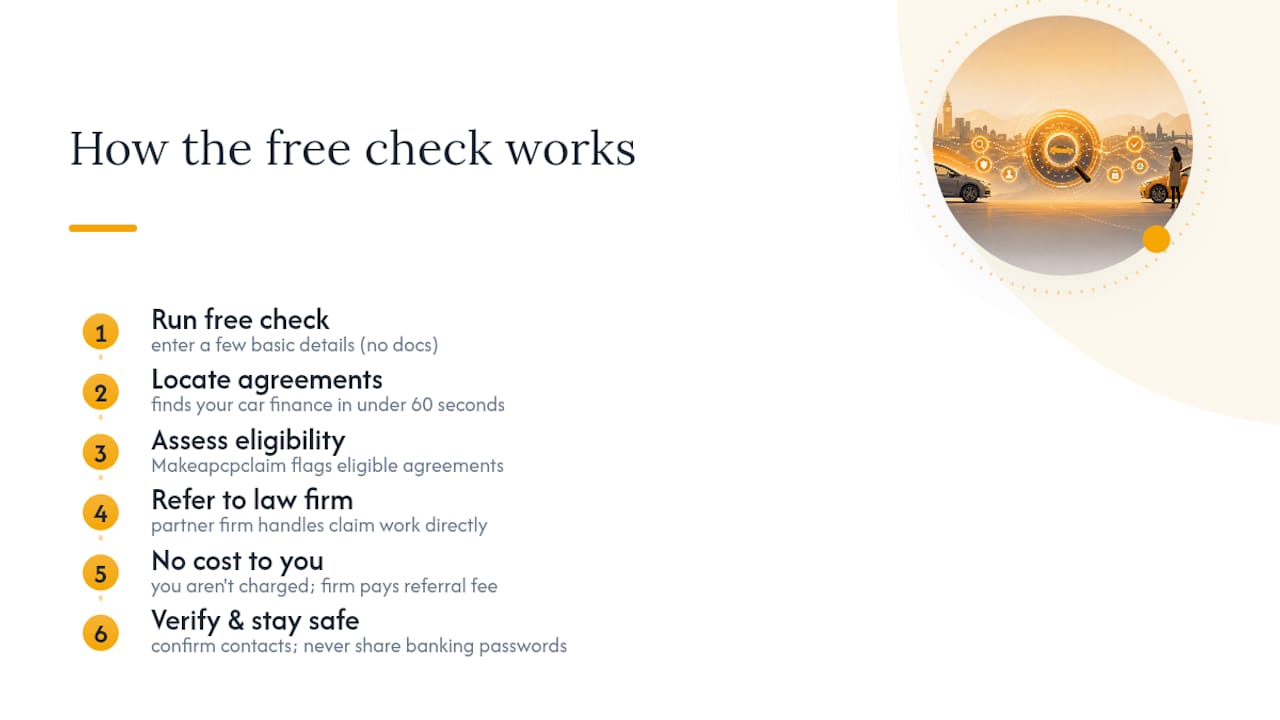
Makeapcpclaim’s free check is built for exactly the uncertainty most people feel at this stage: you don’t need your car registration, your old finance paperwork, or even the name of the lender. Enter a few basic details and the free check locates your car finance agreements in under 60 seconds.
From there, the process stays hands-off. If an agreement looks eligible, it’s referred to a partner law firm with a track record of successful UK Supreme Court cases, who take on the claims work directly. You’re not charged by Makeapcpclaim at any point; the partner law firm pays a referral fee once a claim is submitted, not you. That means there’s no upfront cost to finding out where you stand. As with any communication about your claim, verify contact details independently and never share banking passwords with anyone who reaches out first. If you recognise any of the mis-selling signs described in our full claims guide, the sensible next step is simply to run the check and see what it finds.
Cross-checking against official sources is always worth doing before you complain or claim. Start with the FCA’s car finance complaints page for scheme scope and deadlines, and MoneyHelper’s mis-sold car finance guide for realistic payout expectations. Citizens Advice covers practical complaint steps, and the Financial Ombudsman Service handles escalations free of charge. MoneySavingExpert’s reclaim tool and the Equifax car finance checker are also useful if you’re missing paperwork.
This article is general information, not a substitute for advice from a qualified financial advisor. Consult a qualified financial professional about your own circumstances before acting on anything here.
Look for the signs covered above: no commission disclosure, pressure to focus on monthly payments, a single “best rate” with no alternatives offered, or discounts tied to using dealer finance. If your agreement dates between 6 April 2007 and 1 November 2024 and any of these ring true, it’s worth running a free eligibility check.
Yes. MoneyHelper confirms payouts are being processed under the FCA scheme, with individuals receiving compensation once their claims are assessed and upheld.
MoneyHelper reports average awards in the hundreds of pounds, though your figure depends on how much your interest rate was inflated and how long you held the agreement. There’s no single fixed amount, so a check against your specific agreement is the only way to get a realistic estimate.
The FCA has confirmed the compensation scheme covers agreements from 6 April 2007 to 1 November 2024, with discretionary commission arrangements, high commission, and contractual ties as the three core categories under review. Guidance continues to evolve, so checking your eligibility now rather than waiting is the safer approach.
No. Makeapcpclaim’s free check locates your agreements at no cost, and the business is paid by partner law firms for successful referrals, not by you directly.