490,000+ drivers found their agreements with us

Personal Contract Purchase (PCP) is a conditional sale finance agreement where you pay a deposit, make fixed monthly payments, and then choose at the end whether to pay a final lump sum to own the car, hand it back, or trade it in. Those three choices at the end of the deal are what make PCP different from most other car finance products, and understanding them before you sign is the single most important thing you can do.
The monthly payments are lower than hire purchase because you are only financing the car’s depreciation, not its full value. The Consumer Credit Act governs the agreement, and the Guaranteed Minimum Future Value (GMFV) is the term you will see on every PCP contract. MoneyHelper and Experian both offer free guidance on how these agreements are structured.
Your three end-of-deal options in brief:
PCP is a conditional sale agreement where you pay a deposit and monthly payments covering depreciation, then choose at the end to pay the balloon, return the car, or trade it in using any equity.
| Point | Details |
|---|---|
| PCP structure | Deposit plus monthly payments (covering depreciation plus interest) plus an optional balloon payment (GMFV) at the end. |
| Three end-of-deal choices | Pay the GMFV to own, return the car subject to mileage and wear limits, or trade in if market value exceeds the GMFV. |
| Most important pre-signing check | Confirm the GMFV, APR, mileage limit, and total amount payable in writing before you sign. |
| Excess mileage cost | Charges typically range in the low pennies per mile over the agreed limit, so excess mileage can add up to hundreds of pounds depending on mileage and per-mile rates. |
| Makeapcpclaim free check | Makeapcpclaim locates your car finance agreements for free in under 60 seconds, covering agreements back to 2007, with no paperwork required upfront. |
A PCP contract has three financial components, and each one affects what you pay every month.
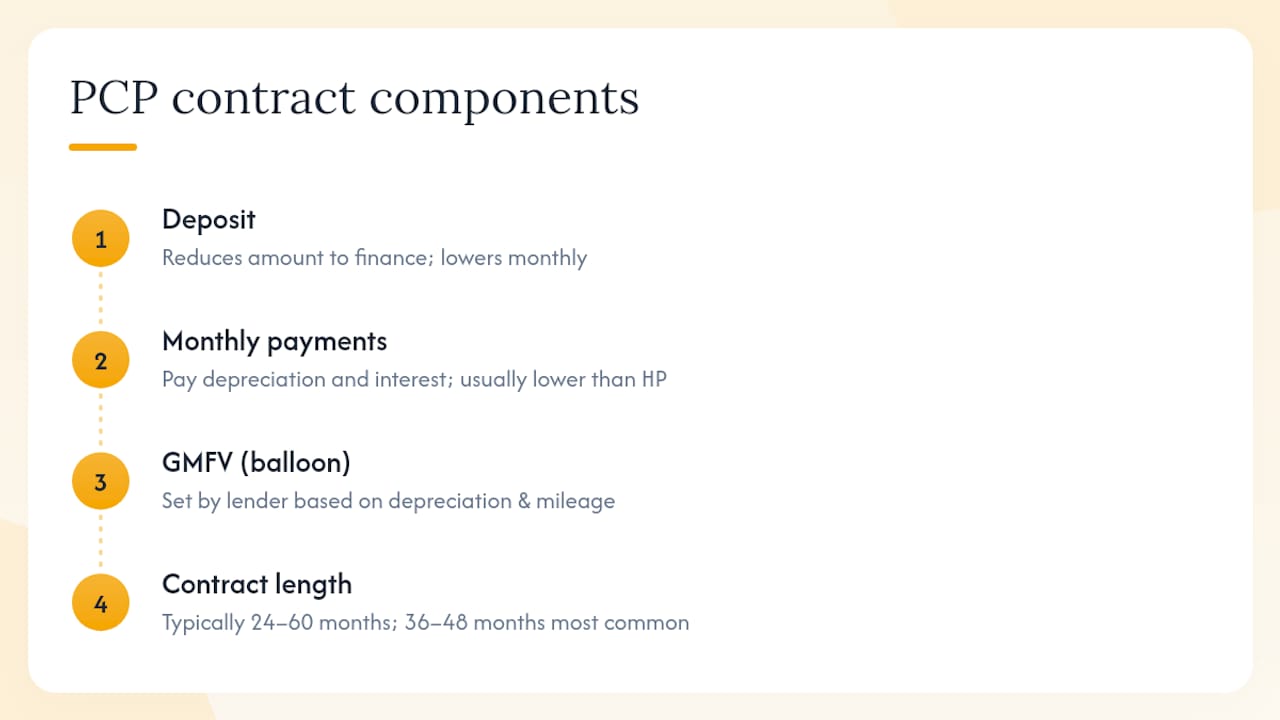
The deposit reduces the amount you borrow. A larger deposit means less to finance, which directly lowers your monthly outgoings.
The monthly payments cover the difference between the car’s purchase price (minus your deposit) and the GMFV, plus interest. You are not paying off the whole car. You are paying for the portion of value the car loses during your contract. That is why PCP payments are typically lower than hire purchase (HP) payments on the same car.
The GMFV (Guaranteed Minimum Future Value) is the predicted value of the car at the end of the contract, set by the lender at the outset based on the car’s expected depreciation and the mileage you agree to cover. It is also called the balloon payment. According to MoneyHelper, typical contract lengths run from 24 to 60 months, with 36 to 48 months being the most common.
Say you want a car priced at a typical value. The lender sets the GMFV based on a contract length and agreed mileage. The remaining balance to finance is the car price minus the deposit and GMFV. Interest is added over the term, resulting in monthly payments lower than hire purchase. At the end, you owe the GMFV if you want to keep the car. Use a PCP calculator from What Car? to run your own numbers with different deposits and terms.
One thing many buyers miss: you are the registered keeper, but the finance company holds a legal interest in the vehicle until the finance is fully repaid. The Car Expert notes that this interest is recorded on vehicle history checks and can restrict your ability to sell the car privately during the term.
Pro Tip: Before you agree a mileage limit, add up your actual annual mileage for the past two years. Underestimating by even 3,000 miles a year can cost you hundreds of pounds in excess-mileage charges at the end.

The headline monthly payment is rarely the full picture. Here is a numbered breakdown of every cashflow to account for.
The total cost of borrowing is the sum of all monthly payments plus any fees, plus the balloon if you pay it, minus the deposit you put in. HSBC’s PCP explainer recommends running this full calculation before signing, not just checking whether the monthly payment fits your budget.
MoneySavingExpert warns that lenders sometimes offset zero-rate deals by inflating the GMFV or the vehicle price, which reduces your end-of-term equity and limits your options. Always check the total amount payable and the GMFV, not just the APR headline.
The end of a PCP is where the real decisions happen. You have three routes, and each one has practical steps attached.
You pay the GMFV (the balloon payment) and the car becomes yours outright. You can fund this from savings, a personal loan, or a new finance arrangement. Before you commit, check whether the car’s current market value is actually higher than the GMFV. If it is, you are buying something worth more than you are paying. If the market has moved against you and the car is worth less, you may be overpaying.
Steps to follow:
You return the vehicle with no further purchase obligation, provided you have stayed within the agreed mileage and the car meets the fair wear-and-tear standard. According to Experian, the GMFV is guaranteed by the lender, so even if the car has depreciated more than expected, that is the lender’s risk, not yours.
What to expect at return:
If the car’s market value is higher than the GMFV, the difference is equity. You can use it as a deposit on your next PCP or HP deal. This is the route dealers tend to promote most actively, and it is worth understanding why: The Car Expert notes that manufacturers and dealers favour PCP partly because it keeps buyers returning for a new car every two to four years.
Mileage limits are set at the start of the contract and directly affect the GMFV. A lower annual mileage means slower depreciation, so the GMFV is higher and your monthly payments are lower. Agree a mileage limit that is too low and you face excess-mileage charges at the end.
What Car? puts typical excess-mileage charges in a band of 3p to 30p per mile over the agreed limit, depending on the lender and vehicle type. That range matters more than it sounds.
Example: If you agreed 30,000 miles over three years but actually drove 36,000, you have 6,000 excess miles. At 10p per mile, that is £600. At 20p per mile, it is £1,200. The charge is calculated at the rate in your contract, not at the lower end of the market range.
Fair wear and tear is not the same as damage. The British Vehicle Rental and Leasing Association (BVRLA) publishes a fair wear-and-tear guide that most finance companies reference. Acceptable examples include minor scuffs on bumpers consistent with normal parking, light stone chips on the bonnet, and small scratches under a certain length. Chargeable damage typically includes:
Before you return the car, gather this evidence:
If you disagree with an inspector’s assessment, you have the right to challenge it. Citizens Advice can help you understand your options.
PCP is not universally good or bad. Whether it works for you depends on what you actually want from the deal.
Advantages:
Disadvantages:
PCP tends to suit:
PCP is less suitable for:
The Consumer Credit Act 1974 gives you statutory rights throughout the agreement, including the right to a settlement figure and protections against unfair terms. Understanding those rights before you sign is not optional.
Most buyers spend more time choosing the car’s colour than reading the finance agreement. That is a mistake. Here is a checklist to work through before you put pen to paper.
Affordability checks:
Contract terms to confirm in writing:
Questions to ask the dealer or finance company:
Red flags to watch for:
Pro Tip: Ask the dealer directly whether they receive a commission for arranging the finance. Following the FCA’s review of discretionary commission arrangements in car finance, this is a question every buyer should ask and get answered in writing.
PCP is one of four common ways to finance a car in the UK. Each suits a different buyer profile.
| Finance type | Monthly payments | Ownership at end | Total cost | Flexibility | Typical term | Best for |
|---|---|---|---|---|---|---|
| PCP | Lower (covers depreciation only) | Optional (pay balloon) | Higher (interest on full value inc. balloon) | Mileage and wear limits apply | 24–48 months | Drivers who want low monthly payments and flexibility at the end |
| HP (Hire Purchase) | Higher (covers full value) | Automatic on final payment | Lower total interest overall | No mileage limits | 24–60 months | Buyers who want to own the car at the lowest total cost |
| PCH (Personal Contract Hire) | Lowest (rental only) | None — car is returned | Fixed rental cost, no equity | Strict mileage and condition limits | 24–48 months | Drivers who always want a new car and never want ownership |
| Personal loan | Depends on loan rate | Immediate (you own the car from day one) | Competitive if rate is low | No mileage or wear restrictions | 24–60 months | Buyers with good credit who want ownership and no usage restrictions |
A few points worth noting beyond the table. HP is straightforward: you pay off the whole car and it is yours at the end, with no balloon and no mileage anxiety. PCH (also called operational leasing) is essentially a long-term rental. You never build equity, but the monthly cost is often the lowest of the four options and the car is always under warranty. A personal loan gives you immediate ownership and no restrictions on use, but the interest rate depends heavily on your credit score.
The right choice comes down to two questions: do you want to own the car, and what is your realistic annual mileage? If ownership matters and mileage is high, HP or a personal loan will almost always cost less in total.
Life changes, and sometimes a finance agreement that made sense at the start becomes difficult to manage. Here is what your options look like.
Missed payments:
Missing a payment does not immediately trigger repossession, but it does trigger a default notice and damages your credit file. If you miss payments and the outstanding balance falls to less than one-third of the total price, the finance company can repossess the car without a court order. Once you have paid more than one-third, they need a court order to repossess. This is a key protection under the Consumer Credit Act.
Contact the lender as soon as you know you are going to miss a payment. Most will agree a payment holiday or a revised schedule rather than go straight to repossession. Citizens Advice and National Debtline both offer free guidance on your rights.
Ending the agreement early:
This is a statutory right under the Consumer Credit Act, not a favour from the lender. You return the car and walk away, provided it is in acceptable condition.
The lender calculates this as the outstanding balance minus a statutory rebate of interest. National Debtline provides sample letters for requesting settlement figures and raising disputes, which is useful if you need to challenge the lender’s calculation.
Know your rights before you call the lender. Under Section 99 of the Consumer Credit Act, you have the right to voluntarily terminate a regulated hire purchase or conditional sale agreement once you have paid half the total amount payable. The lender cannot charge you a penalty for exercising this right, though they can charge for damage beyond fair wear and tear. If the lender disputes your right to terminate, put your request in writing and keep a copy.
Refinancing the balloon:
If you want to keep the car but cannot pay the balloon in one go, you have three practical routes:
Negative equity is the risk here. If the car is worth less than the GMFV when you come to sell, you will need to cover the shortfall from your own funds. This is more likely with cars that depreciate quickly or in a falling used-car market.
Mis-selling in car finance is more common than most buyers realise. The FCA’s review of discretionary commission arrangements identified widespread practices where dealers were paid higher commissions for arranging finance at higher interest rates, without the buyer’s knowledge. If any of the following apply to your agreement, it is worth investigating.
Red flags that suggest mis-selling:
Evidence to gather before contacting a claims service:
Pro Tip: You do not need the original paperwork to start a check. Makeapcpclaim can locate your car finance agreements for free in under 60 seconds, covering agreements going back to 2007, without needing your car registration or lender documents upfront.
Once you have identified a potential mis-sale, the practical next step is to submit a formal complaint to the lender, then escalate to the Financial Ombudsman Service if the lender does not resolve it within eight weeks. A claims management service or partner law firm can handle this process on your behalf.
PCP is a well-designed product when it is sold honestly. The structure makes genuine sense for a specific type of buyer: someone who wants a newer car than they could otherwise afford, drives predictable mileage, and genuinely plans to change vehicles every few years. The lower monthly payment is real, not illusory, because you are financing depreciation rather than the whole car.
The problem is not the product. It is how it has been sold. For years, dealers could earn more commission by arranging finance at a higher interest rate, and buyers had no way of knowing this was happening. The FCA’s review found this practice was widespread. That is not a minor administrative irregularity. It means a significant number of buyers paid more interest than they should have, on agreements they may not have chosen if they had been given the full picture.
The conventional wisdom is that buyers should simply read the small print more carefully. That advice misses the point. When a dealer presents one finance option, describes it as the best deal available, and does not disclose that they earn more commission if you accept a higher rate, reading the small print does not help. The information was never in the small print to begin with.
If you took out a PCP or HP agreement since 2007, the question is not whether you were careful enough at the time. It is whether the person selling you the finance had a conflict of interest they did not disclose. That is worth checking, and checking it costs nothing.
If you financed a car since 2007, there is a straightforward way to find out whether your agreement may have involved undisclosed commission or other mis-selling. Makeapcpclaim locates your car finance agreements for free in under 60 seconds, with no car registration or lender paperwork required. You provide basic details, and the service identifies any agreements that may be eligible for a compensation claim.
There is no obligation after the free check. If your agreement looks eligible, Makeapcpclaim refers you to a partner law firm that handles the claims process on your behalf. You do not pay Makeapcpclaim directly. The partner law firm manages the complaint, the lender correspondence, and any Financial Ombudsman escalation. You stay informed without having to manage the paperwork yourself.
Start your free 60-second check now and find out whether your agreement qualifies.
These are the sources worth bookmarking if you are researching PCP or checking a finance agreement.
This article is general information, not a substitute for advice from a qualified financial advisor. Consult a qualified financial professional about your own circumstances before acting on anything here.