490,000+ drivers found their agreements with us

If you had a PCP agreement between 6 April 2007 and 1 November 2024, complain to your lender now, in writing, and do it yourself first. It costs nothing, average payouts have run around £829 to £830, though parts of the redress scheme are currently facing legal challenge. Before you write a word, use Makeapcpclaim’s free tool to find your car finance agreement in under 60 seconds, no paperwork needed.
TL;DR:
- Most claims under the FCA scheme can yield around 830 pounds, but legal challenges may delay payments, and the actual amount depends on loan specifics.
- Accurate and complete paperwork, including original agreements and payment history, speeds up the investigation process for your claim.
- Early complaints are advised, as they can secure your position in the queue, despite ongoing legal uncertainties affecting some cases.
- Handling the claim yourself costs nothing, but professional help may be justified if your case involves complex arrangements or previous rejection.
- If your claim is rejected, you can challenge it through the Financial Ombudsman and should preserve all correspondence while considering court action for significant or complicated disputes.
The FCA’s redress scheme exists because lenders routinely paid brokers and dealers commission for arranging car finance, and often failed to tell customers about it. If that commission influenced the interest rate you were charged, you may have grounds for a complaint. Here’s the process itself.
Step 1: Identify your lender. Check old paperwork, bank statements, or your credit report. If none of that turns anything up, the Equifax Car Finance Checker searches records going back to 2007 and can usually surface the lender’s name and your account reference. Makeapcpclaim’s own finder does the same job for free in under a minute, without needing your car’s registration or any lender documents to hand.
Step 2: Write your complaint. A strong complaint includes:
You don’t need legal language. State what happened, when, and what you want the lender to do about it.
Step 3: Choose your submission channel. Most lenders accept complaints through an online form, by email, or by post. MoneySavingExpert’s free reclaim tool generates template wording you can adapt and send directly, which saves you drafting from scratch.
Step 4: Wait for the response. Once the lender acknowledges your complaint, Citizens Advice confirms the standard pattern: the lender investigates, gives you a decision, and you then have one month either to accept the offer or challenge it. If you accept, the lender must pay out within a further month.
Submitting the complaint yourself, rather than waiting to be contacted, tends to put you on the quicker “I’ve complained” timetable rather than the slower default queue lenders work through.
Lenders can’t investigate a vague complaint quickly. The clearer your paperwork, the faster your case moves through their process.
Try to gather:
If paperwork is missing, don’t assume you’re stuck. Credit reference agencies such as Equifax, Experian, and TransUnion hold historic finance records. Old bank statements showing regular payments to a finance company work as backup evidence. Dealers sometimes retain records too, and the DVLA can confirm registered keeper history if you need to establish dates.
One detail that catches people out: lenders typically only retain records for around six to seven years after an agreement ends. If your PCP finished a decade ago, the lender’s own file may already be gone, which is exactly why your personal paperwork and credit report history matter more the older the claim gets.
Pro Tip: Build a simple one-page timeline before you submit anything, agreement start date, key payments, agreement end date, and the date you first suspected undisclosed commission. Lenders process clearly laid out timelines faster than a folder of loose documents.
Keep making your normal PCP or HP payments while your claim is live. Stopping payments risks default, repossession, and lasting damage to your credit file, and a live claim gives you no protection from that.
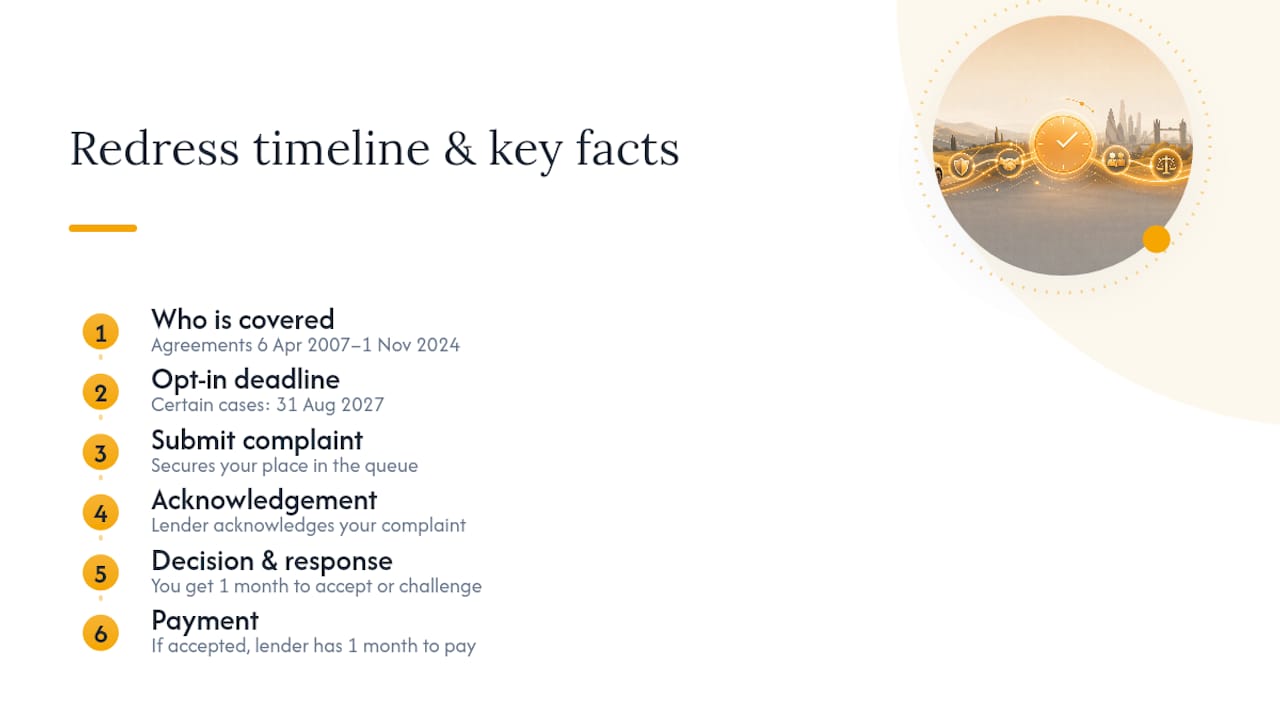
The scheme covers agreements running from 6 April 2007 to 1 November 2024, and the opt-in deadline for certain cases stretches to 31 August 2027, so there’s no need to panic about missing the window entirely. That said, earlier action nearly always means an earlier resolution.
The average payout under the scheme sits around £829 to £830 per agreement, though this is a headline figure. Your actual amount depends on your loan size, the commission rate involved, and how long you held the agreement.
Once you complain, the standard rhythm is: lender acknowledgement, a decision, then a one-month window for you to accept or challenge that decision. Accept, and the lender has one further month to pay.
There’s a genuine complication worth knowing about. Parts of the redress scheme have been legally challenged and partially suspended, which is delaying calculation and payment for some claim types while the legal position gets settled. The Solicitors Regulation Authority points out that Supreme Court rulings are actively reshaping which commission arrangements count as unlawful, meaning whether you had an “unfair relationship” with your lender depends heavily on the specific facts of your case, not a blanket rule.
Don’t let that uncertainty put you off complaining now. Submitting early secures your place in the queue regardless of how the legal questions eventually resolve.
You do not need to pay anyone to use the FCA redress scheme. Citizens Advice is blunt about this: complaining directly to your lender costs nothing, and claims management companies or solicitors can charge somewhere in the region of 30% to 36% of your compensation for doing what you could do yourself with a template.
That said, paid help earns its keep in specific situations:
Pro Tip: If you do sign with a firm, check they’re authorised by the Solicitors Regulation Authority or the FCA, ask for fees in writing before you sign anything, and confirm you have cooling-off rights. Walk away from anyone unwilling to put their fee structure on paper.
Some companies offer models where they find your agreement for free using a tool, then refer eligible cases to partner law firms who handle the claim itself. You may not pay the referring company directly for that referral.
Rejection isn’t the end of the road. Here’s what to do next, in order.
One quirk worth flagging: if your claim is already in court, the lender may pause redress-scheme consideration until the court case resolves, which can change your options around accepting a scheme offer.
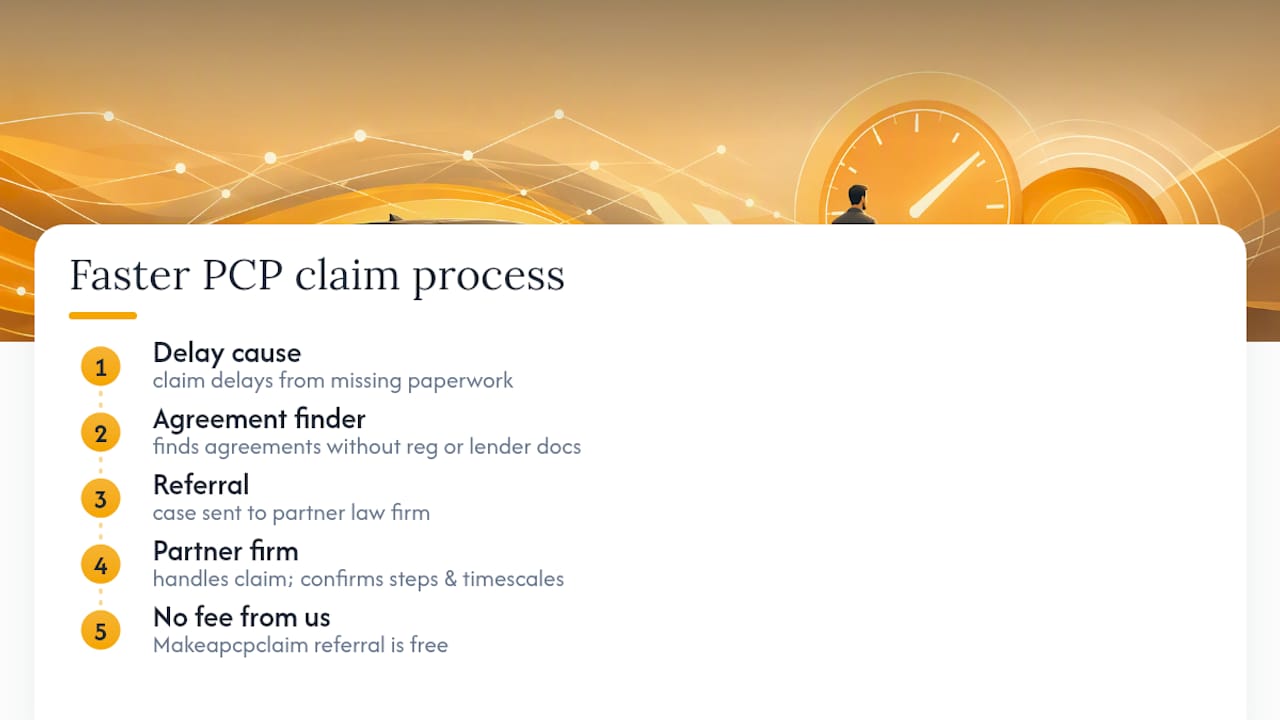
Most of the delay in PCP claims comes from people struggling to find their own paperwork, not from lenders being slow. Some agreement-finder tools can locate your car finance agreement quickly, with no car registration number and no lender documents required to start.
If the finder shows you have a qualifying agreement, Makeapcpclaim refers your case to a partner law firm that handles the claim from there. You’re never charged by Makeapcpclaim directly for that referral. Once you’re referred, the partner firm will typically confirm next steps and rough timescales when they make contact, so you know what to expect before agreeing to anything.
— Jake
Handling a complaint yourself is free and entirely realistic if you’ve got your paperwork sorted, but locating a decade-old finance agreement is where most people lose momentum before they even start. Makeapcpclaim solves that specific bottleneck: its free tool finds your car finance agreement in under 60 seconds, with no registration number and no lender documents required to begin.

If your search turns up a qualifying agreement, in some cases, referrals to partner law firms are made to take the claim forward on your behalf, with no charge from the referring company for that referral. Any fees for the claim itself sit with the partner law firm and depend on their own terms, which they’ll set out before you agree to anything. If you’re ready to see whether you have a claim worth pursuing, check your car finance agreement now and get your result in under a minute.
This article is general information, not a substitute for advice from a qualified financial advisor. Consult a qualified financial professional about your own circumstances before acting on anything here.