490,000+ drivers found their agreements with us

TL;DR:
- PCP costs consist of a deposit, fixed monthly payments, and an optional balloon payment called the GMFV, with interest charged on the full financed balance. Understanding how deposit size, APR, and GMFV interact helps avoid hidden costs, as total interest often exceeds that of hire purchase. The 50% voluntary termination right allows early exit, but buyers should carefully assess total repayment amounts and end-of-term costs like excess mileage charges.
PCP costs break down into three components: a deposit (typically around 10% of the car price), fixed monthly repayments, and an optional final balloon payment called the Guaranteed Minimum Future Value (GMFV). Those three figures determine most of what you will pay, and understanding how they interact is the difference between a deal that fits your budget and one that quietly costs you thousands more than you expected.
Quick estimates by car price band suggest lower to higher monthly payments depending on vehicle value and loan terms, but exact figures vary widely with deposit size, APR, and GMFV set by the lender. Change any one of those variables and the monthly payment shifts accordingly. One important caveat: because interest is charged on the full financed balance including the balloon payment, total interest on a PCP can exceed what you would pay on a hire purchase over the same term, even though the monthly payments look lower.
Deposit commonly around 10% of the car’s purchase price, according to MoneyHelper guidance on PCP agreements.
The clearest way to answer that is with real numbers. The table below shows three worked examples based on different car prices, using assumptions that reflect typical UK PCP deals. The MoneyHelper worked example for a £20,000 car forms the basis of the middle scenario.
| Scenario | Car price | Deposit (10%) | APR | Term | GMFV | Monthly payment (approx.) |
|---|---|---|---|---|---|---|
| Economy | — | — | 6% (example APR) | 36 months | — | — |
| Mid-range | £20,000 | £3,000 | 6% | 36 months | £7,000 | ~£350 |
| Premium | — | — | 6% (example APR) | 36 months | — | — |
The mid-range figure is drawn from MoneyHelper’s published worked example, which puts monthly payments at around £350 for a £20,000 car with a £3,000 deposit, a 6% APR, and a £7,000 GMFV over three years, with total interest of approximately £2,500.
One variable that catches people out: mileage allowance. A lower annual mileage cap raises the GMFV (the car is worth more at the end), which reduces your monthly payment. Set the mileage too low and you will face excess mileage charges at return. Set it realistically and you protect both the GMFV and your end-of-term costs.
PCP splits the car’s price into three parts: your deposit, a series of monthly repayments, and an optional final payment (the GMFV). You do not own the car at any point during the agreement. Ownership only transfers if you pay the GMFV at the end.
The GMFV is the lender’s guaranteed estimate of what the car will be worth at the end of your contract. It is set at the start of the agreement and does not change. Because the lender is effectively deferring a large chunk of the car’s value to the end of the term, your monthly payments cover only the depreciation portion plus interest, not the full value of the vehicle. That is why PCP payments look attractively low compared to hire purchase.
The catch is that interest is charged on the entire financed balance, including the balloon. So while you are not paying off the GMFV each month, you are paying interest on it throughout the term. Over a three or four year agreement, that adds up.
While the car is on PCP, all running costs remain your responsibility: insurance, fuel, servicing, repairs, and road tax. The finance company owns the car, but you carry every day-to-day cost. A breakdown or a service bill does not reduce what you owe.
The average PCP price is not just the monthly repayment. A realistic budget needs to account for every line item below.
Direct PCP finance costs:
Running costs (your responsibility throughout):
Penalty costs at the end of the agreement:
Excess mileage charges are one of the most common sources of unexpected cost at the end of a PCP. Lenders calculate these as a pence-per-mile fee for every mile driven above the agreed annual allowance. The exact rate varies by lender and vehicle, but charges of 6p–15p per mile are common in the UK market. Drive 5,000 miles over your allowance at 10p per mile and you owe an additional £500 at handback. Damage charges apply separately for anything beyond fair wear and tear, assessed against the British Vehicle Rental and Leasing Association (BVRLA) guidelines.
Pro Tip: When agreeing the deal, negotiate the mileage allowance upwards rather than trying to stay under a tight cap. A slightly higher allowance raises the monthly payment marginally but can save a significant sum at the end of the term if your driving habits change.
Representative APRs on UK PCP deals typically range from around 6% to 14%, though manufacturer-backed finance promotions sometimes offer rates below this, occasionally as low as 0% on selected models. Your personal APR will almost certainly differ from the advertised headline rate.
Three factors drive that gap: your credit score, the size of your deposit, and the type of vehicle. A strong credit history and a larger deposit tend to push your rate towards the lower end. A thin credit file or a used car from a smaller dealer tends to push it higher.
Advertised rates are representative, meaning the lender only has to offer that rate to 51% of successful applicants. The other 49% can legally be offered a higher rate. This is not a technicality to ignore: it means the headline APR on a manufacturer’s website is a floor for some buyers and a ceiling for others.
Where to check live rates:
Pro Tip: Before applying for PCP, check your credit report via Experian, Equifax, or TransUnion. A soft search will not affect your score, and knowing where you stand lets you target deals you are likely to be approved for rather than collecting hard-search rejections.
The most important protection you have on a PCP agreement is the voluntary termination right under Section 99 of the Consumer Credit Act 1974. Once you have paid at least 50% of the total amount payable under the agreement, you can hand the car back and walk away with no further liability, provided the vehicle is in good condition and within the agreed mileage.
The critical detail is what “total amount payable” means. It is not just the monthly repayments. It includes the GMFV, all interest, and any fees included in the agreement. So the 50% threshold is calculated against the full contract value, which is typically a larger figure than most people assume. MoneyHelper confirms this definition and provides template letters for contacting lenders.
The 50% voluntary termination right is a statutory protection, not a dealer concession. A lender cannot remove it from your contract.
Watch for these costs even on voluntary termination:
If you exit before reaching the 50% threshold, the lender can charge you the difference between what you have paid and 50% of the total amount payable, plus any outstanding arrears. Early settlement figures are available on request from your lender within five working days under the Consumer Credit Act.
Short answer: if you want to change cars every three or four years and keeping monthly costs low matters more than total outlay, PCP or leasing tends to suit. If you want to own the car outright and minimise total interest paid, hire purchase (HP) or a personal loan usually costs less over the full term.
| Feature | PCP | Hire purchase (HP) | Personal loan | Leasing (PCH) |
|---|---|---|---|---|
| Typical deposit | ~10% | ~10% | None required | 1–3 months’ rental |
| Monthly repayment shape | Lower (balloon deferred) | Higher (full repayment) | Fixed (depends on rate) | Lowest (no ownership) |
| Typical APR range | 6%–14% | 6%–14% | 5%–20%+ | N/A (rental, not loan) |
| Term length | 24–36 months | 36 months | 12–60 months | 24–36 months |
| Optional final payment | Yes (GMFV) | No | No | No |
| Upfront fees | Arrangement/admin fees | Arrangement/admin fees | Possible arrangement fee | Initial rental + admin |
| Excess mileage risk | Yes | No | No | Yes |
| Total cost over term | Higher (interest on balloon) | Moderate | Varies by rate | No ownership cost |
| Ownership at end | Optional (pay GMFV) | Automatic | Automatic | Never |
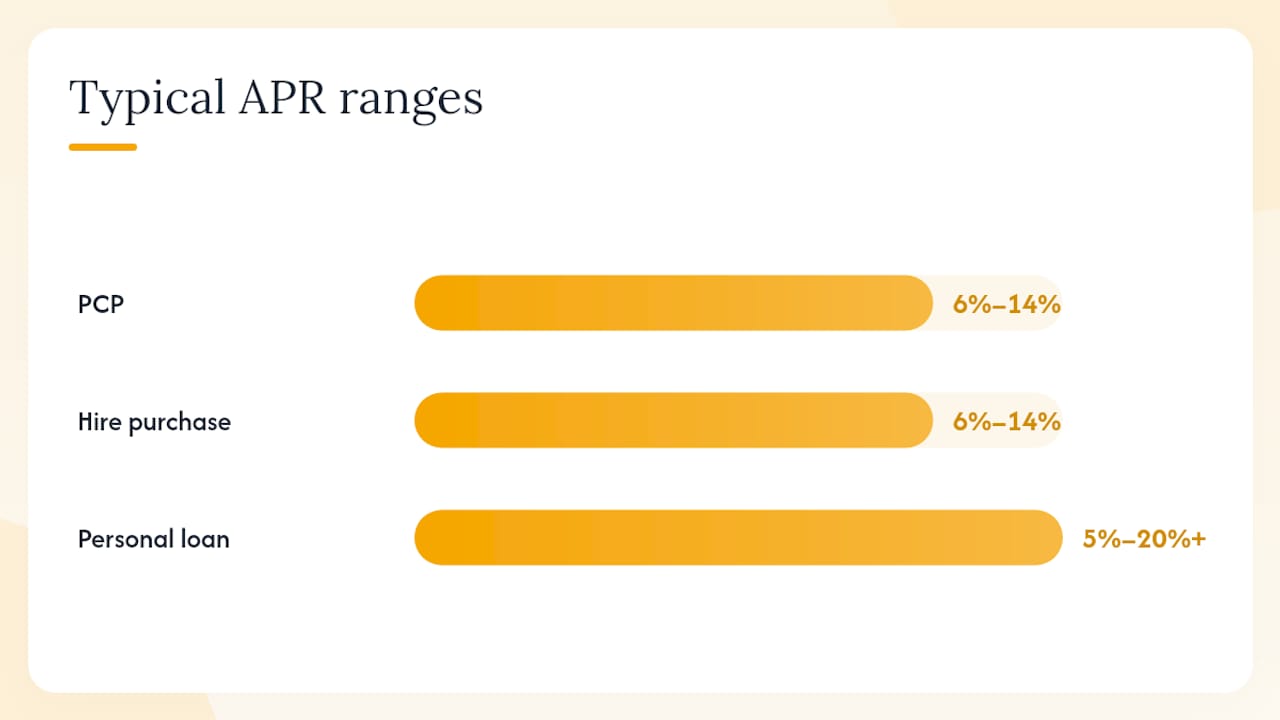
MoneySavingExpert recommends comparing the total amount repayable across all options, not just the monthly payment, before committing. MoneyHelper echoes this and notes that PCP’s lower monthly cost comes at the price of higher total interest. Black Horse, as a major UK motor finance provider, publishes representative examples across both PCP and HP products that are worth using as a benchmark when comparing dealer quotes.
Quick takeaways from the PCP cost comparison:
The biggest lever is the deposit. A larger upfront payment reduces the financed balance, which reduces both the monthly repayment and the total interest paid. Even an extra £1,000 on deposit can meaningfully shift the monthly figure on a mid-range car.
Practical steps to reduce what you pay:
Pro Tip: Improve your credit score before applying. Pay down existing balances, register on the electoral roll, and avoid applying for other credit in the three months before your PCP application. A better score can move you from a 12% APR to a 7% APR on the same car, saving hundreds of pounds over the term.
On the running-cost side, factor in a realistic servicing budget from day one. Returning a car with deferred maintenance or visible damage above fair wear and tear generates charges that can easily exceed the savings from a lower monthly payment. Keep a record of services and address minor bodywork before the end of the agreement.

The trade-off to keep in mind: lower monthly payments via a longer term or a higher GMFV always mean more total interest. The monthly figure is not the cost of the car. The total amount repayable is.
The formula behind every worked example here is straightforward. The principal being financed equals the car price minus the deposit. Interest is then calculated on that full balance (including the GMFV portion) across the term. The monthly payment covers the amortised depreciation portion plus the interest charge spread across the term.
| Variable | Economy example | Mid-range example | Premium example |
|---|---|---|---|
| Car price | — | £20,000 | — |
| Deposit | — (10%) | £3,000 (15%) | — (10.5%) |
| GMFV | — (37.5%) | £7,000 (35%) | — (36.6% (example APR)) |
| Principal amortised monthly | — | — | £20,000 |
| APR | 6% (example APR) | 6% | 6% (example APR) |
| Term | 36 months | 36 months | 36 months |
| Approx. monthly payment | — | ~£350 | — |
The mid-range scenario is anchored to the MoneyHelper worked example (£20,000 car, £3,000 deposit, 6% APR, £7,000 GMFV, 36 months, ~£350/month, ~£2,500 total interest). The economy and premium scenarios use the same method with adjusted inputs.
A few caveats: dealer quotes will differ because lenders use their own proprietary amortisation schedules, exact GMFV figures vary by model and mileage, and manufacturer promotions can alter the effective APR significantly. These examples are a planning tool, not a quote.
PCP costs are driven primarily by deposit size, APR, GMFV, and mileage allowance — and total interest paid is almost always higher than it appears from the monthly payment alone.
| Point | Details |
|—|—| | Three core cost components | Deposit (typically ~10%), monthly repayments, and an optional GMFV balloon payment determine most of what you pay. | | Total interest is higher than it looks | Interest runs on the full financed balance including the balloon, so total PCP interest often exceeds that of hire purchase over the same term. | | Excess mileage adds up fast | Charges of 6p–15p per mile above your allowance are common; 5,000 miles over at 10p per mile costs an extra £500 at handback. | | 50% voluntary termination right | Under the Consumer Credit Act, you can exit once you have paid 50% of the total amount payable, including the GMFV and all fees. | | Makeapcpclaim finds your agreement free | If you suspect your PCP was mis-sold, Makeapcpclaim can locate your finance agreement for free in under 60 seconds, with no paperwork needed. |
Most people approach PCP by asking “can I afford the monthly payment?” That is the wrong question. The right question is “what is the total amount repayable, and what am I actually getting for it?”
The monthly payment is engineered to look manageable. The GMFV is set by the lender, not negotiated by you. The APR applies to a balance that includes the balloon you are not paying off. And the running costs, the insurance, the servicing, the tyres, sit entirely outside the finance agreement. None of that appears on the headline deal.
What concerns me more, having seen how many PCP agreements were structured between 2007 and 2021, is how few buyers were clearly told about the discretionary commission arrangements their dealer had with the lender. That arrangement meant dealers had a financial incentive to set the APR higher than necessary, and the buyer had no way of knowing. The FCA’s review of motor finance has brought this into sharp focus, and it is why checking whether your own agreement was fairly priced is worth doing, not just for peace of mind but because compensation may be available.
The 50% voluntary termination right is real and it is statutory. Use it if you need to. But before you get to that point, understand what you signed. Read the total amount payable, not just the monthly figure. And if you financed a car since 2007 and were never clearly told how the dealer was being paid, that is worth investigating.
If you financed a car since 2007 and were never clearly told that your dealer earned a commission for setting your interest rate, you may have a valid mis-selling claim. Makeapcpclaim can search for your finance agreement for free in under 60 seconds, with no registration number or paperwork required.
Here is how it works:
The review covers all vehicle finance agreements since 2007, including PCP, HP, and other car finance products. If a discretionary commission arrangement inflated your APR without your knowledge, that is exactly the kind of mis-selling the FCA’s review is designed to address.
Check your finance agreement now and find out in under 60 seconds whether you have a potential claim.
This article provides general information about PCP costs and your legal rights. It is not a substitute for personalised financial or legal advice. For formal legal guidance on a specific claim, consult a qualified solicitor or use the FCA’s consumer resources.
These are the primary sources used in this article. Use them to verify rates, run your own calculations, and read the rules in full.
A final note: always request a personalised quote rather than relying on a representative example. The headline APR applies to a specific subset of applicants. Your actual rate depends on your credit profile, deposit, and the lender’s current criteria.